
If you’ve started noticing that your Frigidaire is not cooling properly, you’re probably picking up on small changes first. The refrigerator section feels a little warmer. Drinks aren’t as cold as they used to be. You adjust the setting, wait a few hours, and hope it settles down.
Same symptom turns up on other brands too – start with the Bosch temperature problems troubleshooting guide.
Sometimes it does. Often, it doesn’t.
In Atlanta, refrigerators work harder than most homeowners realize. Between long summer heat, humidity, and kitchens that warm up quickly during the day, your appliance is constantly balancing internal temperature against outside conditions. When something inside that system begins to drift, even slightly, you’ll see temperature fluctuating before you see total failure.
That’s the stage where most Frigidaire temperature problems begin.
In FGHB and FGSS Series models, we regularly see issues tied to dirty condenser coils, evaporator fan wear, thermostat malfunction, failing temperature sensor components, and in more advanced cases, compressor failure or a developing refrigerant leak. The early signs often overlap, which is why guessing rarely solves the problem.
If your fridge feels “almost right” but not quite steady, this is the moment to understand what’s happening inside it. A refrigerator rarely stops without warning. It usually gives you time, if you know what to look for.
Read on to learn how your Frigidaire controls temperature, and why that balance can shift in Atlanta homes.
How Your Frigidaire Maintains Temperature
To understand why a fridge becomes warm or starts temperature fluctuating, it helps to know what it’s trying to do in the first place.
Your refrigerator is constantly moving heat out of the cabinet. That’s its only job. It pulls warmth from inside and releases it into the air around the unit. When everything works together, the process is quiet and automatic. You never think about it.
Inside your Frigidaire FGHB or FGSS Series model, several parts coordinate that process:
- The compressor pressurizes refrigerant and keeps it circulating.
- The condenser coils release heat outside the cabinet.
- The evaporator coils absorb heat from inside.
- The evaporator fan pushes cold air evenly through both compartments.
- A thermostat malfunction or failing temperature sensor can interrupt that balance.
- The control board acts as the traffic controller, deciding when each cycle starts and stops.
When one of these components drifts out of rhythm, the refrigerator compensates. It may run longer. It may cycle more frequently. It may cool unevenly. That’s when you start noticing something feels off.
Maybe the freezer still seems fine, but the refrigerator section feels like a warm fridge. Maybe you hear the compressor running longer than it used to. Maybe you notice temperature fluctuating during the hottest part of the day.
That’s not random. It’s the system working harder to maintain the same result.
Here’s where Atlanta’s climate plays a role. When outside air is already warm, your condenser coils have a harder time releasing heat. If those coils are dirty condenser coils on top of that, heat stays trapped longer. The compressor then works overtime, and small inefficiencies begin to stack up.
Over time, those inefficiencies show up as:
- Not cooling properly
- Inconsistent interior temperatures
- Ice buildup in certain areas
- Early signs of compressor failure
- Or even symptoms that resemble a refrigerant leak
And this is where homeowners often get frustrated. The refrigerator is still running. It hasn’t stopped. But it isn’t performing the way it should.
That in-between stage is important. It’s usually when the problem is still manageable.
The key question becomes: which part of the system is struggling?
Below we’ll showcase the most common causes of Frigidaire temperature problems in Atlanta homes: starting with the simplest issue and working toward the more serious ones.

The Most Common Causes of Frigidaire Temperature Problems in Atlanta Homes
Once you understand how your refrigerator maintains temperature, the next step is figuring out where the balance is slipping.
In our experience servicing Frigidaire FGHB and FGSS Series units across Atlanta, most cooling complaints fall into a handful of categories. Some are maintenance-related. Others involve electrical control or sealed-system components. The challenge is that the symptoms can look similar at first.
You might notice the temperature fluctuating. You might feel a warm fridge compartment. You might hear the compressor running constantly and assume the worst.
Before jumping to conclusions, it helps to match what you’re seeing with what’s most likely happening inside the unit.
Below is a simplified breakdown of the most common causes we diagnose in Atlanta homes:
Frigidaire Temperature Problems: Symptoms and Likely Causes
What You’re Noticing | Most Likely Cause | How Serious It Is | DIY or Professional? |
Fridge slightly warm during hot afternoons | Dirty condenser coils | Mild to moderate | DIY cleaning possible |
Freezer cold, fridge warm | Evaporator fan issue | Moderate | Usually professional repair |
Temperature fluctuating despite setting adjustments | Thermostat malfunction or temperature sensor issue | Moderate | Diagnostic testing required |
Constant running, unit still not cooling properly | Restricted airflow or developing compressor strain | Moderate to high | Professional evaluation recommended |
Both compartments warm, clicking sounds | Compressor failure | Severe | Professional sealed-system repair |
Gradual cooling loss over weeks | Refrigerant leak | Severe | Professional only |
Let’s walk through these one by one, starting with the most common and least intimidating.
Dirty Condenser Coils: The Simple Fix Many People Miss
If your refrigerator is not cooling properly, start with the easiest question: when were the condenser coils last cleaned?
In Atlanta homes, dust buildup is not a small factor. Pet hair, hardwood floor debris, and pollen can collect quickly. When dirty condenser coils trap heat, the refrigerator cannot release warmth efficiently. The compressor compensates by running longer.
At first, this shows up as mild temperature fluctuating. Over time, it becomes a warm fridge problem that does not stabilize.
The good news is that this is often manageable with careful cleaning. The important thing is not to ignore it. Extended strain from clogged coils is one of the quiet contributors to compressor failure.
If you clean the coils and performance improves within a day, you’ve likely solved the issue early.
If not, the problem moves deeper.
Evaporator Fan Problems: When Cold Air Stops Circulating
If your freezer feels normal but the refrigerator section is warmer, airflow is usually the issue.
The evaporator fan distributes cold air evenly. Without it, cooling becomes uneven. Food near the vents may freeze, while items on lower shelves feel warm.
In FGHB models especially, evaporator fan wear is common after years of daily use.
Unlike coil cleaning, this repair typically requires internal disassembly. Proper installation is important to avoid frost buildup or airflow blockages.
Thermostat Malfunction and Temperature Sensor Issues
When temperature fluctuating continues even after airflow is confirmed, the control system becomes the focus.
A thermostat malfunction or failing temperature sensor can send inaccurate readings to the control board. The refrigerator may think it has reached target temperature when it hasn’t, or it may cool continuously without stabilizing.
These issues require diagnostic testing. Replacing parts without confirming electrical values often leads to unnecessary repairs.
If you’ve adjusted settings repeatedly and nothing holds steady, this is the stage where professional diagnosis saves time.
Compressor Failure and Refrigerant Leak: The Serious End of the Spectrum
When both compartments become warm, or you hear repeated clicking from the rear of the unit, the problem may involve compressor failure.
In other cases, cooling may decline slowly over weeks, suggesting a refrigerant leak.
Both situations involve sealed-system work. They require specialized tools, refrigerant handling certification, and precise calibration.
At this stage, guessing is expensive.
If your refrigerator has stopped cooling properly and symptoms point toward compressor failure or refrigerant leak, it’s time to act quickly.
Model-Specific Patterns: FGHB vs. FGSS Series in Atlanta Homes
Not all Frigidaire refrigerators move air the same way. And that matters.
For the wider picture on this brand, see what we’ve seen with Frigidaire leaking water.
The FGHB Series (French door) and FGSS Series (side-by-side) share core refrigeration technology, but their internal airflow design and compartment layout influence how temperature problems show up.
Understanding those differences helps you interpret symptoms more accurately — and avoid assuming the worst too quickly.
Let’s look at how each model typically behaves when cooling balance starts to shift.
What the Manufacturer Says About Cooling Behavior
Frigidaire’s manufacturers emphasize a few practical realities:
- A fridge won’t cool properly if vents are blocked or if the internal airflow is restricted. Clearing space for airflow helps the system achieve stable temperatures.
- Recommended operating temperatures are about 37°F for the refrigerator and 0°F for the freezer; settings outside those ranges can make a unit feel like it’s not cooling properly even if it’s technically functioning.
- Even fully functioning refrigerators require time (up to 24 hours) to stabilize after power interruptions or adjustments.
These basics apply to all Frigidaire models, but how those thermal behaviors show up depends partly on design differences between FGHB and FGSS Series units.
How FGHB Series (French Door) Airflow Typically Behaves
The FGHB layout places the freezer at the bottom and the refrigerator compartment above it. Cold air is generated in the freezer section and then circulated upward into the refrigerator compartment through internal vents and fans.
Because of that design, airflow distribution is everything.
When an FGHB unit begins temperature fluctuating, the first signs often include:
- Middle shelves feeling warmer than top shelves
- Produce drawers losing crispness faster
- Cold spots near vents but warmer air elsewhere
- Refrigerator section struggling while freezer still seems stable
This does not automatically mean compressor failure. In many cases, the issue begins with airflow restriction or evaporator fan inefficiency.
French door models are particularly sensitive to:
- Blocked interior vents from overpacking
- Weak evaporator fan motors
- Ice accumulation affecting airflow
- Temperature sensor misreads across zones
When airflow weakens, the refrigerator section feels like a warm fridge long before the freezer fails.
If you own an FGHB Series unit in Atlanta, pay attention to uneven shelf temperatures. That is often your early warning sign.
FGSS Series (Side-by-Side): Airflow Is Lateral, Not Vertical
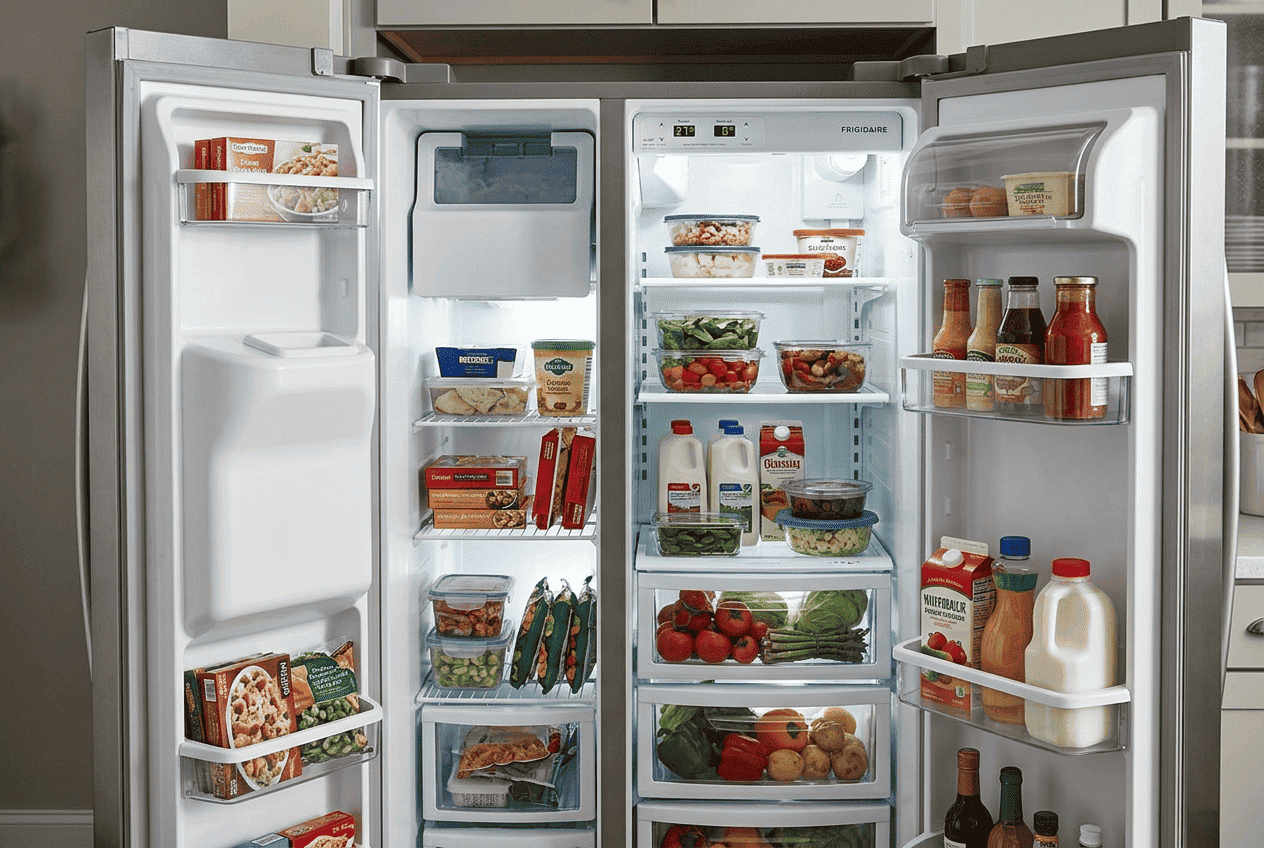
The FGSS layout places freezer and refrigerator compartments side by side. Cold air moves horizontally between sections through a damper control system.
This design changes how problems appear.
When FGSS units begin not cooling properly, homeowners often report:
- The refrigerator side warming up first
- Freezer maintaining temperature
- Sudden temperature fluctuating after setting adjustments
- Audible air movement changes
In side-by-side designs, damper control function becomes critical. If the damper fails to open or close correctly, cold air cannot transfer efficiently from freezer to refrigerator compartment.
Unlike French door units, airflow does not need to travel vertically. However, when the regulation system hesitates, the refrigerator side is usually the first to show instability.
This is why many Atlanta homeowners say, “The freezer is fine, but the fridge is warm.” That pattern is especially common in side-by-side models.
Practical Comparison for Homeowners
Here’s a simplified shortlist to help you recognize patterns more clearly:
Cooling Behavior | FGHB Series (French Door) | FGSS Series (Side-by-Side) |
First noticeable issue | Uneven fridge shelf temperatures | Refrigerator side warms first |
Airflow sensitivity | Vertical circulation from freezer up | Horizontal transfer via damper |
Common early symptom | Warm spots mid-shelf | Fridge not cooling properly, freezer stable |
Likely early suspects | Evaporator fan, airflow block | Damper control, airflow regulation |
Sensor imbalance effect | Zone inconsistency | Fridge side instability |
This doesn’t replace proper diagnosis, but it gives you a smarter starting point.
When you understand how your refrigerator is designed to move air, you can interpret symptoms with more confidence instead of assuming the compressor is failing every time the fridge feels slightly warm.
Why This Matters
Georgia heat amplifies these model-specific patterns.
In a French door unit, reduced airflow combined with summer humidity can intensify uneven cooling. In a side-by-side model, extended compressor cycles during hot afternoons may highlight minor damper inconsistencies.
The climate doesn’t create the problem. It magnifies it.
That’s why temperature fluctuating often appears seasonally in Atlanta homes, especially in older units that haven’t had routine airflow maintenance.
A Quick Reality Check
If both compartments are warm at the same time, the issue likely moves beyond model layout and into sealed-system territory: potentially compressor failure or refrigerant leak.
But if one section is stable while the other struggles, airflow or control components are far more likely than a full system breakdown.
Understanding that difference prevents unnecessary panic.
And it allows you to act earlier, when repairs are simpler and more affordable.
If your Frigidaire is showing early signs of temperature fluctuating or not cooling properly, this is the moment to evaluate airflow and control components, not wait for total shutdown.
Professional diagnosis in Atlanta isn’t about replacing parts blindly. It’s about confirming exactly which part of the cooling cycle is drifting out of balance and correcting it before it escalates.
What You Can Safely Check Before Scheduling Frigidaire Repair
Before assuming the worst, there are several practical checks you can perform safely. Many Frigidaire temperature problems begin with airflow restriction or simple setup issues. Taking ten minutes to verify these basics can either solve the issue — or confirm that it needs professional attention.
Let’s start with the fundamentals.
1. Confirm Temperature Settings
It sounds simple, but settings get changed more often than homeowners realize — especially in households with children or after power interruptions.
For most Frigidaire models:
- Refrigerator: 37°F
- Freezer: 0°F
If your unit was recently adjusted, allow up to 24 hours for stabilization before evaluating performance. Opening doors frequently during that period delays recovery.
If settings are correct and temperature fluctuating continues beyond a full day, the issue likely isn’t a simple reset.
2. Check for Blocked Interior Air Vents
Both FGHB and FGSS Series refrigerators rely on internal vents to distribute cold air.
Take a moment and look:
- Are tall containers pressed against the back wall?
- Are vents covered by food packaging?
- Is the refrigerator tightly packed with no room for circulation?
Cold air needs space to move. Blocked vents can easily create a warm fridge effect on certain shelves while others remain cold.
Rearranging items to allow airflow can stabilize uneven cooling within hours.
3. Inspect Door Seals Carefully
In Atlanta’s humidity, door gaskets wear faster than many homeowners expect.
Run your hand slowly along the seal:
- Do you feel cool air escaping?
- Do you see cracks or separation?
- Is condensation forming near the edges?
A weak seal allows warm air to enter constantly. The refrigerator compensates by running longer cycles, which contributes to temperature fluctuating.
Replacing door gaskets is often straightforward — but identifying them early prevents compressor strain.
4. Examine Dirty Condenser Coils
If you haven’t cleaned the condenser coils in over a year, this is one of the most important steps you can take.
Unplug the refrigerator. Access the rear lower section. Look for dust accumulation.
In many Atlanta homes, dirty condenser coils are the silent contributor to:
- Not cooling properly
- Compressor running constantly
- Warm fridge during summer afternoons
Cleaning them may immediately improve performance.
If performance does not improve within 24–48 hours, deeper mechanical issues may be present.
5. Listen for the Evaporator Fan
Open the freezer and press the door switch. You should hear a consistent airflow sound.
If you hear:
- Grinding
- Weak airflow
- No airflow at all
The evaporator fan may be failing.
At this stage, internal repair is usually required.
When to Stop DIY Troubleshooting
There’s a point where continued DIY adjustments stop being helpful.
If you notice:
- Both compartments warming
- Persistent temperature fluctuating despite clean coils
- Repeated clicking sounds from the rear (possible compressor failure)
- Gradual cooling decline that never stabilizes (possible refrigerant leak)
It’s time to stop experimenting.
Professional diagnostics prevent unnecessary part replacement and protect the sealed system.
Common Troubleshooting Mistakes That Make Frigidaire Temperature Problems Worse
When a refrigerator is not cooling properly, it’s natural to start adjusting things. The problem is not effort — it’s direction. Certain well-intentioned fixes can quietly make the situation worse.
Here are the most common mistakes we see in Atlanta homes:
Quick Reference: What Not to Do
Common Mistake | Why It Backfires | What to Do Instead |
Lowering the temperature setting repeatedly | Forces longer compressor cycles without fixing airflow or sensor issues | Keep settings at 37°F (fridge) and 0°F (freezer) while diagnosing |
Repeatedly unplugging and resetting | Interrupts stabilization cycles and masks the real issue | Reset once. If instability continues after 24 hours, investigate further |
Chipping ice with sharp tools | Can puncture coils and cause a refrigerant leak | Allow controlled defrosting or seek professional help |
Ignoring dirty condenser coils for years | Traps heat, overworks compressor, accelerates failure | Clean coils annually, especially in Atlanta homes |
Replacing parts without testing | Leads to misdiagnosis and wasted money | Confirm airflow, electrical readings, and system performance first |
Most Frigidaire temperature problems do not begin with compressor failure. They begin with imbalance.
- A blocked vent.
- A weak evaporator fan.
- A drifting temperature sensor.
- Restricted airflow from dirty condenser coils.
If you’ve already adjusted settings, cleaned visible buildup, and confirmed airflow but temperature fluctuating continues, that’s the moment to stop experimenting.
Why Cooling Problems Escalate Faster in Atlanta
Atlanta heat doesn’t cause refrigerator failure, but it exposes weakness.
When outside temperatures rise, your refrigerator must release heat into already warm air. That forces longer compressor cycles and increases internal pressure.
If your unit already has:
- Dirty condenser coils
- Restricted airflow
- Early thermostat malfunction
- A drifting temperature sensor
Summer always accelerates the symptoms.
Here’s what changes in high heat:
Condition | What Happens Inside the Refrigerator |
Hot ambient air | Condenser coils release heat more slowly |
Longer run cycles | Compressor works harder |
Restricted airflow | Internal temperature becomes unstable |
Weak components | Temperature fluctuating becomes noticeable |
This is why many Atlanta homeowners report:
- Warm fridge in late afternoon
- Not cooling properly during heat waves
- Freezer stable but refrigerator inconsistent
In mild weather, the system compensates, but in summer, that margin disappears.
What This Means for You
If your Frigidaire is showing temperature fluctuating now, don’t assume it will settle down.
Addressing minor imbalance early protects the compressor and prevents sealed-system damage.
Repair or Replace? A Practical Guide for Frigidaire Temperature Problems
When your refrigerator is not cooling properly, the real question is to meet economics.
Here’s a clear way to evaluate your situation.
Situation | Repair Is Usually Smart | Replacement May Be Considered |
Age of unit | Under 8–10 years | 12+ years |
Problem type | Dirty condenser coils, evaporator fan, thermostat malfunction, temperature sensor | Confirmed compressor failure or major refrigerant leak |
Symptom pattern | Temperature fluctuating recently, one compartment affected | Both compartments warm, repeated major repairs |
Compressor condition | Running normally | Failed or heavily strained |
Repair history | First or second repair | Multiple major component failures |
What Often Gets Misjudged
Many homeowners assume replacement is necessary when:
- The fridge feels like a warm fridge for several days
- Temperature fluctuating becomes noticeable
- Cooling weakens during summer
In reality, airflow and control issues are far more common than compressor failure.
A professional diagnostic often reveals a manageable repair — not a full appliance replacement.
Why Timing Matters in Atlanta
Delaying repair increases risk:
- Restricted airflow → longer compressor cycles
- Longer cycles → overheating
- Overheating → potential compressor failure
In Georgia heat, that progression can accelerate.
Final Thought
A refrigerator should maintain temperature without negotiation.
If your Frigidaire is not cooling properly or showing consistent temperature fluctuating, it’s a mechanical signal that airflow, control, or pressure inside the system has shifted.
The difference between a routine repair and a major failure is usually timing.
In Atlanta’s climate, small imbalances do not stay small for long. Addressing them early protects the compressor, prevents unnecessary replacement, and restores the steady cooling your kitchen depends on.
Reliable performance isn’t optional. It’s expected.
Make sure your refrigerator is operating the way it was designed to — consistently, efficiently, and without guesswork.
Related guides
FAQ
1. Why is my Frigidaire not cooling properly?
When a Frigidaire is not cooling properly, the most common causes are dirty condenser coils, restricted airflow, evaporator fan issues, thermostat malfunction, or a failing temperature sensor. Compressor failure and refrigerant leak problems are less common but more serious.
2. Why is the freezer cold but the fridge warm?
This usually indicates an airflow issue. Cold air is produced in the freezer and circulated to the refrigerator compartment. If vents are blocked or the evaporator fan is weak, the fridge becomes a warm fridge while the freezer remains cold.
3. What causes temperature fluctuating in Frigidaire FGHB and FGSS models?
Temperature fluctuating often results from airflow imbalance, thermostat malfunction, or temperature sensor inaccuracies. In Atlanta’s heat, small inconsistencies become more noticeable and persistent.
4. Should I repair or replace my Frigidaire refrigerator?
If the unit is under 10 years old and the issue involves airflow, thermostat malfunction, or temperature sensor components, repair is usually the smarter choice. Replacement is typically considered in confirmed compressor failure or severe refrigerant leak cases in older units.