
The freezer is cold. The water dispenser works fine. Nothing in the refrigerator section has changed — but the ice bin has been empty for two days.
A Maytag ice maker not working is one of the most common refrigerator service calls, and in the majority of cases, it traces back to one of five diagnosable causes. The fix is rarely as complicated as it looks from the outside.
This guide covers built-in ice makers on Maytag refrigerators — French-door models like the MFI2269VEM10 and MFI2269DRM01, side-by-side configurations, and any Maytag refrigerator with an integrated ice maker assembly. Not standalone freezers.
Here’s what you’re going to check, in this exact order:
- Power, settings, and the shut-off arm
- Water supply path
- The water inlet valve
- Ice jams and mechanical blockages
- Freezer temperature
Fastest checks come first. You may not need all five steps.
Step 1: Check These Before You Touch Anything Else
Three things can stop Maytag ice maker production immediately — and none of them require a single tool to fix.
1. The shut-off arm position
Most Maytag models have a wire bail arm — a small lever that sits just above the ice bin. When it’s pushed up (raised position), the ice maker pauses automatically. That’s by design: a full bin pushes the arm up and stops production.
The problem is the arm sometimes gets stuck up from an ice jam, a shifted bin, or accidental contact. Check it now:
- Open the freezer and locate the arm near the ice maker assembly.
- If it’s in the raised position, lower it manually.
- If it’s stuck and won’t lower, clear any ice blocking its movement.
On models with a control panel instead of a physical arm, go to the settings menu and confirm the ice maker is toggled on. It can be disabled by accident with a wrong button press.
- Recent water filter change
A new filter that isn’t fully seated traps air in the water line. That air pocket creates a pressure drop that stops the water inlet valve from opening — no water reaches the ice maker.
If you changed the filter in the last 30 days:
- Run 2–3 gallons of water through the door dispenser to purge the air.
- Confirm the filter is clicked fully into its housing.
- Verify it’s the correct model number for your specific Maytag refrigerator.
This is the single most overlooked cause of Maytag ice maker not filling with water after a routine maintenance task.
- Demo mode / Control Lock
Maytag refrigerators with digital displays can enter a showroom (demo) mode that disables cooling functions — including the ice maker — while keeping the display and lights fully active. The refrigerator looks like it’s running. It isn’t.
Look for a “DEMO” or “SHOWROOM” indicator on the display panel. Deactivation on most models involves holding two specific buttons simultaneously for 3–5 seconds. Check your model’s user guide for the exact combination.
Bridge: If the arm is down, the filter is seated and purged, and demo mode is off — and the bin is still empty after 24 hours — the issue is mechanical. Keep reading.
Step 2: Water Supply Diagnosis
Maytag refrigerator no ice is often a water supply problem, not an ice maker problem. Before assuming any component has failed, trace the water path from the wall to the ice maker.
1. Check the shut-off valve
Locate the water supply shut-off valve — usually under the kitchen sink or behind the refrigerator. Confirm it’s turned fully open. A valve that’s partially closed drops the line pressure below the 20 psi minimum the water inlet valve needs to operate. Even a quarter-turn restriction can stop ice production completely.
- Inspect the supply line for kinks
Pull the refrigerator away from the wall. The plastic or copper water line connecting the wall valve to the refrigerator back should run in a clean, straight path.
A kinked plastic line restricts flow to near zero. Look for:
- A sharp bend where the refrigerator was pushed close to the wall.
- Any visible flattening or crease in the tubing.
- Discoloration or moisture near a connection point.
If the line is plastic and more than 5 years old, replace it with a braided stainless line while you’re back there — it eliminates this failure point permanently.
3. Check for a frozen fill tube
On Maytag French-door models, the fill tube that carries water into the ice maker mold can freeze solid. The ice maker motor will still cycle — you’ll hear it — but no water enters the mold because the tube is blocked with ice.
Quick test:
- Listen during a cycle. Motor running, no water sound = possible frozen tube.
- Unplug the refrigerator for 30 minutes and let the tube thaw.
- Plug back in and watch the next cycle for water flow.
If the tube freezes again within a few days, the root cause is freezer temperature running too warm. That’s Step 5.
Step 3: The Water Inlet Valve
The water inlet valve is mounted at the lower rear of the refrigerator. It controls all water flow into the unit — one solenoid for the dispenser, a separate solenoid for the ice maker.
When the ice maker solenoid fails, the dispenser keeps working. That makes the failure easy to misread as “not a water problem” when it absolutely is.
How to test it:
- Unplug the refrigerator.
- Access the inlet valve at the rear lower panel (two screws on most models).
- Disconnect the wiring harness from the ice maker solenoid.
- Test resistance with a multimeter across the solenoid terminals.
- A healthy solenoid reads 200–500 Ω. A reading significantly above this range, or OL (open line), means the solenoid has failed
Also check water pressure at the inlet:
The valve physically cannot open if line pressure is below 20 psi — even with a working solenoid. If you’ve confirmed the valve solenoid is in range but ice production doesn’t resume, low household pressure is the next variable to rule out.
One more failure mode worth knowing: mineral deposits from Atlanta’s municipal water supply can clog the valve body itself. The solenoid tests fine, but scale buildup prevents water from passing through. Valve replacement — not cleaning — is the correct fix when this happens.
Use the model number sticker inside your refrigerator door jamb to confirm the correct replacement part. Valve part numbers are not interchangeable across Maytag models.
Step 4: Ice Jams and Mechanical Blockages
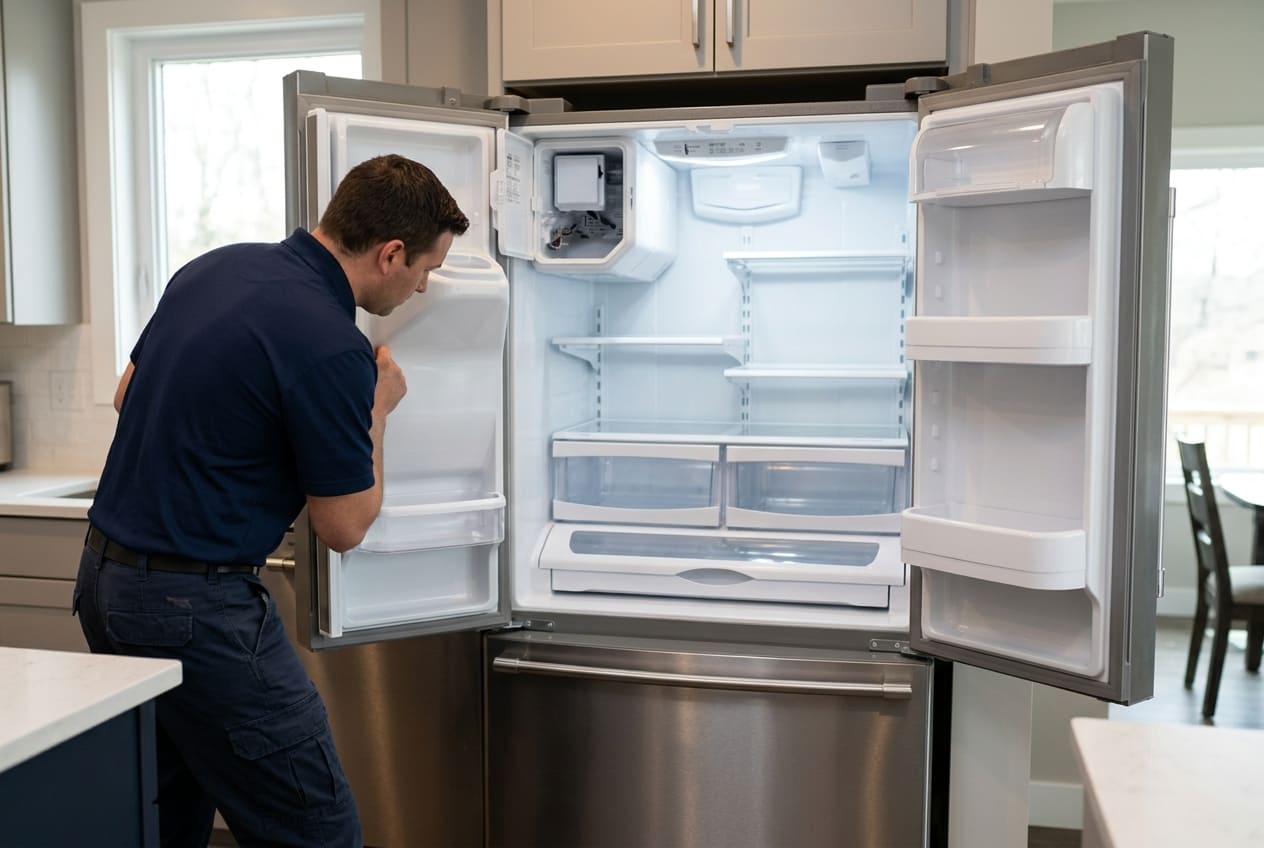
This one gets missed because it doesn’t feel like a technical problem. But a jammed ejector or fused ice block is a real and surprisingly common reason a Maytag ice maker stopped working without warning.
When ice cubes stick together in the bin or a single cube lodges in the ejector mechanism, the ice maker can trigger a safety shutdown and simply stop cycling.
How to clear it:
- Remove the ice bin completely. Break up any clumped or fused ice by hand.
- Look at the ejector blades — the rotating fingers that push ice out of the mold. A single cube or shard jammed in the blade assembly will lock the mechanism.
- Use a plastic utensil to clear any jam. Never use metal — the heating element behind the mold tray can be damaged.
- Turn the ice maker off, remove the bin, and let the mechanism return to room temperature for 30 minutes.
- Turn the ice maker back on. A full cycle should produce ice within 90 minutes.
On some Maytag models, pressing the test button on the ice maker module manually advances the ejector blades through a cycle — check your model’s documentation for button location.
If a single cleaning resolves the problem and ice production resumes normally, the jam was the only issue. If jams recur, check the freezer temperature in Step 5.
Step 5: Freezer Temperature — The Hidden Ice Killer
The ice maker is only as reliable as the environment it works in. If the freezer isn’t holding at or below 5°F, ice production slows, stalls, or stops entirely — even when every other component tests perfectly fine.
This is the most commonly missed cause in DIY Maytag ice maker troubleshooting. The ice maker gets replaced. The problem comes back in a month.
How to check it:
- Place a standalone thermometer in the center of the freezer compartment.
- Wait two hours with the door closed.
- A reading above 5°F means the freezer has a cooling problem.
Common reasons a freezer runs warm:
- Dirty condenser coils — heat can’t escape, compressor works harder, temperatures drift up.
- Failed defrost system — frost builds on the evaporator coils until airflow drops to near zero.
- Overpacked freezer — items pressed against the rear wall block the evaporator fan vents.
If the freezer temperature is confirmed above 5°F, the ice maker is a symptom — not the cause. Fixing the ice maker without addressing the underlying temperature problem won’t hold. See the Maytag refrigerator not cooling article for the full diagnosis path — resolving the cooling issue typically restores ice production without any separate ice maker work.
Putting It Together
Most Maytag ice maker failures trace back to one thing. The diagnostic order above is deliberately built to find that one thing as fast as possible — starting with zero-tool checks and ending at the component level.
Here’s the shorthand recap:
- Arm stuck up or settings off? — 2-minute fix, no parts needed.
- Filter just changed? — Purge the air, confirm the fit.
- Water reaches the fridge but not the ice maker? — Inlet valve solenoid.
- Ice maker cycles but no output? — Jammed ejector or frozen fill tube.
- Freezer running warm? — The temperature is the real problem.
When your Maytag refrigerator ice maker isn’t working in Atlanta or anywhere across Metro Georgia, Appliance Repair Master can pinpoint the exact cause and fix it — same day or next day in most cases.
FAQ
1. How often should I replace the water filter to keep my Maytag ice maker working?
Maytag recommends replacing the water filter every six months — or sooner if the filter indicator light activates. A clogged filter reduces line pressure below the threshold the water inlet valve needs to open. Ice production slows or stops even though the refrigerator otherwise seems fine. In Atlanta homes with higher mineral content in the water supply, the six-month interval may need to be shorter — if you notice slower dispenser flow before the indicator triggers, that’s the signal.
2. Can I bypass the Maytag water filter to test whether it's causing the ice maker problem?
Yes — Maytag’s own troubleshooting documentation recommends removing the filter and installing the bypass plug (included with the refrigerator) as a diagnostic step. If ice production resumes without the filter in place, the filter was the restriction point. This is a valid temporary measure for diagnosis only. Reinstall a new, correct-model filter promptly to restore water quality.
3. Why does my Maytag ice maker make a grinding noise but produce no ice?
Grinding without output means the ejector mechanism is cycling but found nothing frozen to eject — the mold filled with air rather than water. The most common cause at this stage is a failed ice maker solenoid on the water inlet valve. The motor runs its cycle normally, pushes through an empty mold, and the ejector blades grind against nothing. A multimeter test of the solenoid’s resistance confirms or rules this out quickly.
4. My Maytag MFI2269VEM10 ice maker stopped working after a power outage. What should I check first?
Power outages can reset the control board settings on French-door Maytag models — sometimes activating demo mode or toggling the ice maker off via the control panel without any visible indication. Check the display for a “DEMO” indicator and confirm the ice maker toggle is enabled. Also verify the freezer temperature returned to 0°F: if the outage was extended and the freezer warmed above 10°F, the ice maker cycle may have paused automatically and will need a manual reset before production resumes.
5. How long should I wait after a reset before concluding the ice maker is still broken?
Allow a full 24 hours after any reset or repair before evaluating ice output. The first cycle after a reset typically produces a small test batch that the mechanism discards — full production begins on the second cycle. Maytag French-door models generally produce their first viable batch 8–12 hours after a successful reset. Checking the bin at the 2–3 hour mark will look empty regardless of whether the fix worked.
6. Can Atlanta's water pressure affect whether my Maytag ice maker works?
Atlanta’s municipal water pressure is generally adequate, but it can drop below the water inlet valve’s 20 psi minimum in homes with multiple appliances running simultaneously, aging pipes, or an undersized pressure regulator. A slow or weak dispenser flow is the clearest sign of a household pressure issue — if both the dispenser and ice maker are underperforming, a plumber can measure actual pressure at the refrigerator’s supply connection. The fix is typically at the pressure regulator, not the refrigerator.