

Finding a puddle under your freezer stops you cold. First thought: something’s seriously wrong. Second thought: how much is this going to cost? Here’s the thing — water leaks in Maytag standalone freezers are almost always traceable to one of a handful of known causes, and most of them are fixable without a major repair bill.
Before anything else, one fact that changes the entire troubleshooting picture: standalone freezers have no water supply line. Unlike a refrigerator with an ice maker or water dispenser, your Maytag upright or chest freezer isn’t connected to your home’s plumbing at all. Every drop of water you’re seeing on that floor came from one place — frost or ice that melted inside the unit and ended up somewhere it shouldn’t.
That single distinction narrows the list of possible causes dramatically. You’re not dealing with a burst line or a plumbing failure. You’re dealing with a defrost system issue, a drainage problem, or a door seal that’s letting in too much warm air. All of those are diagnosable. Most are fixable.
This article walks through the 5 actual causes of water leaks in Maytag standalone freezers — covering both frost-free upright models and manual-defrost chest freezers — with clear guidance on what you can handle yourself and when it’s time to bring in a technician.
Where Does the Water Come From? Understanding Freezer Moisture
To understand why your freezer is leaking, it helps to understand how water is supposed to move through the system — because every freezer produces moisture internally, by design.
In frost-free upright Maytag freezers (like the MZF34X16DW, MZF34X20DW, and MZF34X18FW), an automatic defrost cycle runs several times a day. A heating element briefly warms the evaporator coils, melting any accumulated frost. That meltwater flows down through a defrost drain at the back of the freezer interior, travels through a drain tube, and collects in a drain pan located beneath the unit near the compressor. The compressor’s heat evaporates the water in the pan — and under normal conditions, you never see a drop.
In manual-defrost chest freezers (like the MZC5216LW and MZCC4316TG), there’s no automated system. Frost builds up on the interior walls over time and has to be removed manually. Maytag recommends defrosting when frost accumulation reaches about ¼ inch thick.
When any part of either system breaks down — a clogged drain, a cracked pan, a failing defrost component, or a compromised lid seal — water ends up on your floor instead of where it belongs. The five causes below cover every realistic scenario for a standalone Maytag freezer.
The 5 Real Causes of Water Leaks in Maytag Standalone Freezers
Cause 1 — Clogged or Frozen Defrost Drain (Most Common)
This is the single most frequent cause of water leaks in frost-free Maytag upright freezers, and it’s the first thing to check.
During each defrost cycle, meltwater flows toward a small drain opening at the bottom of the freezer’s back wall. If that drain gets blocked — by ice, food debris, or mineral buildup — the water has nowhere to go. It backs up, pools on the freezer floor, and eventually either refreezes into a sheet of ice or overflows and leaks out the bottom of the unit.
Signs pointing to a clogged defrost drain:
- Sheet of ice forming on the freezer floor (not on the walls).
- Water pooling inside the freezer at the bottom.
- Water leaking from the front or bottom of the unit, often after a defrost cycle.
On models like the MZF34X16DW, the defrost drain is accessible by removing the back interior panel — a straightforward process covered step-by-step in Section 3 below.
Cause 2 — Cracked or Overflowing Drain Pan
Even when the defrost drain is working perfectly, the water still has to go somewhere — and that somewhere is the drain pan beneath the freezer. Under normal conditions, the compressor’s heat evaporates the collected water before it accumulates. But a few things can go wrong:
- Cracked pan: A hairline crack lets water seep directly onto the floor. The crack may be small enough that you only notice it when the pan fills up.
- Misaligned pan: If the pan has shifted out of position (common after moving the unit), water from the drain tube misses the pan entirely.
- Overflowing pan: If the defrost system is running more cycles than normal — often due to a bad door seal letting in extra warm air — the pan fills faster than it can evaporate.
How to check: Unplug the freezer and pull the drain pan out from the front or rear base panel (location varies by model). Look for visible cracks, staining, or standing water that suggests overflow. A cracked pan needs to be replaced — it can’t be reliably patched.
Cause 3 — Faulty Door Gasket Causing Condensation and Excess Frost
A worn or damaged door gasket doesn’t just cause temperature problems — it directly contributes to water leaks. When the seal is compromised, warm humid air enters the freezer continuously. That moisture freezes on the evaporator coils and interior surfaces, creating far more frost than the defrost system is designed to handle. The result: more meltwater per defrost cycle than the drain and pan can manage.
There’s a secondary effect too. A bad gasket causes condensation on the exterior of the freezer cabinet — water that drips down the sides and pools on the floor, easily mistaken for an internal leak.
If you’re seeing water on the floor and noticing frost buildup that seems heavier than usual, the gasket is a strong suspect. For a full walkthrough on diagnosing and fixing gasket issues, see our guide on [Maytag freezer door not sealing].
Cause 4 — Defrost System Malfunction (Heater, Timer, or Thermostat)
In frost-free upright models, the automatic defrost system has three main components: the defrost heater, the defrost timer, and the defrost thermostat. When any one of them fails, the defrost cycle either doesn’t run at all — or runs too long.
- Heater stuck on: Melts more ice than normal → excessive meltwater overwhelms the drain → leak
- Timer failure: Defrost cycles become irregular — too frequent or not frequent enough
- Thermostat failure: Doesn’t cut off the heater at the right temperature → same result as a stuck heater
Telltale pattern: You notice the freezer alternating between heavy frost accumulation and puddles of water. That back-and-forth is a classic sign of an inconsistent defrost cycle.
This is not a DIY repair. Diagnosing which component has failed requires testing with a multimeter, and replacing defrost system components involves working near the evaporator coils. This is a job for a technician.
Cause 5 — Excessive Frost in Manual-Defrost Chest Freezers
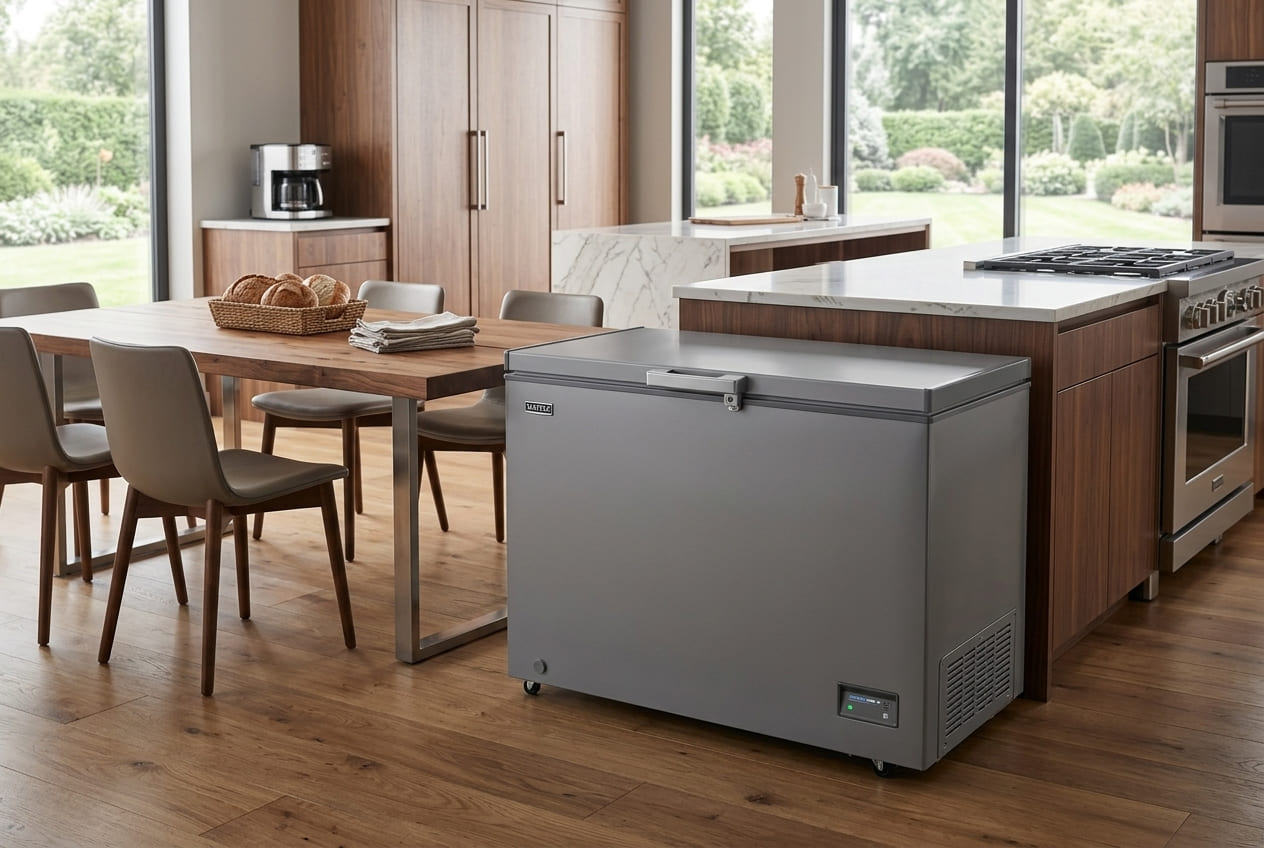
For MZC5216LW and MZCC4316TG owners, the leak scenario is different. There’s no automated defrost system to fail — but frost still builds up, and if it’s not managed properly, it creates its own water problem.
When frost is allowed to accumulate well beyond the ¼-inch threshold, the eventual manual defrost produces a large volume of meltwater in a short period. If the unit isn’t positioned to drain properly, or if there aren’t enough towels down to absorb the runoff, water ends up on the floor.
Contributing factors:
- Opening the lid frequently (each opening introduces warm, humid air).
- Leaving the lid slightly ajar — even briefly.
- A worn lid gasket that allows continuous air infiltration between defrosts.
Prevention is straightforward: defrost on schedule, minimize unnecessary lid openings, and keep the gasket in good condition.
Quick Reference — 5 Causes at a Glance
# | Cause | Freezer Type | DIY Fix? |
1 | Clogged or frozen defrost drain | Frost-free upright | Yes |
2 | Cracked or overflowing drain pan | Frost-free upright | Partial |
3 | Faulty door gasket | Both types | Partial |
4 | Defrost system component failure | Frost-free upright | No — pro required |
5 | Excessive frost / improper defrost | Manual-defrost chest | Yes (prevention) |
Step-by-Step — How to Unclog a Maytag Freezer Defrost Drain
This is the fix for Cause 1 — and since it’s the most common cause of leaks in frost-free Maytag upright freezers, it’s worth walking through in detail. Budget about 45–60 minutes.
What you’ll need:
- Turkey baster or small funnel
- Warm (not boiling) water
- Pipe cleaner or flexible drain brush
- Towels
- Screwdriver (Phillips or flat, depending on panel screws)
- Hair dryer (optional)
Step 1 — Unplug the freezer and remove all food.
Safety first — always disconnect power before opening any internal panels. Transfer perishables to coolers with ice.
Step 2 — Remove shelves, baskets, and any interior drawers.
You need clear access to the back wall of the freezer interior. Set everything aside on a clean surface.
Step 3 — Unscrew or unclip the back interior panel.
This panel covers the evaporator coils and the defrost drain. On most Maytag upright models including the MZF34X16DW and MZF34X20DW, it’s held in place by a few screws along the edges. Remove them and carefully pull the panel forward.
Step 4 — Locate the defrost drain opening.
It’s typically a small hole or channel at the bottom of the evaporator area. If you see a solid block of ice covering it, that’s your problem.
Step 5 — Clear the ice blockage.
Use a hair dryer on low heat to melt ice around the drain opening — work slowly and keep the dryer moving. Alternatively, pour small amounts of warm water directly over the ice using a turkey baster. Do not use boiling water — thermal shock can crack plastic components.
Step 6 — Flush the drain.
Once the opening is clear, use the turkey baster to push warm water through the drain. You should hear or see it flowing through to the drain pan below. If it’s still sluggish, work a pipe cleaner gently into the drain to break up any debris or mineral buildup.
Step 7 — Confirm drainage at the pan.
Pull out the drain pan from the base of the unit and check that water is actually arriving there. If the pan is dry after flushing, the drain tube may have a secondary blockage further down.
Step 8 — Reassemble and monitor.
Replace the back panel, reinstall shelves, plug the freezer back in, and return food to the unit. Check for leaks over the next 24 hours. If water reappears on the floor, the drain isn’t the only issue — or there’s a deeper blockage in the drain tube that needs professional attention.
Frost-Free vs. Manual-Defrost Freezers — Why Leak Causes Differ
If you’re not sure which type of Maytag freezer you have, here’s the short version:
Frost-free upright freezers (MZF34X16DW, MZF34X20DW, MZF34X18FW) run automatic defrost cycles using a built-in heater, timer, and thermostat. You never have to manually defrost them. The tradeoff: there are more components that can fail. When a leak happens in a frost-free model, it almost always traces back to the drain system or one of those defrost components.
Manual-defrost chest freezers (MZC5216LW, MZCC4316TG) have no automated defrost system at all — no heater, no timer, no thermostat. Frost builds up naturally and you remove it yourself. Leaks in these models are almost never caused by component failure. They’re caused by frost management — defrosting too infrequently, improper technique, or a lid seal that’s letting in too much moisture.
Why this matters for troubleshooting:
Frost-Free Upright | Manual-Defrost Chest | |
Defrost system components | Yes — can fail | None |
Defrost drain | Yes — can clog | Usually not present |
Drain pan | Yes | Usually not present |
Leak cause | Drain, pan, or component | Frost overflow or gasket |
DIY-friendly? | Partially | Mostly yes |
Knowing which category your freezer falls into cuts your troubleshooting list in half before you even open the door.
How to Prevent Your Maytag Freezer from Leaking Again
For Frost-Free Upright Freezers
- Annually: During a deep clean, flush the defrost drain with warm water to clear any early-stage buildup before it becomes a blockage.
Every 6 months: Pull out the drain pan, empty it, and inspect for cracks or staining that suggests overflow. - Ongoing: Keep the door gasket in good condition — a tight seal means less frost, which means less meltwater per cycle.
Always: Don’t block the interior air vents with food packages — restricted airflow forces the evaporator to work harder and accelerates frost buildup.
For Manual-Defrost Chest Freezers
- Defrost on schedule — when frost on the interior walls reaches ¼ inch, it’s time. Waiting longer means more water to manage when you finally do it.
- Use towels generously during defrosting — lay them around the base of the unit before you start, not after the water is already on the floor.
- Never chip ice with sharp objects — a screwdriver or ice pick can puncture the evaporator coils, which is a far more serious (and expensive) problem than a water leak.
- Location matters — if your chest freezer is in a garage or basement with high humidity, expect faster frost accumulation and plan your defrost schedule accordingly.
Conclusion
Water on the floor under a Maytag freezer looks alarming. In practice, it almost always comes down to one of five causes — and none of them involve your home’s plumbing. Standalone freezers have no water supply line. Every drop traces back to internal frost and ice that melted and ended up somewhere it shouldn’t.
The defrost drain is the first thing to check in any frost-free upright model. It’s the most common cause, it’s accessible, and clearing it is a legitimate DIY fix. From there, the drain pan, the door gasket, and the defrost system components cover the remaining scenarios for upright models. For chest freezers, the answer is almost always frost management — defrost on schedule, keep the lid seal tight, and the problem stays under control.
Act on it early. A small leak that gets ignored turns into a compressor running around the clock, food that’s cycling through partial thaws, and eventually a repair bill that dwarfs what a service call would have cost. Whether you work through it yourself or call a technician, a Maytag freezer leaking water is a solvable problem — not a reason to replace the unit.
When in doubt, a professional diagnosis saves you time, guesswork, and the risk of making the wrong repair. Maytag freezer repair in Atlanta is one call away!
FAQ
1. I found a sheet of ice at the bottom of my Maytag upright freezer, and now there's water on the floor. Are these related?
Yes — directly. The ice sheet forms when a clogged defrost drain forces meltwater to pool at the bottom of the freezer interior and refreeze. Over time, that ice sheet grows thick enough that it eventually melts and overflows out the front or bottom of the unit. The defrost drain needs to be cleared. Follow the step-by-step process in Section 3 above. Once the drain is open and flowing, the ice sheet won’t reform.
2. My Maytag chest freezer only leaks when I defrost it. Is something wrong?
Not necessarily — some water on the floor during a manual defrost is normal if you don’t have enough towels down or if the unit isn’t positioned to drain toward the drain plug. Check whether your model has a drain plug at the base (the MZC5216LW does) and make sure it’s routed into a bucket or toward a floor drain. If the volume of water seems excessive relative to how long it’s been since the last defrost, the lid gasket may be letting in extra moisture between cycles.
3. Can I use bleach to clean my Maytag freezer's defrost drain?
A very dilute solution — about 1 tablespoon of bleach per quart of warm water — can help sanitize the drain after you’ve physically cleared the blockage. But bleach alone won’t dissolve an ice or debris clog. Always use a pipe cleaner or flexible brush to clear the drain mechanically first, then flush with the diluted solution. Don’t pour concentrated bleach directly into the drain — it can damage plastic components and leave residue that affects food safety.
4. My Maytag freezer is in the garage and leaks more in the summer. Why?
Higher outdoor temperatures and humidity mean more warm air enters the freezer every time the door opens — and more moisture infiltrates through any weak point in the gasket. That translates to heavier frost accumulation and more meltwater per defrost cycle than the drain system is designed to handle in normal conditions. The MZC5216LW is built to handle a wider ambient temperature range than standard models, but even garage-rated freezers are vulnerable to this pattern when the gasket is aging. Inspect the seal and clean it thoroughly before summer hits.
5. I hear a gurgling noise and then see water leaking from my Maytag upright freezer. What's happening?
The gurgling is the sound of water trying to push through a partially blocked defrost drain. When the drain can’t handle the flow, water backs up and finds another path out — usually through gaps at the front base of the unit. The noise and the leak are the same problem: a drain that needs to be cleared. Once the blockage is removed and water flows freely through to the drain pan, both the gurgling and the leak should stop.
6. After a power outage, my Maytag freezer has water inside it. Is this a leak?
No — this is not a mechanical leak. During the outage, the compressor wasn’t running, so the interior temperature rose and frost melted. The water you’re seeing is simply that meltwater. Once power is restored and the freezer returns to operating temperature, it will refreeze normally. Wipe out any standing water before it refreezes in an inconvenient spot. The more important question after an outage is food safety — check the USDA guidelines on what’s safe to keep after a thaw event.