
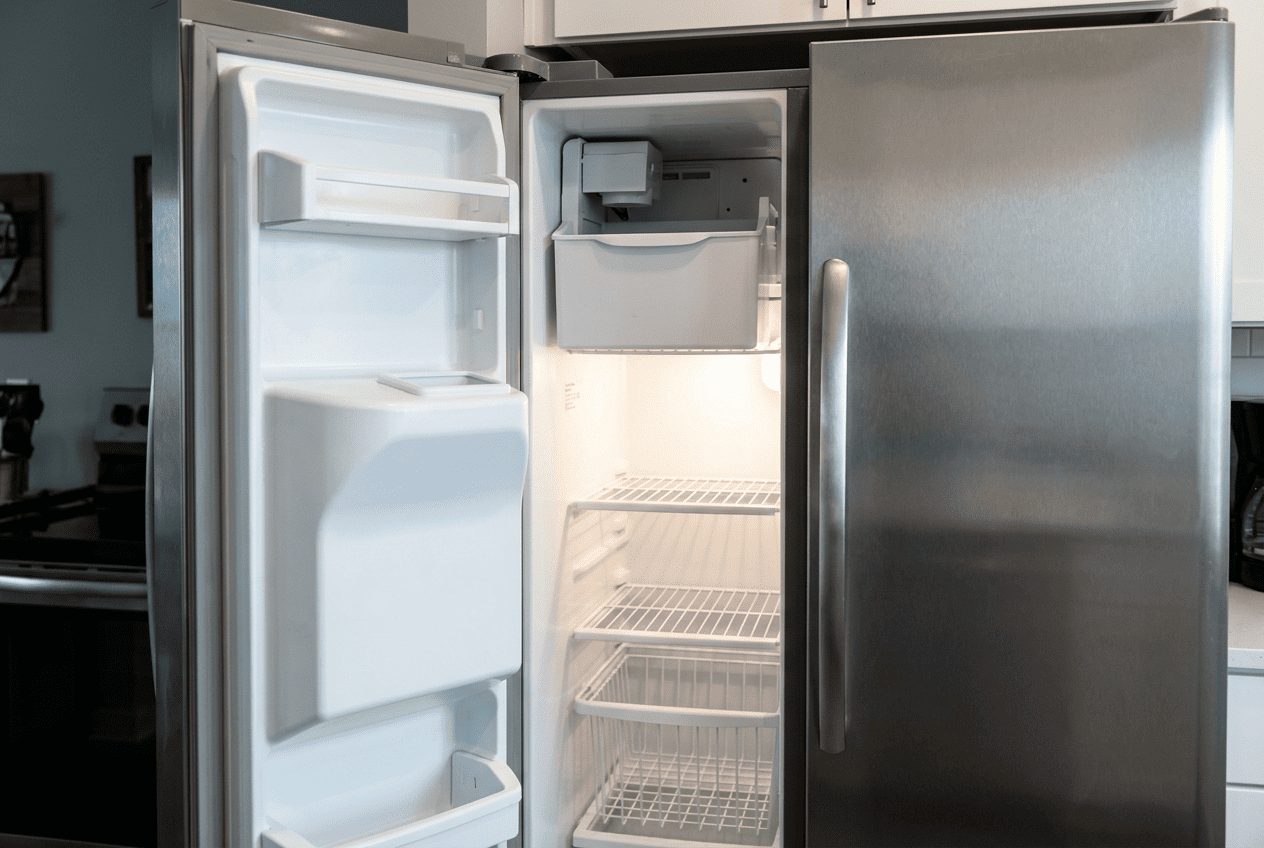
When a Frigidaire ice maker stops producing ice, the failure almost always follows a sequence. Ice production does not disappear without a reason. Either water stopped entering the mold, the freezing cycle is not completing, or the control system is not advancing the harvest cycle.
Same symptom turns up on other brands too – start with the Bosch ice maker not working troubleshooting guide.
In the Frigidaire FGHB and FGSS Series, the ice maker depends on four conditions remaining stable:
- proper freezer temperature,
- unrestricted water flow through the water inlet valve,
- a clear fill path without a frozen fill tube,
- and a functioning ice maker module that can cycle, harvest, and reset correctly.
When any one of those fails, the result is obvious: no ice.
The challenge is that different failures produce similar symptoms. A water filter clogged condition can look like a bad water inlet valve. A frozen fill tube can look like an electrical failure. A control arm stuck in the wrong position can mimic complete system failure. Even a minor rise in freezer temperature can pause ice production entirely while the refrigerator continues cooling normally.
In our repair practice, most Frigidaire ice maker not working complaints fall into predictable categories. Ice production stopped gradually. Cubes became smaller before stopping. The unit cycles but does not fill. The bin is empty with no mechanical noise. Each pattern points toward a specific subsystem.
Our guide explains how the ice maker system in FGHB and FGSS Series models is designed to operate, what typically interrupts the process, how to isolate a water inlet valve issue from a frozen fill tube obstruction, when an ice maker reset restores operation, and when the ice maker module itself has failed.
By the end of the article, you’ll understand not only why there is no ice, but which component is responsible and whether the repair involves water supply, temperature stability, or internal control failure.
How Ice Production Works in FGHB and FGSS Series
Before diagnosing why a Frigidaire ice maker is not working, it’s better to understand the cycle it follows every time while producing ice.
In FGHB and FGSS Series models, the process is automatic and repeatable. When freezer temperature is low enough, the ice maker module initiates a harvest cycle. A heating element briefly warms the mold just enough to release the frozen cubes. A motor turns ejector fingers that push cubes into the bin. Once the mold is empty, the module signals the water inlet valve to open for a timed fill.
Water flows through the fill tube into the mold. The valve closes. The water freezes. The cycle waits for temperature to reach the correct threshold before repeating.
If ice production stopped, the interruption occurred somewhere in that sequence.
The system depends on three core elements:
- Temperature control
- Water delivery
- Mechanical harvest
We evaluate them in that order.
Freezer Temperature: The Silent Assistant
Ice production does not begin unless freezer temperature is within specification. In most Frigidaire FGHB and FGSS models, the freezer must remain at or below approximately 0°F for consistent cycling.
If freezer temperature rises, even slightly, the ice maker pauses. This protects the system from producing soft or incomplete cubes.
When customers complain about no ice, we measure actual freezer temperature rather than trusting the display. A temperature sensor drift can cause inaccurate readings. The control board may show normal numbers while the actual temperature is higher.
Indicators temperature is the root cause include:
- Cubes becoming progressively smaller
- Ice production slowing before stopping
- Ice partially melting in the bin
- Refrigerator recently experiencing not cooling properly issues
If freezer temperature stability is compromised, replacing the ice maker module will not restore production. Temperature comes first.
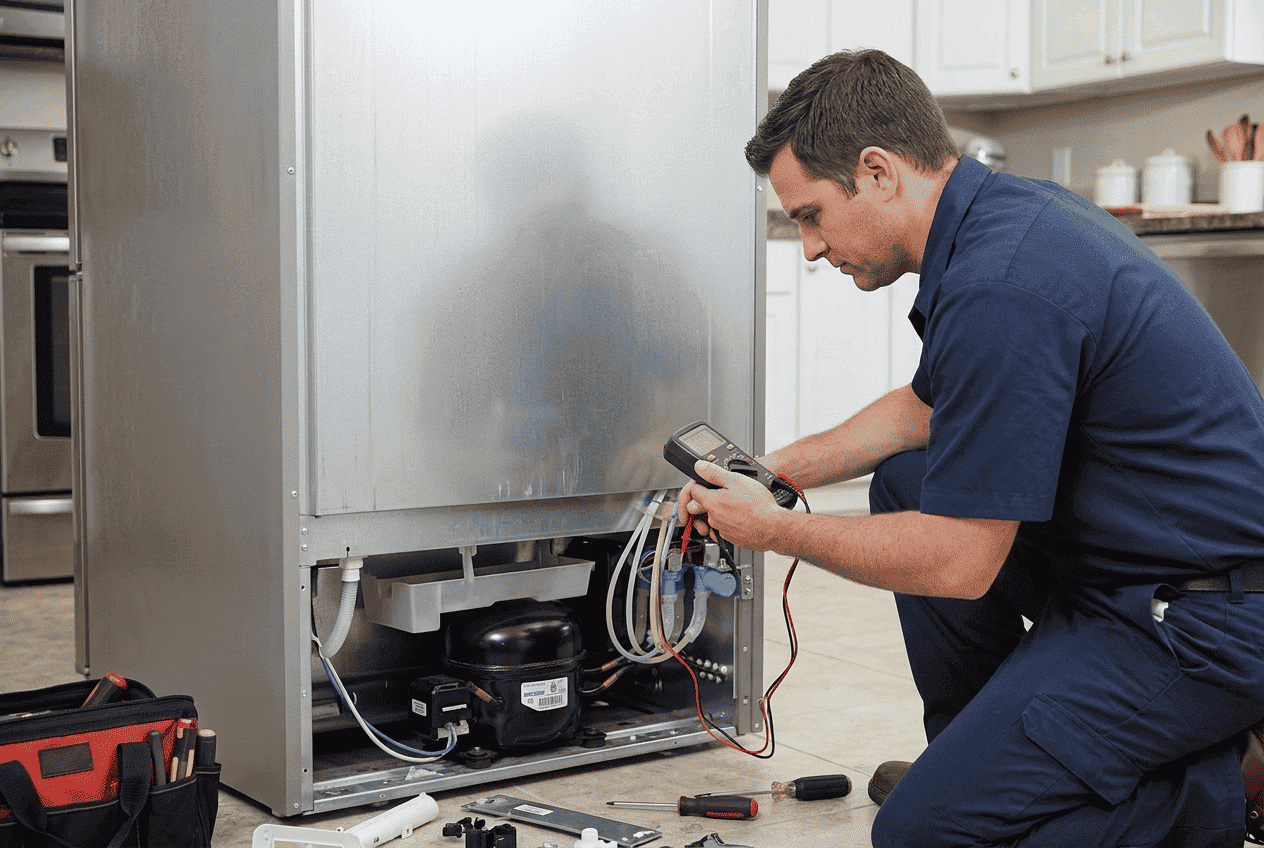
Analyzing the Basis of Water Inlet Valve
Once temperature is confirmed stable, we turn to water supply.
The water inlet valve is electrically controlled. When the ice maker module calls for water, the valve opens for a brief, timed interval. That timing determines cube size.
A failed water inlet valve may present in several ways:
- No water entering the mold at all
- Weak fill producing hollow cubes
- Intermittent fill cycles
- Valve humming but not opening
Mineral buildup inside the valve body can restrict flow even if the electrical coil is intact. In areas with hard water, we see this often.
Another common scenario is reduced pressure caused by a water filter clogged condition. When the filter reaches the end of its lifespan, flow rate drops. The valve may open normally, but insufficient water reaches the mold.
In those cases, replacing the water filter restores normal ice production immediately.
Before replacing the valve, we verify water pressure at the supply line and confirm that the valve receives proper voltage during the fill cycle.
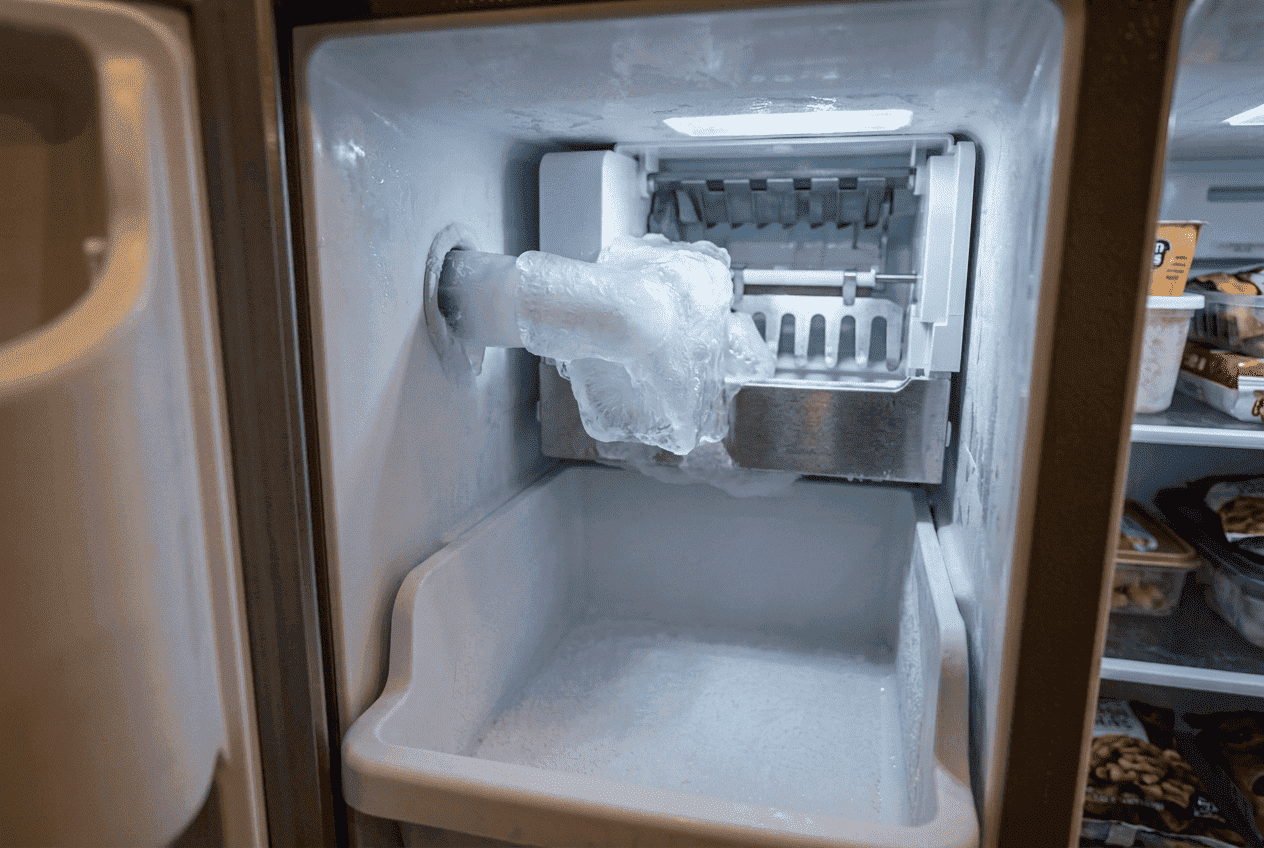
Frozen Fill Tube: A Physical Blockage
If the water inlet valve is functioning but the mold remains dry, the frozen fill tube becomes a primary suspect.
The fill tube directs water from the valve into the ice mold. If residual water remains in the tube between cycles, it can freeze and slowly narrow the passage.
Over time, the tube may freeze completely.
When this happens:
- The ice maker module cycles normally
- The valve opens as expected
- No water enters the mold
Thawing the frozen fill tube temporarily restores function. However, if the water inlet valve is seeping slightly between cycles, the tube will freeze again.
This is why recurring frozen fill tube cases often involve both the tube and the valve.
Proper diagnosis requires checking for slow drips at the valve outlet.
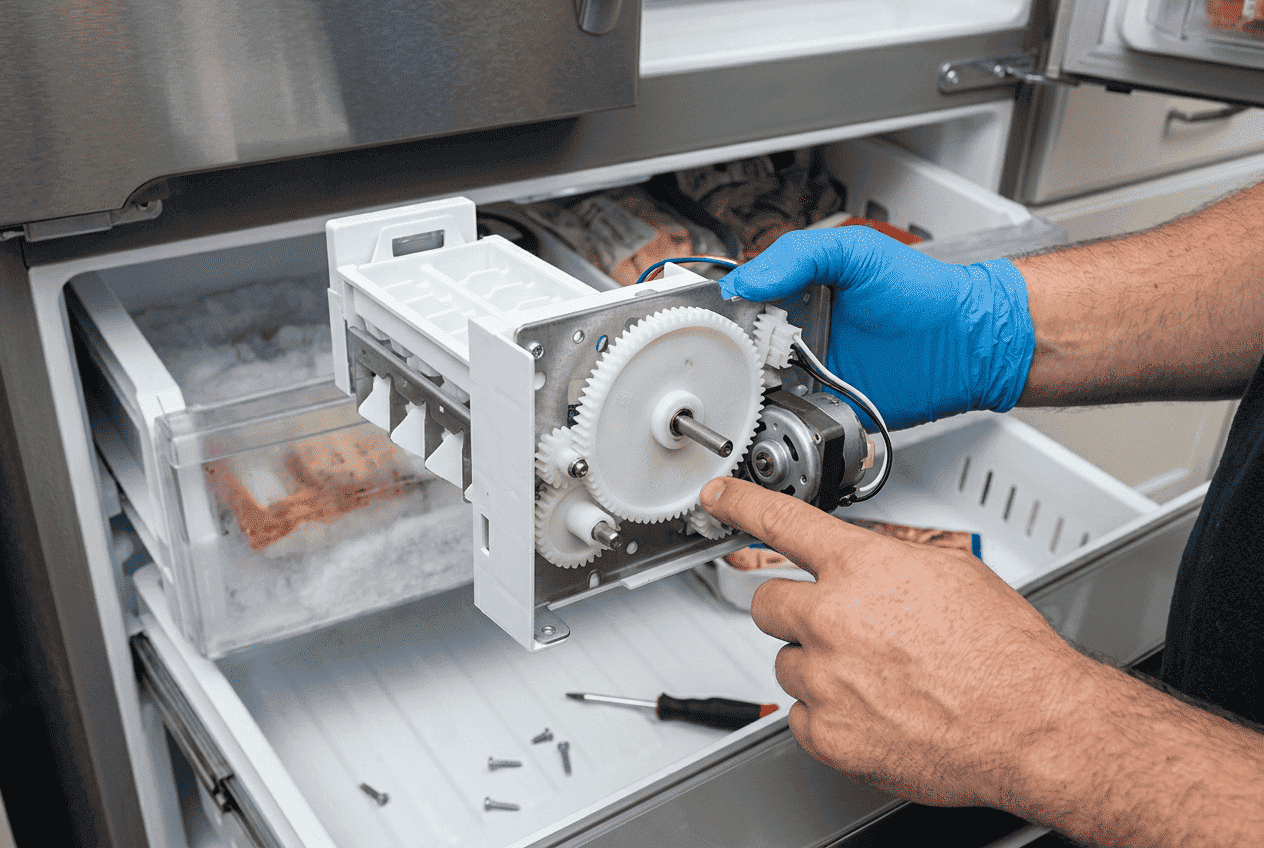
Ice Maker Module
If temperature and water supply are both confirmed normal, the issue may lie within the ice maker module itself.
The module contains:
- A small drive motor
- A gear assembly
- A heating element
- Internal timing contacts
When the module fails, common patterns include:
- No movement during harvest
- Ejector fingers stalled mid-cycle
- No call to the water inlet valve
- Unit unresponsive even after ice maker reset
In some cases, a control arm stuck in the raised position prevents cycling. The arm is designed to stop production when the bin is full. If it binds or misaligns, the ice maker interprets the bin as full and remains idle.
For the wider picture on this brand, see our Frigidaire leaking water guide.
We always inspect the control arm for free movement before replacing the module.
An ice maker reset can restore operation in cases where the module lost synchronization. However, if internal gears are stripped or the motor has failed, reset will not correct the issue.
Electrical Logic and Cycle Testing
When a Frigidaire ice maker is not working and both freezer temperature and water supply appear normal, electrical confirmation becomes necessary.
The ice maker module does not operate continuously. It cycles in stages:
- Freeze phase
- Harvest phase
- Water fill phase
If the unit remains silent with no ice production stopped message and no mechanical movement, one of these stages is failing to initiate.
In FGHB and FGSS Series units, we confirm:
- Power reaching the ice maker module
- Voltage delivered to the water inlet valve during fill
- Motor continuity inside the ice maker module
- Proper freezer temperature feedback
A unit may have power but fail to advance the harvest cycle. In that case, internal module contacts may be worn.
If the module advances but never sends voltage to the water inlet valve, the issue lies in control logic or module timing.
Symptom Comparison Table
When diagnosing a Frigidaire ice maker not working condition, symptom pattern is everything.
Observed Behavior | Likely Cause | What We Check First |
No movement, no sound | No power to module or failed ice maker module | Module voltage and internal motor |
Ice maker cycles but mold stays dry | Frozen fill tube or failed water inlet valve | Fill tube inspection and valve voltage |
Hollow or small cubes | Water filter clogged or low pressure | Filter condition and supply pressure |
Ice production slowed before stopping | Rising freezer temperature | Actual freezer temperature reading |
Ice maker runs constantly | Control arm stuck or sensor fault | Arm position and bin detection |
This table reflects all our field experience. The pattern narrows the direction before parts are replaced.
Real Case Pattern From Our Practice
A recent FGHB Series unit presented with no ice for three days. Freezer temperature was stable. The customer had already performed an ice maker reset without success.
Inspection showed:
- Ice maker module advancing normally
- Water inlet valve energizing
- No water entering mold
The fill tube was fully frozen. Upon thawing, we found the water inlet valve seeping slightly between cycles. That slow seepage created residual water that froze and blocked the tube.
Replacing the valve corrected the root cause. Thawing alone would have resulted in repeat failure.
This pattern is common in humid environments.
How Ice Maker Reset Fits Into Diagnosis
An ice maker reset is often attempted before calling for service. In some cases, it resolves electronic synchronization errors.
However, reset only addresses control logic. It does not repair:
- A water filter clogged condition
- A frozen fill tube
- A failed water inlet valve
- A damaged ice maker module motor
Reset is useful only if the module stalled electronically. It is not a mechanical fix.
Preventing Repeat Ice Failure
Ice systems fail more often from restriction and moisture than from complete component failure.
In our service experience, prevention includes:
- Replacing water filters at recommended intervals
- Keeping freezer temperature stable
- Inspecting door seals for air leaks
- Avoiding overloading freezer shelves near the fill tube
- Addressing minor ice irregularities early
A Frigidaire ice maker is a precision cycle system. Small irregularities compound quickly.
When the Problem Is Not the Ice Maker
Occasionally, the ice maker itself is not the failing component. Instead, the refrigerator may have a broader cooling instability.
If freezer temperature fluctuates due to airflow restriction or dirty condenser coils, ice production becomes inconsistent.
When customers report that ice production stopped alongside a fridge warm issue, we evaluate the entire cooling system first.
Ice failure can be a symptom of cooling imbalance.
Decision Flow Summary
To simplify the diagnostic path:
- Confirm freezer temperature is within specification.
- Inspect fill tube for ice blockage.
- Verify water filter condition and supply pressure.
- Test water inlet valve voltage during fill cycle.
- Evaluate ice maker module motor and control arm movement.
Skipping steps often leads to incorrect part replacement.
Technical Troubleshooting Chart: Frigidaire FGHB / FGSS Ice Systems
The following chart reflects a structured diagnostic path we use in the field. It moves from least invasive checks to component-level evaluation.
Step | Observation | Test Action | Interpretation | Next Move |
1 | No ice, freezer feels normal | Measure actual freezer temperature | Above 5°F | Correct cooling issue before servicing ice maker |
2 | Freezer temperature stable | Inspect mold for water | Mold dry | Proceed to water delivery testing |
3 | Mold dry | Activate fill cycle and measure voltage at water inlet valve | No voltage | Ice maker module not advancing |
4 | Mold dry | Voltage present at water inlet valve | No water flow | Valve restricted or failed |
5 | Mold dry | Valve energizes, pressure normal | Water not entering mold | Frozen fill tube obstruction |
6 | Cubes small or hollow | Check water filter age and supply pressure | Low flow detected | Replace water filter clogged unit |
7 | Ice maker silent, no movement | Confirm power to module | No power | Trace wiring or control fault |
8 | Ejector fingers stall | Inspect gear assembly inside ice maker module | Gear wear or motor failure | Replace module |
9 | Bin empty but system inactive | Inspect control arm stuck position | Arm raised or binding | Adjust or replace mechanism |
10 | Intermittent production | Monitor freezer temperature stability | Fluctuation detected | Address airflow or cooling imbalance |
How to Use This Chart
This chart is designed to prevent premature part replacement.
Start at freezer temperature. If temperature is not within specification, correct that first. Ice production depends entirely on freezer temperature stability.
If temperature is correct, determine whether water is entering the mold. A dry mold points toward water delivery or fill obstruction. A filled mold that never ejects cubes suggests an issue inside the ice maker module.
Voltage confirmation at the water inlet valve is critical. Without verifying whether power is present during the fill cycle, replacing the valve becomes speculation.
The frozen fill tube check should follow valve testing, not precede it. Many fill tubes freeze due to a seeping valve. Thawing without correcting the valve leads to repeat blockage.
Each step narrows the failure point.
Escalation Awareness
Some symptoms overlap. For example, a water filter clogged condition can mimic valve failure. Likewise, unstable freezer temperature can mimic module malfunction.
That is why sequence matters.
In FGHB and FGSS Series refrigerators, ice systems are reliable when temperature, airflow, and pressure remain stable. Most failures originate in one of those supporting systems rather than in the ice maker module itself.
Electrical Testing: What to Measure and Why It Matters
Once basic visual checks are complete, electrical verification becomes the next logical step. Ice systems rely on timed voltage delivery. Without confirming voltage, replacing parts becomes guesswork.
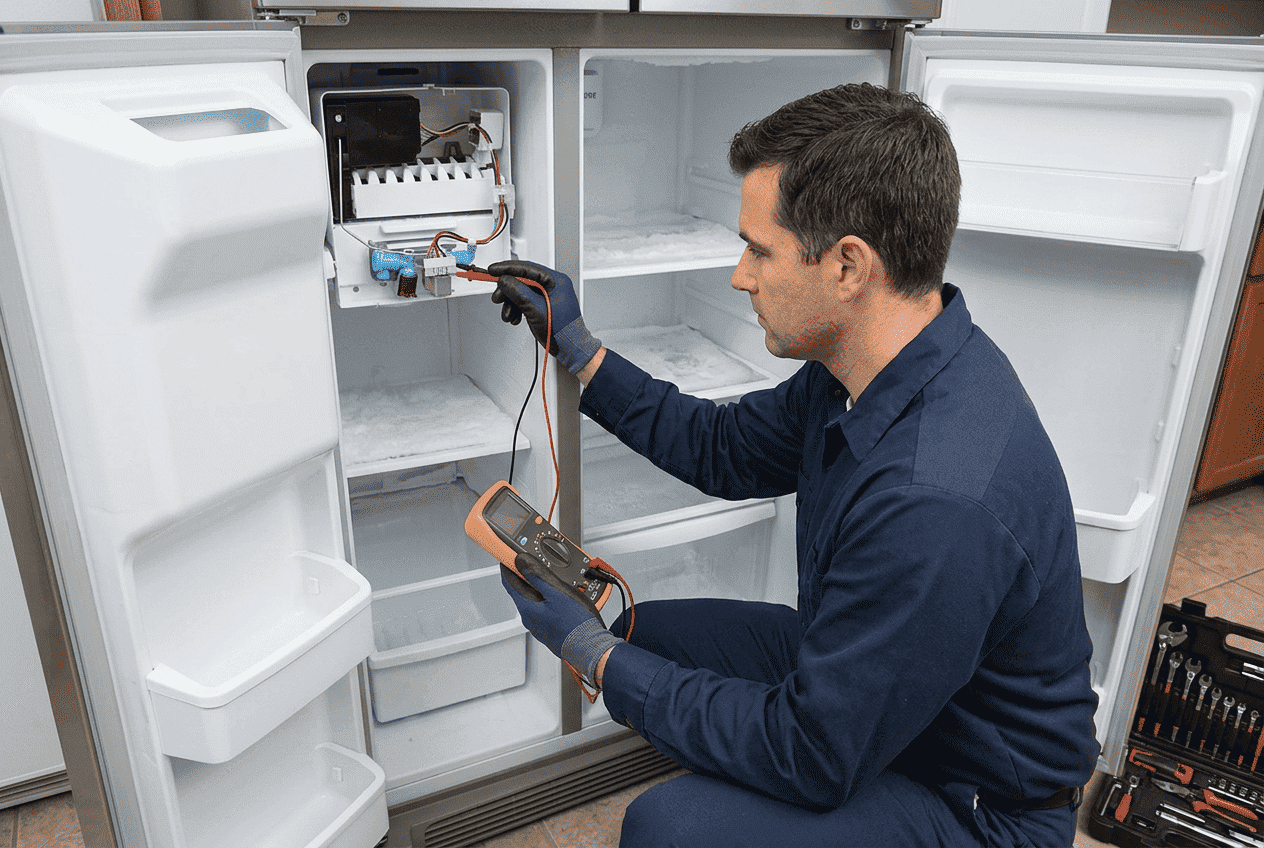
In FGHB and FGSS Series models, the ice maker module sends power to the water inlet valve during the fill stage. If the valve never receives voltage, the issue is not the valve itself. It is upstream.
When testing:
- Confirm constant power supply to the ice maker assembly.
- Measure voltage at the water inlet valve during the fill cycle.
- Check continuity across the ice maker module motor.
- Inspect wiring connections for corrosion or loosened terminals.
If voltage reaches the valve but no water flows, the valve is likely restricted or failed.
If no voltage reaches the valve during fill, the ice maker module is not advancing correctly.
Electrical confirmation prevents unnecessary valve replacement.
Harvest Cycle Failures and Gear Wear
In many service calls involving frigidaire ice maker not working, the mechanical portion of the harvest cycle has worn down gradually.
Inside the ice maker module is a small motor connected to a gear assembly. Over time, plastic gears may strip or crack. When that happens, the module may appear to start but fail to complete rotation.
Typical signs include:
- Ejector fingers stopping mid-turn
- Grinding or clicking during harvest
- Partial cube ejection
- Ice production stopped without water issues
In these cases, an ice maker reset will not restore normal function. The internal motor can no longer advance the cycle reliably.
Gear wear is more common in older units that have run through thousands of harvest cycles.
Intermittent Failures: The Most Frustrating Category
Some ice maker complaints are not constant. Ice production resumes temporarily, then stops again.
Intermittent behavior often points to:
- Marginal freezer temperature fluctuation
- A water inlet valve that opens inconsistently
- A water filter clogged enough to restrict flow under peak demand
- Wiring connections that expand and contract with temperature
In humid climates, even slight airflow imbalance inside the freezer can create small frost buildup near the frozen fill tube, partially restricting water entry.
Intermittent systems require patience and structured testing. Replacing the first suspected part rarely solves the issue long term.
When to Replace the Ice Maker Module
Replacement becomes appropriate when:
- Motor continuity fails
- Internal contacts are burned
- Gear assembly is damaged
- Control arm stuck repeatedly despite adjustment
- Ice maker reset produces no response
If freezer temperature is stable and water delivery has been confirmed, module replacement is justified.
However, if temperature or pressure conditions are unstable, replacing the module will not restore reliable production.
The ice maker depends on the refrigerator’s larger system.
Long-Term Reliability Considerations
The ice maker operates under demanding conditions. It cycles through freezing, heating, and mechanical movement multiple times per day. Small inefficiencies accumulate.
To maintain reliable ice production in FGHB and FGSS Series units:
- Replace filters on schedule to avoid water filter clogged restrictions.
- Keep condenser coils clean to protect compressor efficiency.
- Avoid overpacking the freezer near air vents.
- Address minor cooling irregularities before they affect freezer temperature.
Ice makers are often the first component to reveal cooling imbalance.
Final Thoughts
When a Frigidaire ice maker not working complaint arises, the solution rarely requires guessing. The failure lies in one of four areas: freezer temperature stability, water supply through the water inlet valve, obstruction from a frozen fill tube, or malfunction within the ice maker module.
Each presents distinct patterns. Careful observation narrows the cause. Structured testing confirms it.
Replacing parts without confirming voltage, pressure, and temperature often leads to repeat repair.
Ice production is predictable when the system is stable. When ice production stopped, something in that sequence shifted. Finding that shift restores reliability.
Related guides
FAQ
1. Why is my Frigidaire ice maker not working even though the freezer seems cold?
Ice production depends on precise freezer temperature, not just whether the freezer feels cold. In FGHB and FGSS Series models, even a slight rise above the proper freezer temperature can pause cycling. If ice production stopped but food remains frozen, measure the actual temperature rather than relying on the display. Temperature instability is often the first cause of no ice.
2. How do I know if the water inlet valve is the problem?
If the mold remains dry after a harvest cycle and the ice maker module appears to advance normally, the water inlet valve should be tested during the fill stage. If voltage reaches the valve but no water flows, the valve is likely restricted or failed. However, a water filter clogged condition can mimic valve failure, so pressure should be verified before replacement.
3. What causes a frozen fill tube?
A frozen fill tube usually develops when residual water remains in the tube between cycles. This can happen if the water inlet valve seeps slightly after closing. Over time, that moisture freezes and narrows the passage until water can no longer reach the mold. Simply thawing the tube may restore operation temporarily, but if the valve continues to seep, the blockage will return.
4. Does an ice maker reset fix most no ice problems?
An ice maker reset can restore operation if the ice maker module has lost synchronization. It does not repair mechanical wear, stripped gears, a control arm stuck in the raised position, or a failed water inlet valve. Reset should be used as a diagnostic step, not as a permanent repair solution.
5. When should the ice maker module be replaced?
Replacement is appropriate when freezer temperature is stable, water delivery through the water inlet valve has been confirmed, the frozen fill tube has been cleared, and the module fails to advance or send voltage during the fill cycle. Electrical confirmation and continuity testing should be performed before installing a new ice maker module.