
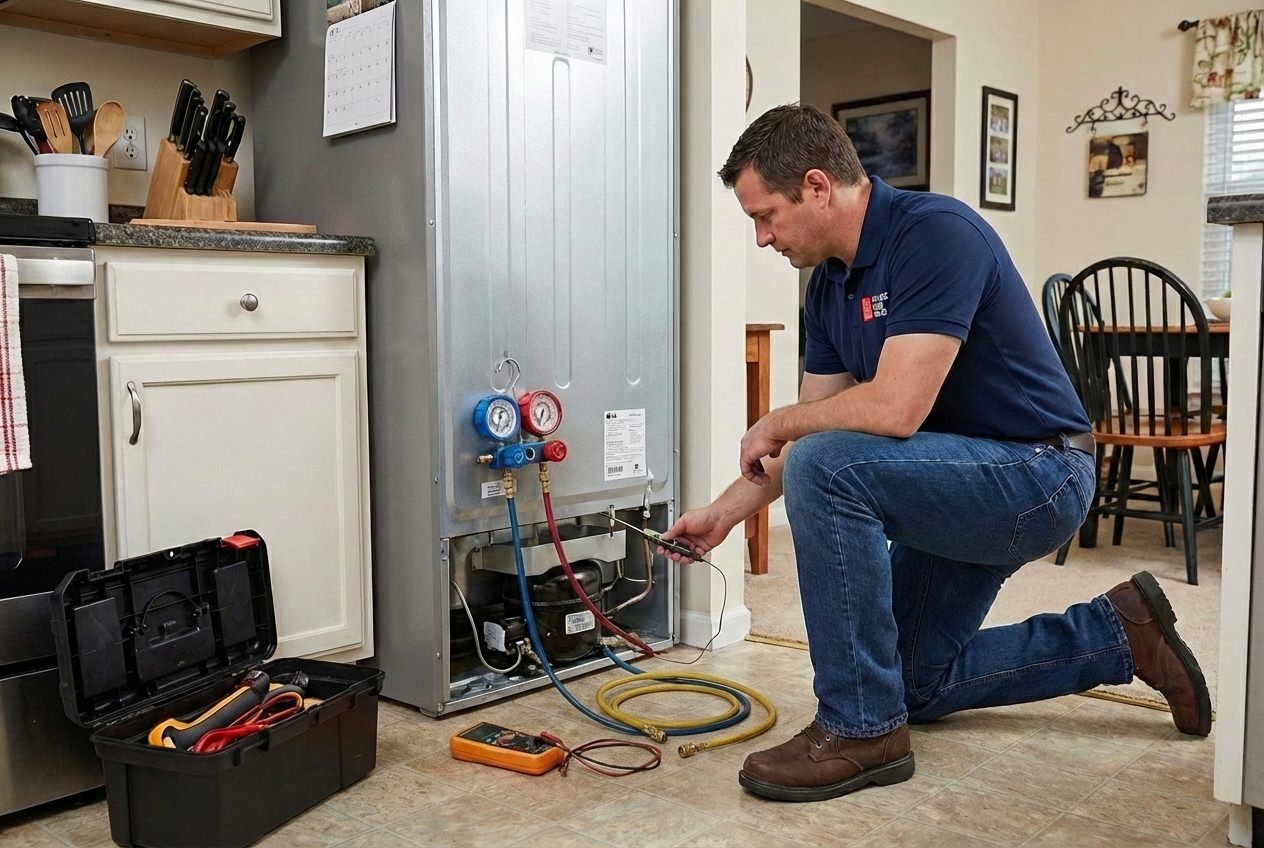
The LG LRFV Series can develop a small set of repeat cooling and airflow faults, but the symptoms do not all point to the same repair. This article explains what the most common performance changes usually mean, how to separate maintenance issues from component failure, and when professional LG LRFV series repair is the practical next step.
Same symptom turns up on other brands too – start with our guide to Bosch 800 Series problems.
We focus on the complaints homeowners report most often: fresh-food warming, weak recovery after door openings, moisture at the gasket line, slower ice production, and uneven temperatures from shelf to shelf. We also explain where condenser coils cleaning, the door seal paper test, and checks for evaporator fan obstruction fit into a proper diagnosis.
For Atlanta service calls, the key question is whether the refrigerator is still behaving within normal operating range. That means checking if it can hold temperature 37-40F, recover after normal kitchen use, and cool both compartments evenly. That is the framework behind this guide to LG LRFV series problems.
At Appliance Repair Master, we sort those paths before we talk about parts. We verify whether the fresh-food section is holding temperature 37-40F, whether airflow is even from shelf to shelf, whether the door seal paper test reveals weak gasket contact, and whether the symptom belongs to routine care or a deeper cooling fault. That is how we handle LG LRFV series repairs in Atlanta.
At a glance
- Fresh-food section warming first usually points to airflow, vent blockage, or an early fan-path issue.
- A light rub or scrape after the doors close can be a clue for evaporator fan obstruction.
- Moisture along the door edge often means the cabinet is pulling in warm, humid room air.
- If both sections are warming together, the repair conversation can move toward sealed system failure.
- If the fresh-food side cannot hold temperature 37-40F, it is time to stop watching and start diagnosing.
Tell us what you notice first.
Every tiniest detail of a symptom is always useful information. Knowing those clues well is what turns a generic service call into a focused repair visit.
Quick symptom snapshot
What you notice | What we check first |
|---|---|
Fresh-food section warms first | Airflow pattern, recovery time, and vent circulation |
Unit runs long after the doors close | Condenser heat release and overall cooling efficiency |
Whirring, rubbing, or scraping sound | Fan path condition and evaporator fan obstruction |
Display looks normal but food is not cold enough | Sensor response and electronic control board logic |
Moisture along the door edge | Gasket contact, cabinet level, and room-air intrusion |
Ice slows down with temperature drift | Whole-system cooling performance, not just the ice maker |
That snapshot keeps the diagnosis honest. The visible symptom matters, but the order in which it appeared matters just as much.
Where LRFV performance usually starts to slip
In service calls, the first complaint is usually a change in routine: milk on the top shelf is not as cold by morning, the deli drawer feels warmer than the rest of the cabinet, or the machine hums longer after dinner when the doors have been opened a few times. Owners notice the routine before they notice the fault.
That is useful information. A refrigerator that loses its edge after repeated door openings points us toward recovery time, airflow, and heat rejection. A refrigerator that never gets fully cold points us toward control response or system-side cooling. A cabinet that sweats along the trim sends us to the gasket and level first.
Those are the kinds of details that make a service call productive. On the LG LRFV Series, one symptom can look like another until the pattern is read correctly.
Most common LG LRFV Series problems we repair in Atlanta
When cooling loss points to sealed system failure
When both sections begin running warm and the refrigerator struggles to pull temperatures down after hours of runtime, we start thinking beyond a simple airflow issue. In the LG LRFV Series, a full-cabinet cooling complaint can indicate a compressor-side problem, a restriction in the cooling circuit, or another form of sealed system failure.
Many owners land on that possibility by searching linear compressor class action. We understand why. The phrase has become shorthand for a broader concern: is this refrigerator losing cooling capacity at the sealed-system level, or is another fault making it look that way? The answer comes from testing, not from the search term itself.
A true system-side problem usually leaves a clear trail. Both compartments drift upward. The machine may run for long stretches without catching up. Ice production drops because the entire cooling cycle is underperforming, not because the ice maker suddenly became the only failed part. On premium French-door models, that distinction matters.
Airflow trouble and evaporator fan obstruction
Not every warm-food complaint belongs to the compressor. One of the more common service patterns in the LG LRFV Series is a refrigerator section that softens first while the freezer seems closer to normal. That split usually points toward airflow.
An evaporator fan obstruction can create that pattern quickly. Ice buildup, a shifted panel, or food pushed too far into an air channel can interrupt circulation and leave the cabinet uneven from top to bottom. Owners may hear a light tick, a rub, or a brief scraping note as the fan catches frost or meets resistance.
For the wider picture on this brand, see our guide to LG LFXS Series problems.
In these calls, the machine is still trying to cool. The problem is that cold air is no longer moving through the cabinet the way it should. Once airflow breaks down, the LRFV refrigerator can look contradictory: one shelf feels acceptable, another does not, the display still responds, and food quality still slips.
The electronic control board
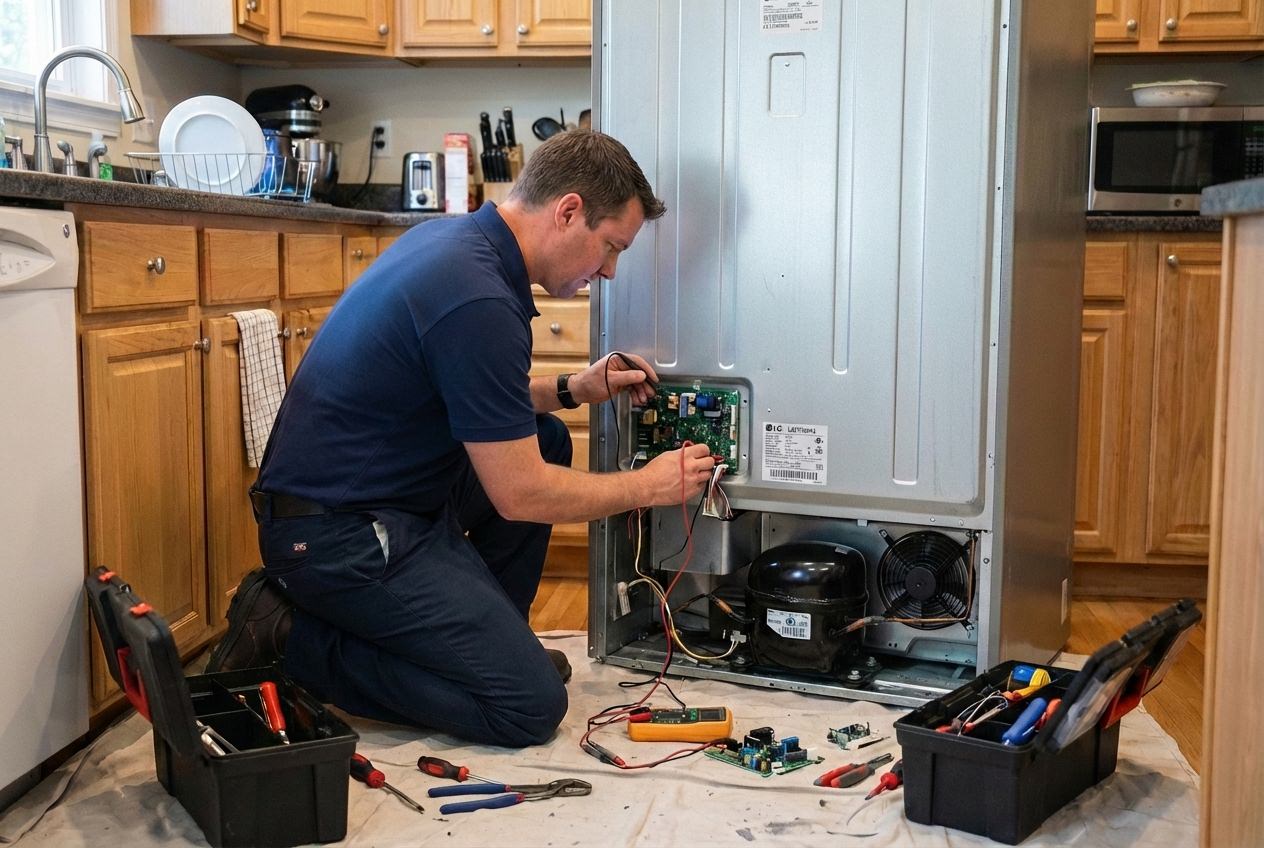
Modern refrigerators do not depend on one switch and one thermostat. The LRFV platform relies on sensors, dampers, fans, and timing logic working together. When the electronic control board starts missing inputs or sending the wrong outputs, the symptom can look scattered rather than dramatic.
The display may light normally. Interior lamps still come on. The unit may cool reasonably well for a few hours and then drift. We see this most often after power irregularities, intermittent temperature complaints, or service calls where the behavior changes from one day to the next with no obvious blockage or leak.
Board-side diagnosis has to be earned. We look at fan response, damper movement, cabinet temperature feedback, and overall cooling calls together. Replacing the electronic control board because the refrigerator seems “confused” is not a method. It is a gamble.

Door leakage, condensation, and the door seal paper test
Some LRFV cooling complaints start at the door edge. A gasket can look acceptable at a glance and still leak room air if the door is slightly out of level, if the bins are overloaded, or if the sealing surface is dirty and not seating evenly. In Atlanta kitchens, humid air makes that problem easier to spot because moisture shows up faster.
The quickest screening check is the door seal paper test. Close a sheet of paper in the door at several points and pull gently. You should feel steady resistance. If the paper slips out too easily at the top, middle, or bottom, the seal deserves a closer look.
The door seal paper test does not replace service, but it does tell us where to begin. A weak seal changes cabinet recovery, raises the moisture load inside the refrigerator, and can make a perfectly healthy cooling system work harder than it needs to.
Heat-release issues and condenser coils cleaning
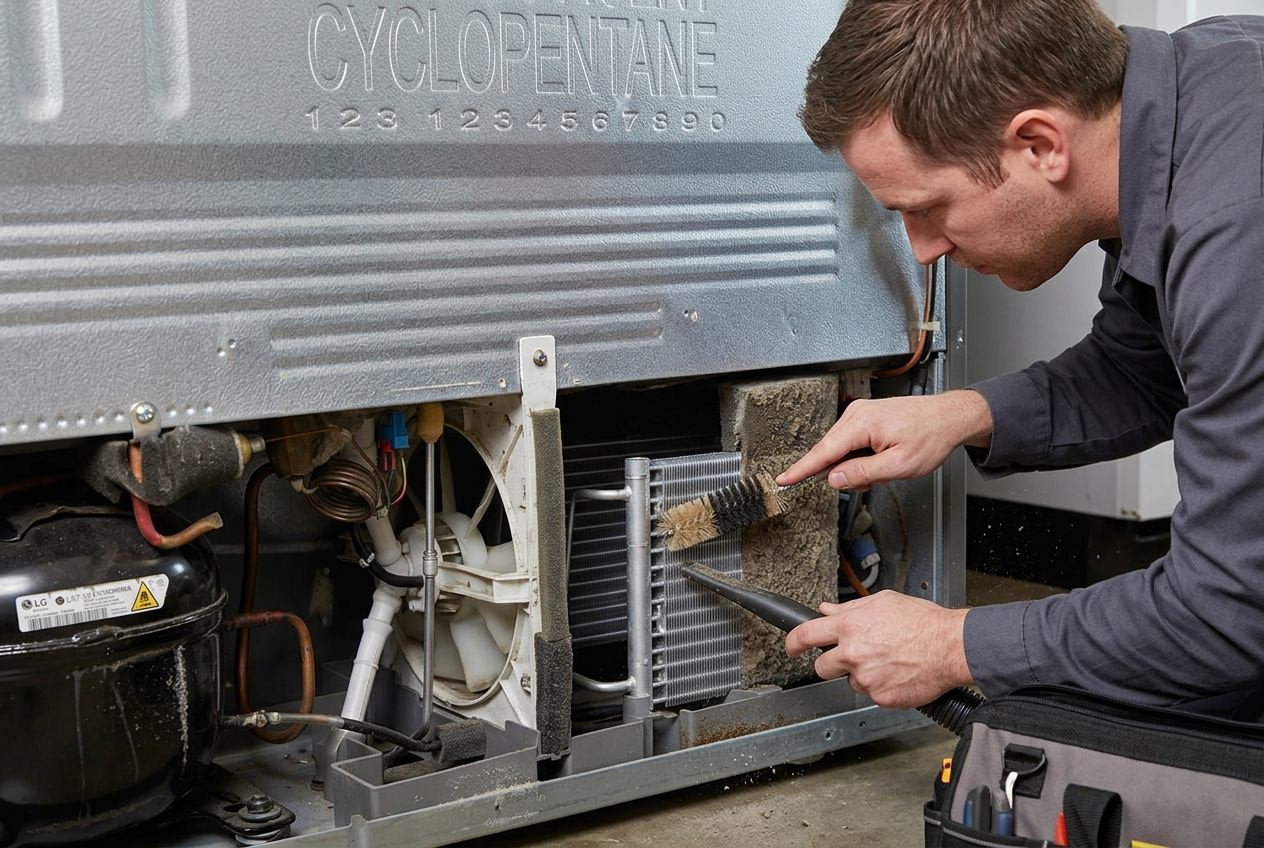
We also keep one foot in the basics. Condenser coils cleaning still matters on a premium refrigerator. Dust, pet hair, and kitchen debris reduce the unit’s ability to release heat. When that happens, run time grows longer and the cooling margin gets thinner, especially during warmer months.
That is one reason we bring up condenser coils cleaning in an LRFV article at all: not every service call should turn into a major repair story. Some refrigerators are underperforming because heat exchange has been neglected for too long. Others are running warm because dirty coils are stacked on top of another developing issue.
It is routine work, but it matters. Before a homeowner spends money chasing the wrong part, the condenser area needs to be checked and the airflow around it needs to make sense.
Repair quick answer for LRFV owners
Not every warm refrigerator belongs in the same category. This is the framework we use when owners want a plain-language answer before approving work:
Condition | What it often means | Typical next step |
|---|---|---|
Fresh-food section misses temperature 37-40F while the freezer seems steadier | Airflow loss, fan restriction, or control-side response issue | Inspect vent path, confirm fan operation, and test board logic |
Both sections drift warm at the same time | System-side cooling loss or sealed system failure | Run a full cooling-performance diagnosis before discussing major parts |
Moisture or weak pull at the door edge | Gasket contact issue, alignment problem, or room-air leak | Check level, seal integrity, and cabinet loading |
Long run times with visible dust around the lower rear cover | Restricted heat release and poor condenser airflow | Perform condenser coils cleaning and reassess recovery |
Cooling complaint changes after a storm or power event | Possible electronic control board or start-circuit issue | Test response, fan calls, and control outputs before replacing parts |
Repair usually makes sense when the fault is contained to airflow, a fan path, a gasket, or a board-side issue that has not cascaded into the cooling circuit. Replacement enters the conversation more seriously when we confirm sealed system failure on an older unit or find multiple high-cost problems stacked together.
That is why we do not treat every warm cabinet the same way. A refrigerator missing temperature 37-40F because the door is leaking humid air lives in a very different category from a unit that has lost system efficiency.
Safe checks to make before you call
- Place a thermometer on the middle shelf and verify whether the refrigerator is holding temperature 37-40F. A set temperature and an actual temperature are not always the same thing.
- Try the door seal paper test at the top, middle, and bottom of each fresh-food door. Uneven resistance is useful information.
- Look for platters, drink packs, or large containers pressed against rear vents. A blocked air path can make one shelf run warm while another still feels acceptable.
- Check the lower rear area for visible dust accumulation and note whether condenser coils cleaning has been overdue.
- Listen for fan noise that changes from smooth airflow to ticking, rubbing, or scraping after the doors close.
- Avoid resets, board replacement, or sealed-system DIY work. Those shortcuts usually muddy the diagnosis more than they help it.
Why Atlanta kitchens expose these faults faster
Humidity finds every weak seal. A gasket issue that might stay subtle in a dry home often turns into visible moisture, slower recovery, or light frost sooner in Atlanta.
Open kitchens and active households create more door openings during the busiest parts of the day. That adds recovery load and makes airflow or temperature-control issues easier to feel in normal use.
Dust and pet hair also reach the condenser area faster than many owners expect. When summer heat narrows the margin even further, a small LRFV problem can show its hand more quickly than it would in a cooler, drier setting.
Component failure summary
Issue | Common symptom | Typical repair |
|---|---|---|
sealed system failure | Both sections warm; long run times; weak recovery | Confirm cooling loss and discuss sealed-system repair or replacement path |
evaporator fan obstruction | Fresh-food section warms first; rubbing or scraping sound | Clear obstruction, resolve ice buildup, and restore airflow |
electronic control board fault | Display appears normal but temperatures drift or cycle inconsistently | Test control response and replace the board only when confirmed |
Door seal leak | Condensation at the door edge; uneven pull in the door seal paper test | Correct alignment, gasket contact, or door-loading issue |
Dirty condenser area | Longer run times and weaker cooling efficiency | Perform condenser coils cleaning and verify recovery |
Why call Appliance Repair Master
- We note the model, the temperature complaint, and whether both compartments are affected or only one.
- We ask what changed first: cooling, ice production, noise, moisture, or display behavior.
- We inspect airflow, seals, fan operation, and condenser condition before recommending parts.
- We test control response so an airflow or board issue is not mistaken for a compressor failure.
- We explain the repair path in plain language and quote the work before anything major begins.
If your refrigerator is missing the set point, waiting usually means more food risk and less certainty. Early diagnosis keeps the repair path cleaner.
Conclusion
The LG LRFV Series is a sophisticated refrigerator platform, but the warning signs are still familiar: food warms sooner than it should, airflow becomes uneven, ice slows down, or moisture appears where it never used to. Good service starts by reading those clues in the order they showed up.
Some of those complaints are resolved with airflow correction, condenser coils cleaning, gasket work, or control-side repair. Others lead to more serious findings such as sealed system failure. The value of diagnosis is not in naming the scariest part first. It is in testing the refrigerator in the order the symptoms point.
If you are seeing LG LRFV series problems in Atlanta, Appliance Repair Master can help you narrow the issue quickly and move toward a repair that makes sense. We service the LG LRFV Series throughout Atlanta and nearby suburbs, explain the findings clearly, and quote the work before anything major begins.
Call us today to schedule LG LRFV series repairs.
Related guides
FAQ
1. What temperature should I look for in the fresh-food section?
For everyday food storage, temperature 37-40F is the practical target range. If the cabinet will not hold that range consistently, the issue is no longer just about settings.
2. Does the door seal paper test really tell me anything useful?
Yes. It is a simple screening check that can reveal weak gasket contact or a leveling problem. It does not replace diagnosis, but it gives useful direction.
3. When does linear compressor class action become relevant to a repair call?
Usually when both sections are warming and the owner is trying to understand whether the cooling loss is minor or compressor-side. The phrase explains the concern; testing explains the refrigerator.
4. Can condenser coil cleaning solve poor cooling by itself?
Sometimes, especially when the condenser area is heavily loaded with dust or pet hair. It will not correct a failed fan, a bad board response, or sealed system failure, but it can restore performance when heat release is the real bottleneck.
5. How do I know whether the electronic control board is involved?
Look for inconsistent behavior: the display appears normal, but temperatures drift, fan response seems irregular, or the machine behaves differently from one day to the next without an obvious blockage.
6. What does evaporator fan obstruction usually sound like?
Owners often describe a light ticking, rubbing, or scraping sound, especially after the doors close and the fan comes back into play. That sound is a useful clue when paired with warm fresh-food temperatures.