
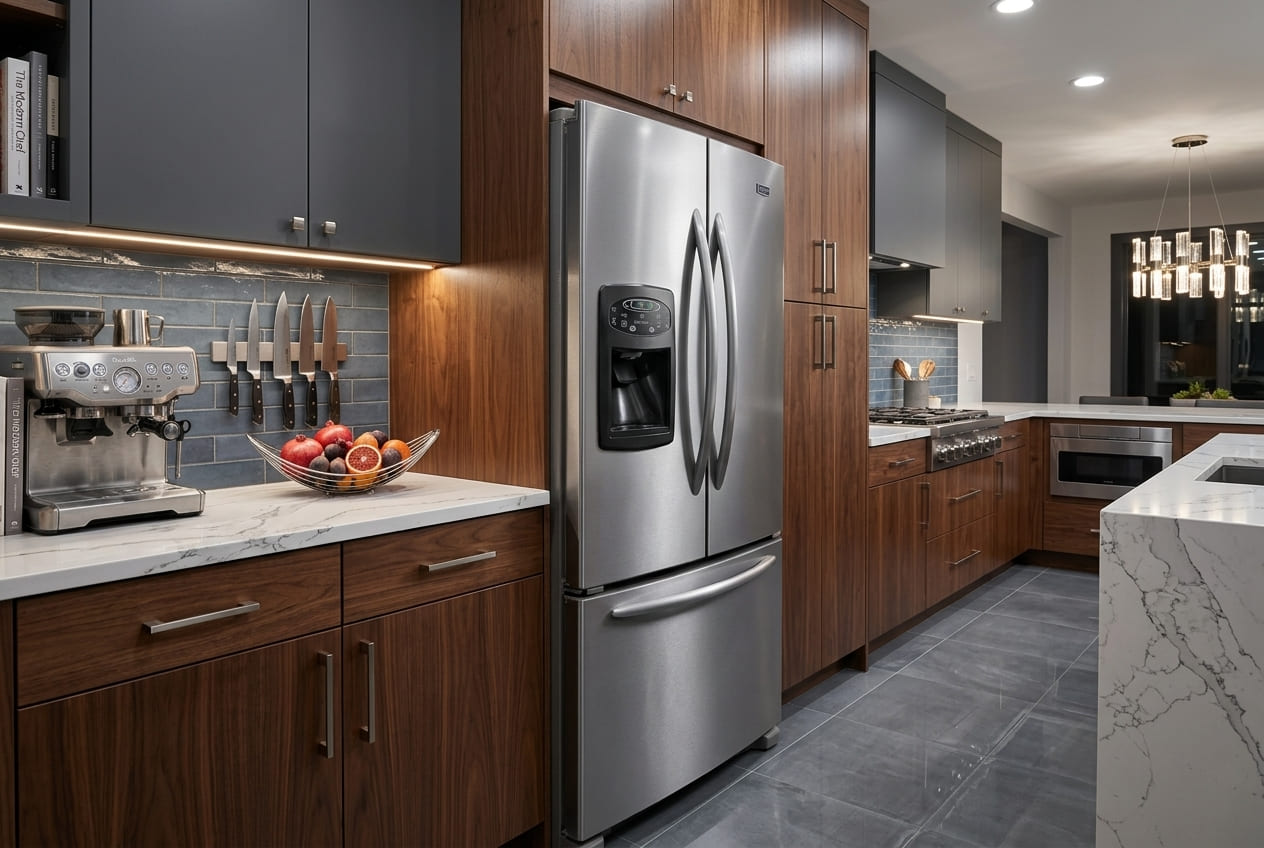
Every Maytag refrigerator not cooling situation has one of a finite number of causes. The challenge is that “not cooling” looks the same from the outside whether the evaporator fan has failed, the condenser coils are clogged, or the compressor circuit has stopped. The symptom is identical — warm interior, food going bad — but the cause and the fix are entirely different.
Same symptom turns up on other brands too – start with the Frigidaire not cooling troubleshooting guide.
This guide is structured to match your specific symptom to the right section immediately, so you’re not reading about condenser coils when your problem is a stuck air damper. Applies to Maytag MFI2568AES French-door and Maytag MSD2756GES side-by-side refrigerators, as well as most Maytag top-freezer and bottom-freezer configurations.
Start here. Answer both questions before reading further:
Which symptom matches your situation?
Is the freezer also warm — not just the refrigerator section?
- YES — Both zones are losing cold. Problem is most likely the compressor, a sealed system issue, or a defrost failure affecting the entire unit. Go to Sections 3 and 5.
- NO — Freezer is cold, but the refrigerator section is warm. Problem is airflow between the two zones — the evaporator fan, the air damper, or a blocked duct. Go to Section 2.
Is the refrigerator running — can you hear the motor humming?
- RUNNING — The cooling system is active but not performing. Sections 1, 2, and 3 are your path.
- SILENT — The compressor or its control circuit isn’t starting. Go directly to Sections 4 and 5.
Section 1: Check These Before Anything Else
Before touching a single component, work through these four zero-tool checks. They resolve roughly 20% of Maytag fridge warm service calls — and every one of them takes under two minutes.
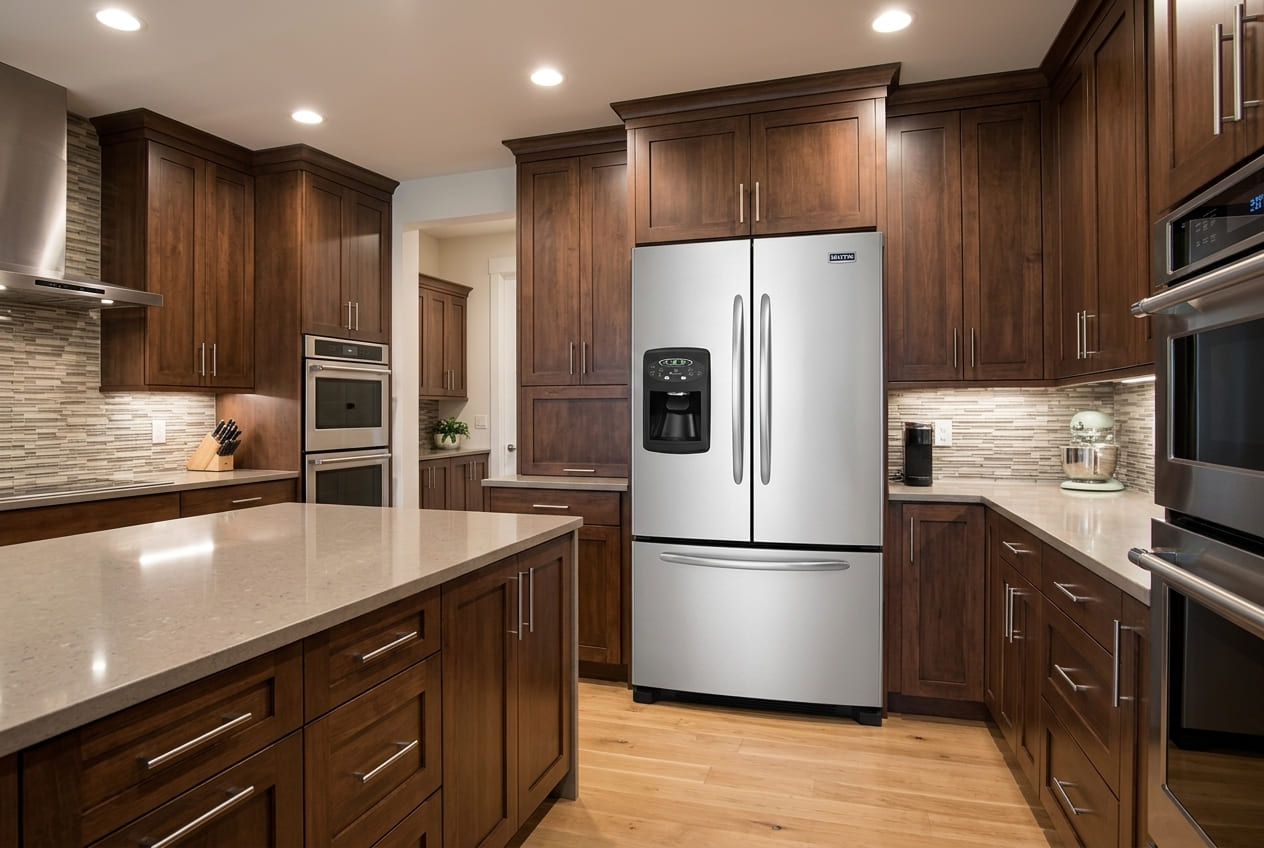
- Temperature settings
The fresh food section should be set to 37°F. The freezer should be set to 0°F. On digital control panels — standard on Maytag French-door and side-by-side models — power outages and accidental button presses reset these values. The display shows the target setpoint, not the actual measured temperature, so a setting that looks correct after a power event may have quietly changed.
After adjusting any temperature setting, allow the refrigerator a full 24 hours to stabilize before evaluating the result. Checking after two hours tells you nothing useful.
- Door seal — the dollar bill test
Close the refrigerator door firmly on a dollar bill, then try to pull it out. If the bill slides free with no resistance, the door gasket isn’t creating adequate contact. Warm air enters continuously around the failed seal, and the compressor runs constantly trying to compensate — without ever bringing the temperature down.
Run this test on all four edges of the door, not just the middle. Corner sections fail first on Maytag refrigerators with heavy use. A gasket that’s cracked, hardened, or visibly warped needs replacement.
- Blocked air vents
The cold air supply vents on most Maytag refrigerators sit at the rear wall of the fresh food section. Packages pushed flush against that wall block airflow from the freezer section. Rearranging food to leave 3–4 inches of clearance along the rear wall costs nothing and sometimes solves a partial cooling problem in 24 hours.
- Demo (showroom) mode
A refrigerator in demo mode runs lights, displays, and fans normally — but the compressor never turns on and no cold air is produced. It looks completely operational except for the lack of cooling. This mode is common in recently purchased units and in refrigerators that have been moved or had their control panel reset.
Check the display for a “DEMO” indicator or unusual icon. Deactivating demo mode typically requires pressing and holding two specific buttons for 3–5 seconds — consult your model’s user guide for the exact sequence. Once deactivated, allow 24 hours before evaluating cooling.
Section 2: The Airflow Culprits — Freezer Cold, Fridge Warm
If your freezer is maintaining temperature but the refrigerator section is warming up, the sealed system isn’t the issue. The refrigerant is circulating, the evaporator coils are cold — but cold air isn’t reaching the fresh food compartment. Two components control that transfer.
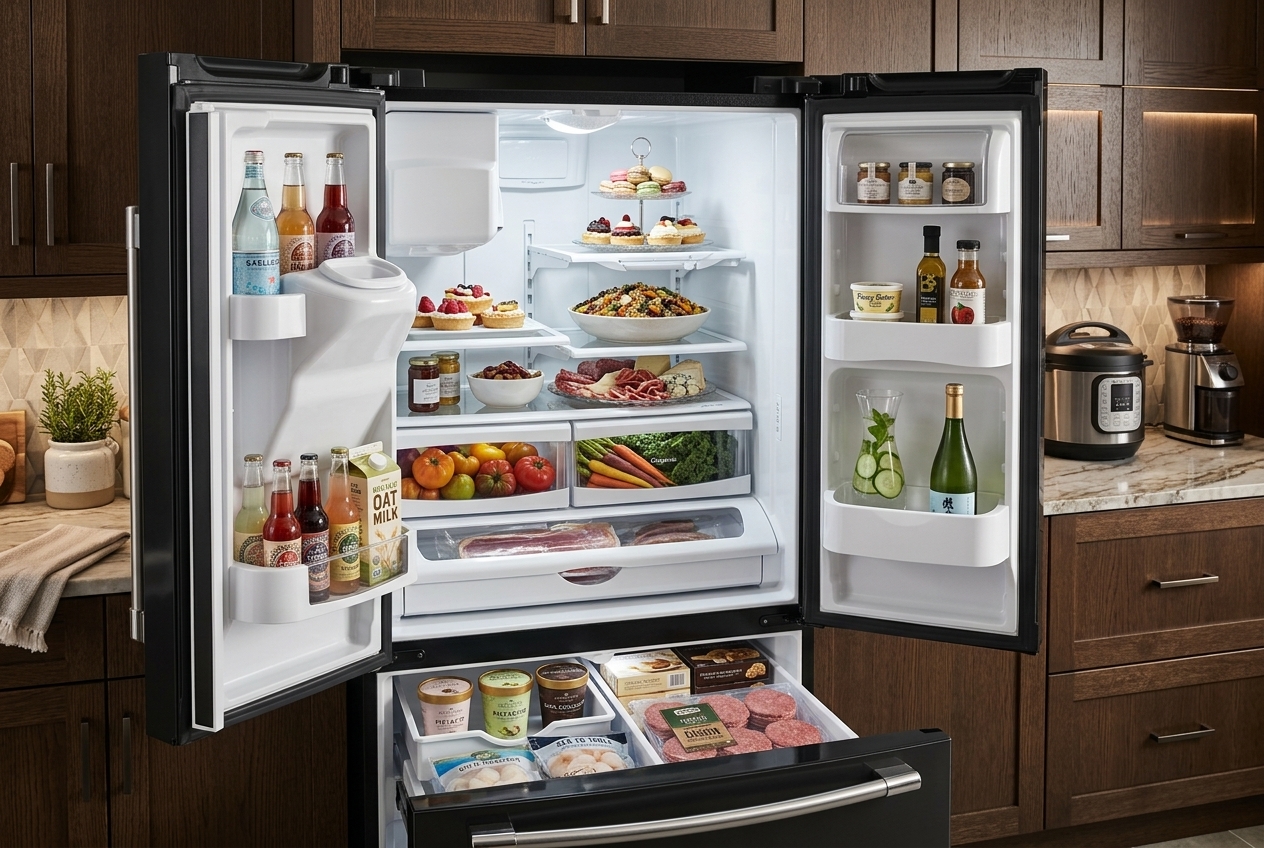
The Evaporator Fan
The evaporator fan motor sits inside the freezer, behind the rear wall panel. Its job is to draw air across the cold evaporator coils and push it through a duct into the refrigerator section above or beside it. When this fan fails — from a failed motor, a broken blade, or ice buildup jamming the blade — the freezer stays cold (the coils are still doing their job) but the refrigerator section warms steadily because no air movement is reaching it.
Test it in under two minutes:
- Open the freezer door.
- Locate the small door switch — typically a button or lever in the door frame that the door normally depresses when closed.
- Press and hold it manually — this tricks the refrigerator into thinking the door is shut.
- Listen and feel for the fan starting within a few seconds
If there’s silence, the fan motor has stopped. On Maytag MFI2568AES French-door and MSD2756GES side-by-side models, evaporator fan failure is a documented and relatively common failure mode. Replacing the motor requires removing the freezer’s rear wall panel — an intermediate repair that’s achievable if you’re comfortable with disassembly and have the part number for your specific model.
The Air Damper
The air damper — sometimes called the baffle — is a small motorized or thermostat-controlled flap that regulates exactly how much cold air passes from the freezer zone into the fresh food section. On Maytag French-door configurations, the damper is typically located in the upper rear of the fresh food compartment, behind a plastic housing.
When the damper sticks in the closed position, cold air flow to the refrigerator section drops to near zero. When it sticks open, too much cold air enters — and fresh food freezes.
Quick diagnostic: Adjust the temperature control and listen for a faint click from the damper area. On models with a mechanical damper, that click confirms the mechanism is responding. No click, no movement, and a consistently warm (or frozen) fresh food section points to a stuck damper.
The damper assembly is not typically user-serviceable — accessing it requires panel removal and the replacement part must match the exact configuration of your model.
Section 3: Condenser Coils — The #1 User-Fixable Cause of Gradual Cooling Decline
Dirty condenser coils are responsible for more gradual Maytag not cooling situations than any other single cause. They’re also the most overlooked — because the refrigerator continues to run, just less and less effectively over weeks and months, until one day the interior temperature is clearly wrong.
Here’s the mechanism: the condenser coils release heat that the refrigerant absorbed from the interior of the refrigerator. When those coils are coated with dust, pet hair, and debris — which accumulates regardless of how clean the kitchen appears — heat can’t escape efficiently. The compressor runs longer and hotter on every cycle. The interior temperature rises slowly, and nothing triggers a visible alarm.
Tools needed:
- Vacuum cleaner with a brush attachment.
- Long-handled condenser cleaning brush (available at most hardware stores).
- Flashlight
Coil location varies by model type:
Configuration | Condenser coil location |
French-door and bottom-freezer | Front-bottom, behind the kick plate grille |
Side-by-side | Rear of the unit — pull the refrigerator away from the wall |
Top-freezer | Rear or bottom, depending on model year — check the owner’s manual |
Vacuum the coil surface thoroughly, then use the brush to reach between the fins where the vacuum can’t. After cleaning heavily fouled coils, cooling improvement is often measurable within 12–24 hours.
Atlanta note: HVAC systems that recirculate indoor air, pets, and the fine clay dust common to the Atlanta area all accelerate coil fouling. The standard recommendation is every 6 months. For Atlanta households with pets or older HVAC systems, every 3 months is a more realistic interval for keeping coils genuinely clean rather than just technically serviced.
A single cleaning session on coils that haven’t been touched in 2–3 years can restore meaningful cooling performance. If the refrigerator still isn’t cooling adequately 24 hours after a thorough cleaning, the coil condition was a contributing factor but not the only cause.
Also see Maytag temperature problems if cleaning the condenser restores cooling but the temperature continues to fluctuate — a secondary component may be active.
Section 4: Preventive Maintenance Schedule — What Keeps a Maytag Refrigerator Cooling Long-Term
This is the only table in this series built purely around owner benefit. Every row explains not just what to do, but what specific failure it prevents — in plain terms.
Frequency | Task | What it actually prevents |
Monthly | Dollar bill door seal test; confirm temperature settings are at 37°F / 0°F | Warm-air infiltration that forces the compressor to run continuously without cooling; settings drift after power events |
Every 3 months | Wipe door gaskets with mild soap and warm water; inspect for cracks or stiffened sections | Gasket degradation — a cracked gasket doesn’t fail all at once, it fails gradually, raising your energy use and interior temperature simultaneously |
Every 6 months | Replace water filter; clean condenser coils; inspect and empty the drain pan if accessible | Ice maker failure from restricted water flow; coil fouling that forces compressor overwork; drain pan overflow that causes floor leaks |
Annually | Inspect and tighten door hinge screws; vacuum the coil area thoroughly; confirm defrost drain is clear | Door misalignment that prevents full gasket contact; accumulated coil fouling; drain clogs that produce interior ice and eventually affect cooling airflow |
As needed | Manual defrost if frost builds beyond ¼ inch on any surface (upright freezers without auto-defrost) | Frost accumulation that blocks evaporator airflow — the same failure mode that makes both sections warm and looks like a compressor problem |
The maintenance actions that prevent the most serious cooling failures — gasket replacement and condenser cleaning — cost a combined $30–70 in parts and materials per year and take under an hour. The compressor failures they prevent cost significantly more.
If you suspect a Maytag ice maker not working issue, check the freezer temperature as part of this schedule — an ice maker that stops producing often indicates a freezer running warmer than 0–5°F, which is also the first sign of a broader cooling problem.
Section 5: When the User-Accessible Checks Run Out — Decision Table
Every Maytag not cooling diagnosis reaches a point where the checks available without instruments or disassembly are exhausted. The table below marks that line clearly and honestly — some of these are genuinely DIY-doable, and saying otherwise would be misleading.
Situation | DIY action available? | When to call a technician |
Settings or demo mode | ✓ Yes — fix it yourself | Already confirmed correct, still not cooling |
Failed door gasket | ✓ Order part, attempt replacement | Door warps or seal doesn’t hold after new gasket |
Dirty condenser coils | ✓ Yes — vacuum and brush | Still not cooling 24 hrs after thorough cleaning |
Evaporator fan failed | Test with door switch; order motor | Rear panel removal required or correct motor unavailable |
Air damper stuck | No — panel access required | Immediately — not user-serviceable |
Defrost system failure | Manual defrost as a temporary diagnostic test | Immediately — component testing requires instruments |
Compressor / sealed system | No DIY path | Immediately — requires EPA-certified technician |
The sealed system is the hard line. Diagnosing and repairing refrigerant leaks, testing compressor amperage, or replacing a compressor involves refrigerant handling that requires EPA Section 608 certification and recovery equipment. Attempting it without that background doesn’t just risk personal injury — it can introduce air into the system and cause the compressor to fail permanently.
For a full breakdown of compressor failure symptoms and what each one means, see Maytag compressor failure — that article covers every compressor-circuit failure pattern with specific diagnostic tests before any professional call is needed.
Conclusion
Every Maytag refrigerator not cooling situation follows one of two paths: an airflow failure or a sealed system failure. The symptom decision points at the top of this article tell you which path you’re on before you open a panel or pick up a tool.
- Freezer cold, fridge warm → evaporator fan or air damper. Section 2.
- Both sections warm, compressor running → condenser coils, defrost failure, or sealed system. Sections 3 and 5.
- Both sections warm, compressor silent → start circuit or compressor. Section 5
- Checks all pass, still not cooling → professional diagnostic needed.
The maintenance schedule in Section 4 closes most of the gap between reactive repairs and preventive ownership. Condenser cleaning and door seal checks are the two actions that prevent the most expensive cooling failures in Maytag refrigerators — and both are tasks any owner can do with a vacuum and a dollar bill.
When your Maytag fridge warm situation has moved past the user-accessible fixes — freezer cold and refrigerator warm, or both sections off — Appliance Repair Master matches the symptom to the component and fixes it. Same-day and next-day appointments available across Atlanta and all of Metro Georgia.
If the fix above does not hold, Appliance Repair Master can take it from here.
Related guides
FAQ
1. How long is food safe in a Maytag refrigerator that stopped cooling?
USDA guidelines set the threshold at approximately 4 hours for a full refrigerator after cooling stops — provided the door remains closed. A refrigerator that’s only half full loses safe temperature faster because there’s less thermal mass. Frozen food in a full freezer holds for about 48 hours; half-full, closer to 24. Practically: if your Maytag refrigerator not working situation has lasted more than 4 hours and you can’t confirm the temperature stayed below 40°F throughout, treat perishables — meat, dairy, cooked leftovers — as unsafe. This standard applies regardless of how recently the food was purchased.
2. Can Atlanta's summer heat cause my Maytag refrigerator to stop cooling?
Indirectly, yes — and it’s more direct in certain locations. Maytag refrigerators are rated for ambient environments up to 110°F. Uninsulated garages in Atlanta during July and August can approach or reach this threshold, causing the compressor to short-cycle or the thermal overload protector to trip repeatedly. Inside a conditioned home, summer heat raises the refrigerator’s duty cycle — it runs more frequently to maintain target temperature, which stresses the condenser and compressor over time. Quarterly condenser coil cleaning during Atlanta’s summer months is specifically recommended for this reason, rather than waiting for the standard six-month interval.
3. My Maytag refrigerator stopped cooling after I added a large load of food. Could that be the cause?
Possibly — and it’s worth understanding why. Loading a large quantity of warm or room-temperature food significantly raises the interior temperature in a short period. A refrigerator functioning at the edge of normal capacity — partially fouled condenser coils, a slightly weakened door seal, a fan running below full speed — may be unable to recover from that sudden demand. What looks like a failure triggered by the food load was often a marginal condition that had been building. Give it 4–6 hours with the door closed before drawing conclusions. If it doesn’t recover to 37°F in that window, the underlying issue was already present before the food was added.
4. How do I confirm my Maytag refrigerator has been repaired and is cooling correctly again?
Use a standalone refrigerator thermometer — not the unit’s built-in display, which shows the target setpoint rather than the actual measured temperature. Place it in the center of the fresh food section and check it after 24 hours. It should read 35–38°F. Place a second thermometer in the freezer; it should read 0–5°F. If both readings fall in range and the compressor is cycling normally — turning on and off — rather than running continuously, the repair is confirmed. Continuous compressor running after a repair with both compartments at target temperature is normal for the first few hours as the unit stabilizes; it should resolve within 12–24 hours.
5. Can Atlanta's summer humidity affect how often my Maytag refrigerator needs condenser cleaning?
Atlanta’s humidity accelerates the way debris binds to condenser fins. In dry climates, dust accumulates loosely and is easier to vacuum off. In high-humidity environments, that same dust absorbs moisture and compresses into a denser layer that reduces airflow more severely and is harder to remove. Homes with central air conditioning that recirculates indoor air compound this effect. In practice: if you’re cleaning your Maytag condenser coils every six months and still seeing cooling issues by late summer, quarterly cleaning is the correct interval for Atlanta conditions — not an excessive precaution.
6. What's the difference between a Maytag refrigerator not cooling because of a defrost failure versus a compressor failure?
These two failures produce nearly identical symptoms — both compartments warming gradually — and they’re confused regularly. The distinguishing test is manual defrost: unplug the refrigerator for 24–48 hours with the doors open, allowing any frost on the evaporator coils to fully thaw. Then restore power. If cooling returns and the unit maintains temperature normally for 3–5 days before the warming pattern begins again, the defrost system failed — a heater, thermostat, or adaptive defrost control that isn’t clearing frost on schedule. If the refrigerator doesn’t cool at all even immediately after the manual defrost period — coils clear, no cooling — the sealed system is the issue and a technician is needed. That single test separates the two without any instruments.