

There’s a moment every refrigerator owner dreads: you walk into the kitchen, notice the silence, open the fridge — and feel room-temperature air. No hum, no cold, no cooling. When a Kenmore compressor failure is behind it, you’re not dealing with a minor inconvenience. The compressor is the engine of the entire refrigeration system. Without it, nothing works.
Unlike a clogged filter or a worn door seal, a compressor not running isn’t something you can work around temporarily. The food clock starts ticking immediately, and the longer the diagnosis is delayed, the more complicated the situation can become — especially if refrigerant has already begun leaking from the system.
What makes Kenmore compressor failures particularly relevant right now is the documented history of defective LG linear compressors installed in a wide range of Kenmore models. This isn’t a fringe issue — it’s been the subject of federal class action litigation and has affected tens of thousands of households across the country.
This article covers how compressor failure happens, what the LG defect actually involves, how to recognize the warning signs, and how to decide between repair and replacement. We back every repair we perform with a warranty on our work — because a compressor job done right should hold up.
Understanding the Kenmore Compressor: How It Works and Why It Fails
To understand why a compressor fails, it helps to understand what it actually does — and what kind of stress it operates under every single day.
The Basics of Compression
The compressor’s job is to pressurize the refrigerant gas and push it through the sealed cooling circuit. It draws in low-pressure gas from the evaporator, compresses it into a high-pressure, high-temperature state, and sends it to the condenser — where heat is released and the refrigerant begins its cycle again.
Two compressor designs are relevant to Kenmore owners:
Type | How It Works | Common In |
Reciprocating (piston) | A piston moves up and down to compress gas | Older Kenmore models |
Linear | A piston moves in a straight line, magnetically driven | Kenmore models 2014–2020+ |
The linear design was marketed as quieter and more energy-efficient. In theory, fewer moving parts meant less friction and longer life. In practice, the design introduced a specific vulnerability that became a widespread problem.
Where the System Breaks Down
The most common internal failure point in both compressor types is the discharge valve. This valve opens to release compressed refrigerant into the high-pressure side of the system and closes to prevent backflow. When the discharge valve is weak — worn, warped, or no longer sealing properly — pressure bleeds back into the compression chamber.
The result: the compressor runs, draws power, generates heat — but can’t build enough pressure to move refrigerant through the system. The fridge gets warm, the compressor gets hot, and the cycle repeats until the unit gives out entirely.
Other contributing factors to Kenmore compressor failure include:
- Age and duty cycle — a compressor that’s run continuously for 10+ years has accumulated significant wear
- Voltage fluctuations — power surges can damage the motor windings or start components
- System contamination — moisture or debris in the refrigerant circuit accelerates internal wear
- Overheating — dirty condenser coils force the compressor to run hotter and longer than it’s designed to
The LG Linear Compressor Problem: Lawsuits and Class Actions
This is the section that matters most for owners of Kenmore refrigerators built in the last decade. The LG linear compressor lawsuit history is well-documented, and understanding it can directly affect your repair or replacement decision.
The History of the LG Linear Compressor Defect
Kenmore doesn’t manufacture its own appliances. The brand — owned by Sears, and later by Transform SR Brands — has historically sourced refrigerators from major manufacturers, with LG supplying a significant portion of the lineup.
LG’s linear compressor technology was introduced with considerable fanfare. The design promised 10-year durability, reduced noise, and better energy ratings. Kenmore refrigerators equipped with these compressors were sold at premium price points throughout the mid-2010s.
By 2017, consumer complaints had begun accumulating at scale. Refrigerators that were 3–5 years old — well within their expected service life — were failing completely. The pattern was consistent: the compressor would stop running, the unit would warm up, and repair estimates would come back at figures that made replacement look more attractive. For a refrigerator that cost $1,500–$2,500 new, that’s a significant problem.
The root cause, as identified through teardowns and engineering analysis, was premature wear on the internal components of the linear compressor — specifically the pistons and their guide surfaces. The design didn’t tolerate real-world operating conditions as well as lab testing had suggested.
Evaporator Tubing Corrosion: A Related Issue
One consequence of the linear compressor defect that doesn’t always get discussed: evaporator tubing corrosion. As the compressor degrades and loses efficiency, the refrigerant circuit operates under abnormal pressure conditions. Over time, this stress — combined with moisture that can enter a compromised system — accelerates corrosion in the copper tubing of the evaporator.
Corroded tubing develops pinhole leaks. Refrigerant escapes slowly at first, then faster as the leak grows. By the time the refrigerator stops cooling entirely, the system may have lost most of its refrigerant charge — and the repair now involves not just the compressor, but leak detection, tubing repair or replacement, and a full system recharge.
This is why early diagnosis matters. A compressor that’s failing but hasn’t yet caused secondary damage is a more straightforward repair than one that’s taken the evaporator tubing with it.
Recognizing the Signs of Compressor Failure
Compressor problems don’t always announce themselves dramatically. Some failures are gradual; others happen overnight. Knowing what to listen and look for can help you catch the problem before it becomes more expensive.
Audible Symptoms
Sound is often the first indicator. Here’s what different sounds typically mean:
Sound | What It Suggests |
Complete silence | Compressor not running at all — motor or start components failed |
Clicking every 2–5 minutes | Start relay attempting to kick the compressor on, failing, resetting |
Loud hum or buzz, no cooling | Compressor motor running but not pumping — internal mechanical failure |
Brief run, then shutdown | Thermal overload protector cutting power due to overheating |
The Kenmore compressor clicking noise pattern — that rhythmic click every few minutes — is one of the most recognizable signs. It means the start relay is doing its job, but the compressor isn’t responding. Left unaddressed, this cycling stresses the relay and can damage the motor windings further.
Performance Symptoms
Beyond sound, watch for these behavioral signs:
- The refrigerator section is warm and the freezer isn’t freezing — both compartments affected simultaneously
- The back panel of the unit, near the compressor, is not warm — a working compressor generates heat; a dead one doesn’t
- Interior lights and controls function normally, but there’s no cooling whatsoever
- The unit runs continuously without ever reaching set temperature
That last point is worth noting: a compressor that runs non-stop without cooling is often worse than one that’s completely stopped. It’s consuming power, generating heat, and potentially damaging itself further with every hour it operates.
What NOT to Do
A few things we see homeowners try that make the situation worse:
- Don’t attempt to “jump-start” the compressor by tapping or striking the unit. This is a persistent myth with no mechanical basis and risks damaging refrigerant lines.
- Don’t ignore the clicking. Every failed start attempt puts additional stress on the motor. If you hear it, turn the refrigerator off and call for service.
- Don’t leave perishables in a warm refrigerator hoping the problem resolves on its own. The FDA’s two-hour rule applies: food above 40°F for more than two hours should be discarded.
Repair vs. Replace: Making the Right Decision
This is the question we get asked most often when a compressor diagnosis comes back confirmed. There’s no universal answer — it depends on the specific unit, its age, and the scope of the damage.
When Repair Makes Sense
Compressor replacement is worth pursuing when:
- The refrigerator is under 10 years old and otherwise in good condition
- The Kenmore compressor warranty on the sealed system is still active — many Kenmore models carried a 5-year sealed system warranty, and some LG-sourced units had extended coverage specifically because of the known defect
- The evaporator tubing is intact and there’s no secondary refrigerant leak
- No other major components (control board, evaporator fan, defrost system) are showing signs of failure
A compressor replacement on a well-maintained, relatively young refrigerator is a legitimate repair — not a stopgap.
When Replacement May Be Better
The math shifts when:
- The unit is 12–15 years old or older
- There are multiple failing components beyond the compressor
- Evaporator tubing corrosion has already caused a refrigerant leak, adding significant labor and parts to the repair scope
- The model is one of the affected series from the class action period and is no longer under any warranty coverage
In these cases, the repair cost can approach — or exceed — the value of a comparable replacement unit. A technician who gives you an honest assessment will tell you this directly.
EPA Certification: Why It Matters for Compressor Repair
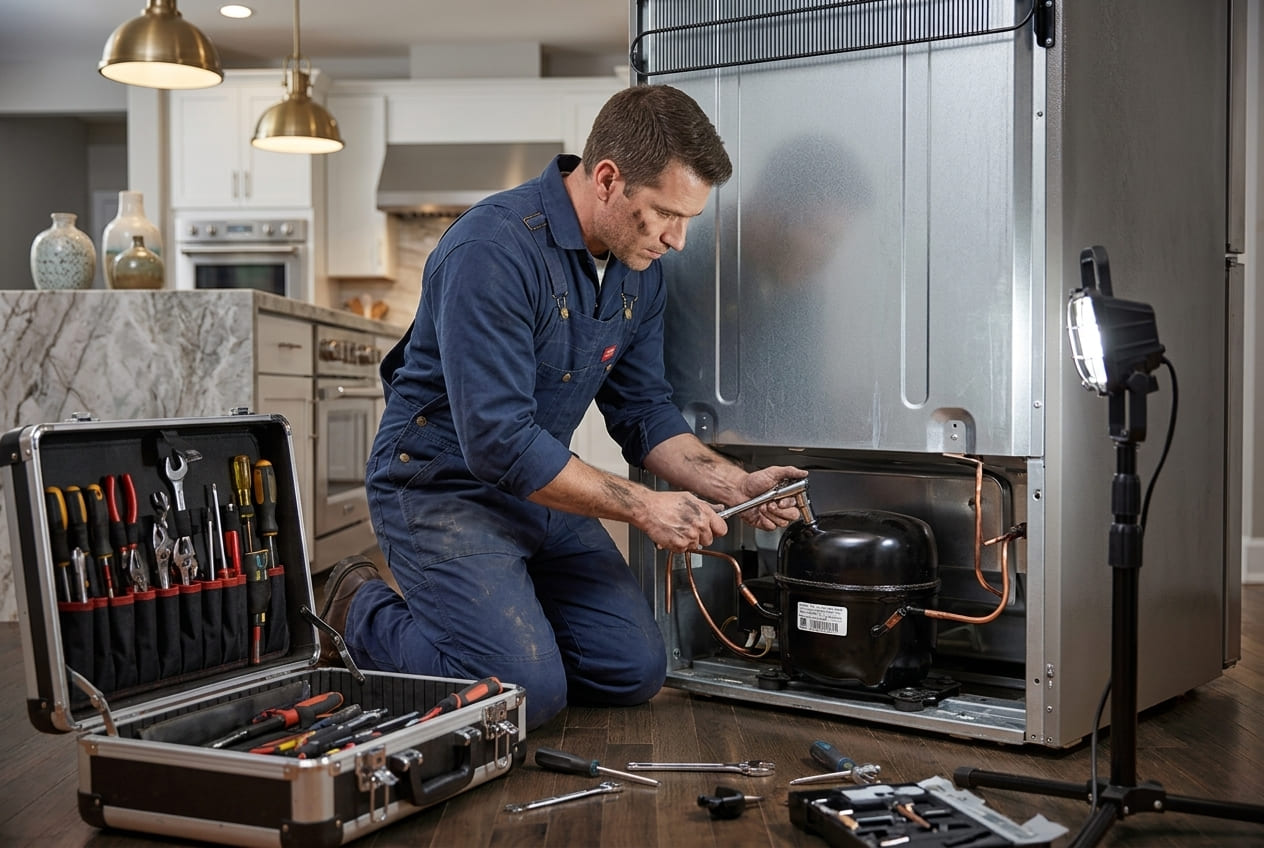
Compressor replacement isn’t just a mechanical job. It requires recovering the existing refrigerant, working within the sealed system, and recharging with the correct refrigerant type and quantity. Under Section 608 of the Clean Air Act, this work can only be performed by technicians who hold EPA certification for refrigerant handling.
This isn’t a formality. Improper refrigerant handling carries federal fines and poses real environmental and health risks. When evaluating who to call for a compressor repair, confirming that the technician holds the appropriate EPA credentials is a non-negotiable step.
If your Kenmore fridge isn’t cooling but the compressor still runs, the cause might be different — see our article on Kenmore Not Cooling for other diagnostic possibilities.
What to Expect During a Professional Compressor Diagnosis
When one of our technicians arrives for a compressor evaluation, the process follows a specific sequence. Nothing gets replaced until the diagnosis is confirmed — because a compressor isn’t the only thing that can cause a compressor not running.
- Step 1 — Electrical components first.
The start relay, overload protector, and wiring are checked before the compressor itself. A failed relay mimics a dead compressor perfectly — and costs a fraction of the price to fix. - Step 2 — Compressor winding test.
Using a multimeter, the technician tests the resistance across the compressor’s motor windings (start, run, and common terminals). Open windings or a short to ground confirms internal motor failure. - Step 3 — System pressure check.
Manifold gauges are connected to the service ports to read high-side and low-side pressures. A system with no pressure differential — or one that equalizes immediately — points to a failed compressor or a significant refrigerant loss. - Step 4 — Leak inspection.
If refrigerant loss is suspected, an electronic leak detector or UV dye is used to locate the source. This determines whether the repair involves the compressor alone or the broader sealed system.
Typical on-site time: A full compressor replacement, once parts are confirmed and on hand, generally takes 2–4 hours. Complex cases involving tubing repair or system flushing take longer.
Conclusion
Kenmore compressor failure sits at the serious end of the appliance repair spectrum — it’s not a problem that resolves on its own, and it’s not one where waiting improves the outcome. Whether the cause is normal wear, a voltage event, or the well-documented LG linear compressor defect, a compressor not running means the entire refrigeration system is down.
The good news: with the right diagnosis, many of these repairs are entirely viable. A compressor replacement on a refrigerator that’s otherwise sound is a legitimate fix — not a temporary patch. The key is getting an accurate assessment before making any decisions, and making sure the work is done by someone with the experience and proper credentials to handle the sealed refrigerant system correctly.
At Appliance Repair Master, we offer same-day or next-day service across Atlanta and the surrounding GA areas for compressor diagnostics. We’ve worked through enough LG linear compressor cases to know exactly what to look for — and how to give you a straight answer on whether repair or replacement makes more sense for your specific unit.
FAQ
1. What causes evaporator tubing corrosion in Kenmore refrigerators?
In many cases, it’s a downstream consequence of the linear compressor defect. As the compressor loses efficiency, the refrigerant circuit operates under abnormal pressure conditions. Combined with any moisture that enters a compromised system, this accelerates corrosion in the evaporator’s copper tubing — eventually leading to pinhole leaks and refrigerant loss.
2. Will my food stay safe during compressor repair?
Plan for the refrigerator to be out of service for the duration of the repair visit. Move perishables to a cooler with ice beforehand. The FDA recommends discarding refrigerated food that has been above 40°F for more than two hours. Frozen items that still contain ice crystals are generally safe to keep, but evaluate them individually before refreezing.
3. Can power surges cause Kenmore compressor failure?
Yes. A significant voltage spike can damage the compressor’s motor windings or burn out the start relay and overload protector. If your refrigerator stopped working shortly after a storm or a power outage, electrical damage is a real possibility. A technician will check the electrical components first — in some cases, only the start relay needs replacement, not the compressor itself.
4. What is the typical lifespan of a Kenmore refrigerator compressor?
Under normal operating conditions, a compressor should last 10–15 years. The LG linear compressors installed in Kenmore units from 2014–2020 have shown a pattern of failing significantly earlier — often at 3–7 years. This premature failure rate is the basis of the class action litigation and is well outside the expected service life for a component of this type.
5. Is it safe to run my Kenmore fridge with a failing compressor?
Not for long. A compressor that’s cycling on and off repeatedly — clicking, running briefly, shutting down — is under significant electrical and thermal stress with each attempt. Continuing to run it risks burning out the motor windings entirely, which can turn a repairable situation into a full replacement. If you suspect the compressor is failing, turning the unit off and scheduling a diagnostic visit is the safer call.