
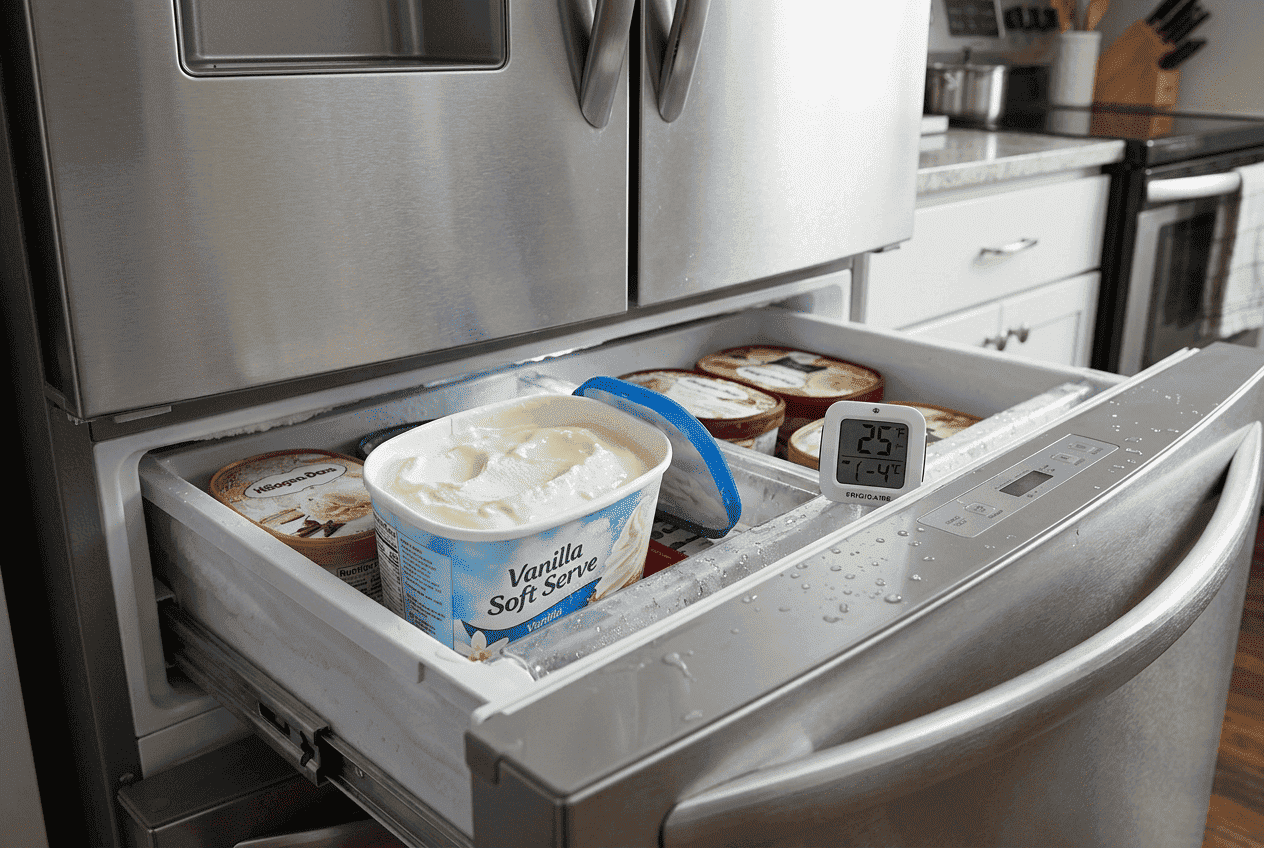
A freezer that isn’t freezing changes the way you use your kitchen immediately.
Same symptom turns up on other brands too – start with our GE refrigerator freezer compartment not freezing properly guide.
You open the door expecting solid frost and firm packaging. Instead, the ice cream is soft around the edges. Ice cubes are clumped together. Frozen vegetables feel flexible instead of rigid. You see that your freezer is running. It sounds normal, yet the results aren’t there.
If you’re dealing with a frigidaire freezer not freezing, the important distinction is this: cooling and freezing are not the same thing.
Your freezer can still feel cold while failing to reach proper freezing temperature. That gap between cold and fully frozen is where most problems begin.
In Frigidaire FGHB and FGSS Series refrigerators, loss of freezing performance usually develops gradually. It starts with reduced efficiency. The freezer compartment hovers above target temperature. Air circulates, but not forcefully enough. Frost may form in the wrong places. Food stays chilled but not preserved.
At this point, the issue is often correctable.
What determines the outcome is how quickly the cause is identified, and whether the system is allowed to continue operating under strain.
Let’s clarify first what proper freezing means before diagnosing what’s wrong.

Cold Isn’t Frozen: What Proper Freezing Requires
A freezer can feel cold to your hand and still be failing.
For food to remain safely frozen, the compartment needs to stay at 0°F (-18°C) or below. At that temperature, water molecules in food remain solid. Texture stays stable. Ice stays separate. Meat holds structure.
Once temperatures rise above that threshold — even slightly — you start to see subtle changes:
- Ice cubes fuse together.
- Ice cream softens.
- Frost melts and refreezes unevenly.
- Packaging develops moisture inside.
These signs don’t mean total breakdown. They mean the freezer is hovering above target.
In FGHB and FGSS Series models, freezing performance depends on three things happening consistently:
- Strong airflow inside the compartment
- Accurate temperature sensing
- Efficient heat removal from the system
If any one of those weakens, the freezer may still run, but it won’t fully freeze. That distinction is critical.
Before assuming major failure, it’s important to confirm whether the issue is temporary instability or sustained temperature drift.
Here’s a practical way to tell.
Quick Stability Check
Before adjusting settings or unplugging the unit, check:
- Is the freezer set to 0°F?
- Has the door been opened frequently in the past 24 hours?
- Was there a recent power interruption?
- Is the freezer overpacked, blocking internal vents?
If the freezer was recently adjusted or power was restored, allow a full 24 hours for stabilization.
If the freezer remains warm beyond that window, the issue is no longer temporary.
That’s when you move from observation to diagnosis.
How Your Freezer is Behaving
When you deal with a frigidaire freezer not freezing issue, the symptoms follow recognizable patterns. The key is identifying whether you’re dealing with mild instability or system-level decline.
For the wider picture on this brand, see our guide to Frigidaire leaking water.
Freezer Diagnostic Reference
What You Notice | What It Indicates | Urgency Level | What To Do Next |
Ice cream soft but freezer still feels cold | Freezer hovering slightly above 0°F | Low–Moderate | Confirm settings, check airflow and loading |
Ice cubes clumped together | Temperature fluctuating above freezing point | Moderate | Inspect door seal and internal vents |
Frost buildup on back interior wall | Airflow restriction or defrost imbalance | Moderate | Check for blocked vents; schedule evaluation if it persists |
Freezer warm but refrigerator normal | Air distribution issue or evaporator fan concern | High | Professional diagnostic check recommended |
Both freezer and fridge warming | System-wide cooling problem | High | Prompt service recommended |
Clicking from rear, no freezing recovery | Possible compressor strain | High | Stop adjusting settings; request professional evaluation |
The urgency level isn’t meant to frighten you. It simply reflects how quickly the issue can escalate if left unaddressed.
Low–moderate issues often relate to airflow or loading.
High urgency symptoms suggest deeper mechanical strain.
If your freezer has remained unstable beyond a full stabilization period, especially in high-urgency categories, delaying evaluation increases the risk of compressor damage.
A precise diagnostic check protects the system and prevents unnecessary part replacement.
FGHB vs. FGSS Series: Why Freezer Problems Show Up Differently
Frigidaire FGHB (French door) and FGSS (side-by-side) models share the same core refrigeration principle, but the freezer layout changes how instability appears.
If you understand the layout, you can interpret symptoms more accurately.
Frigidaire side-by-side freezer section with frost buildup near rear panel
FGHB Series (French Door, Bottom Freezer)
In FGHB models, the freezer is a lower drawer. Cold air is concentrated in a compact space, and circulation happens within a tighter compartment.
When a frigidaire freezer not freezing issue starts in these units, you’ll typically notice:
- Ice cream softening first
- Ice cubes clumping
- Frost forming unevenly along the back panel
- Bottom drawer items thawing before top-layer items
Because the freezer is self-contained in a lower drawer, airflow issues often create uneven freezing zones before full failure occurs.
If the freezer is warm but not fully thawed, this usually points to airflow restriction or sensor imbalance rather than immediate compressor failure.
FGSS Series (Side-by-Side)
In FGSS models, the freezer occupies the entire left vertical section. Air circulation is more vertically distributed.
When freezing performance drops in these units, the symptoms often look slightly different:
- Upper freezer shelves soften first
- Ice maker output declines
- Frost buildup may appear near vents
- Refrigerator side may also show instability shortly after
Because the freezer section is taller and shares airflow dynamics differently, circulation weaknesses can affect multiple vertical zones more quickly.
If the freezer warm condition is accompanied by refrigerator instability, the issue is more likely system-wide.
Quick Comparison
Symptom Pattern | FGHB (Bottom Freezer) | FGSS (Side-by-Side) |
First sign of instability | Soft ice cream or uneven drawer freezing | Upper shelves warming first |
Frost appearance | Back panel frost in drawer | Frost near upper vents |
Airflow sensitivity | Compact, concentrated | Vertical distribution dependent |
Spillover to fridge | Slower | Often sooner |
Understanding these distinctions prevents misinterpretation.
A bottom drawer freezer behaving unevenly is not the same scenario as a vertical side-by-side losing freeze from top to bottom.
The model design influences how a freezer not freezing issue progresses.
When Model Differences Stop Mattering
If both freezer and refrigerator sections are warming together, or if the freezer fails to recover after 24 hours at proper settings, layout is no longer the key factor.
At that point, the issue is likely:
- Sealed-system strain
- Compressor performance decline
- Or a broader cooling disruption
That’s when continued adjustment becomes counterproductive.
The Smart Owner Strategy to Keep Your Freezer Long Working
Freezer performance weakens gradually. Smart owners prevent that drift before it becomes a freezer warm emergency.
Here’s what long-term stability looks like.
Long-Term Freezer Stability Plan
Strategy | What It Involves | Why It Matters |
Preventive maintenance | Regular inspection of seals, vents, and airflow | Stops small imbalances before they affect freezing performance |
Cleaning coils | Removing dust from condenser coils annually | Improves heat release and reduces compressor workload |
Routine service | Scheduled professional system evaluation | Identifies early fan, sensor, or defrost irregularities |
Diagnostic check | Component-level testing of airflow, sensors, and system pressure | Confirms freezing efficiency before failure develops |
Filter replacement | Replacing water/air filters on schedule | Reduces excess moisture and supports internal stability |
Performance optimization | Fine-tuning airflow, control calibration, and system balance | Maintains consistent 0°F freezing without overworking components |
This approach shifts freezer care from reactive repair to structured reliability.
A freezer that consistently reaches and maintains 0°F operates within design parameters.
Final Thought
If your Frigidaire freezer is not freezing properly, the issue is mechanical, not mysterious.
Freezers lose performance for specific reasons: airflow restriction, control imbalance, frost interference, or system strain. Identifying the cause early keeps the repair focused and prevents unnecessary part replacement.
Most freezer warm conditions begin gradually. Addressing them at that stage protects the compressor and preserves long-term performance.
A freezer is designed to maintain 0°F consistently. If it cannot hold that temperature, it requires evaluation — not repeated adjustments.
Structured maintenance and accurate diagnosis restore freezing stability without guesswork.
Related guides
FAQ
1. Why is my Frigidaire freezer not freezing but still running?
If your freezer is running but not freezing properly, the issue is usually related to airflow restriction, evaporator fan performance, thermostat malfunction, or a temperature sensor imbalance. The compressor may still operate, but the freezer may not be reaching 0°F consistently.
2. What should the freezer temperature be for proper freezing?
For proper freezing, the freezer should maintain 0°F (-18°C). Temperatures above that level can cause ice to soften, food texture to change, and long-term preservation to decline. If the freezer warm condition persists beyond 24 hours at the correct setting, further evaluation is necessary.
3. Can dirty coils cause a freezer not freezing problem?
Yes. Dirty condenser coils reduce the system’s ability to release heat efficiently. When heat is not removed properly, freezing capacity declines and the compressor runs longer cycles. Regular cleaning of coils is part of preventive maintenance and supports stable freezing performance.
4. When is a professional diagnostic check necessary?
A diagnostic check is recommended if:
The freezer remains unstable after confirming settings
Frost buildup continues to return
Both freezer and refrigerator sections begin warming
You suspect compressor strain or a refrigerant leak
Accurate diagnosis prevents unnecessary part replacement and protects the sealed system from further damage.