
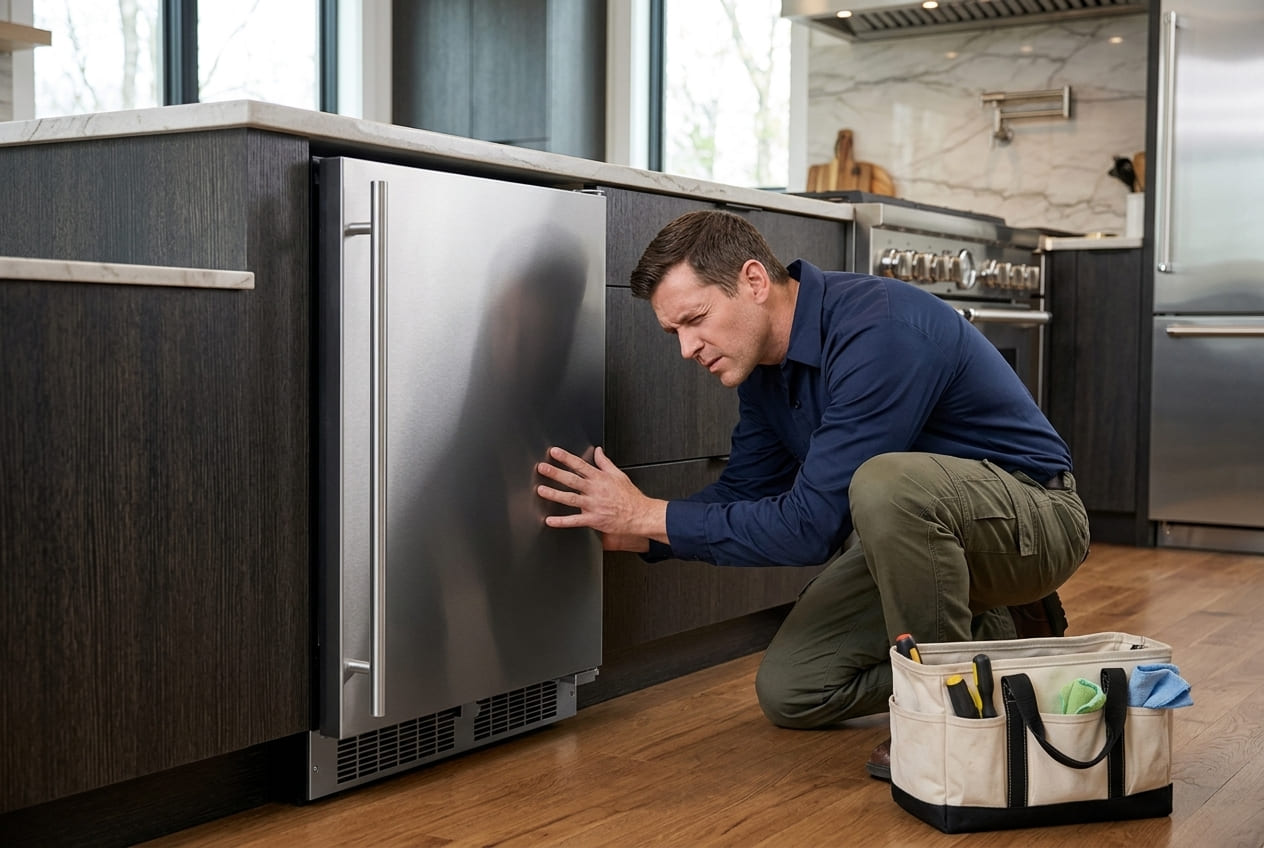
A Marvel freezer that starts making noise is doing exactly what it’s designed to do: it’s giving you a signal. Every abnormal sound from a Marvel freezer making loud noise corresponds to a specific component under stress. Identify the sound correctly, and you’ve already done the hardest part of the diagnosis. A scraping noise points in one direction; a grinding knock points in another; a bottom rattle points somewhere else entirely.
Same symptom turns up on other brands too – start with our step-by-step on LG making noise.
That matters because the urgency varies enormously. A loose drain pan rattling at compressor speed is a five-minute fix. A compressor producing a hard grinding knock is a situation where continued operation risks turning a repairable failure into a full compressor seizure. Treating both with the same level of urgency is a mistake — in opposite directions.
One thing worth knowing about Marvel undercounter freezers before getting into individual sounds: these units are compact by design. The evaporator, condenser, compressor, fans, and drain components are all packed into a tight footprint. That proximity means sounds can be harder to localize than in a full-size refrigerator — a noise generated at the rear of the unit can seem to come from the bottom, and a fan issue can sound superficially similar to a compressor issue. This guide helps you cut through that ambiguity methodically.
The five component sources covered here are the evaporator fan, the condenser fan, the compressor, the defrost timer, and the drain pan. Start with the table below.
Marvel Freezer Noise Identification Guide: What Kind of Sound Is It?
This table is the fastest way to narrow down the source. Find your sound type in the first column, then go directly to the relevant section.
Sound Type | Likely Source | Urgency |
Buzzing or humming while unit is running | Compressor start relay, condenser fan motor, or low refrigerant | Moderate |
Grinding or hard knocking | Compressor failing internally | High — stop operating |
Scraping or ticking when door is closed | Ice buildup on evaporator fan blades | Moderate |
Squealing or high-pitched whine | Evaporator or condenser fan motor bearing failure | High |
Rattling or vibrating from the bottom | Loose or unseated drain pan | Low |
Clicking every few minutes, unit not running properly | Start relay failing — compressor can’t start | Moderate-High |
Soft ticking during a specific cycle | Defrost timer — often normal | Low |
Use this table as your starting point. The sections below provide the full diagnostic detail for each source.
Evaporator Fan Noise — Ice Buildup and Motor Failure
Scraping, Whirring, or Clicking When the Door Is Closed: Check the Evaporator Fan First
The evaporator fan circulates cold air through the freezer compartment. It runs continuously during normal operation — but on most Marvel undercounter models, it stops when the door is opened. That behavior is your single most useful diagnostic tool for this component.
If the noise stops when you open the door, the evaporator fan is almost certainly the source. That one test eliminates all other components in one step. Apply it before anything else.
Cause 1: Ice Buildup on the Fan Blades
Ice accumulating on or around the evaporator fan blades is the most common source of scraping, ticking, or periodic knocking that stops at door opening. As the blades rotate, they strike the ice around them, producing a rhythmic scraping or ticking sound that can be quite loud despite coming from a small component.
How ice gets there in the first place is the more important question. Some frost on the evaporator is normal — it’s defrosted on a scheduled cycle. But if the defrost system isn’t completing its cycle correctly (a failing defrost heater, defrost thermostat, or defrost timer), frost accumulates beyond what the next cycle can clear. That progressive buildup eventually reaches the fan blades.
A manual defrost — unplugging the unit and allowing it to thaw for 24–48 hours with the door open — will clear the ice and stop the scraping. However, this is a temporary fix if the defrost system itself has a fault. If the ice returns within days or weeks, the underlying defrost system issue needs professional attention. Don’t repeat manual defrosts indefinitely — each cycle of re-icing compounds the problem.
If you’re also noticing that the unit is running warmer than its set temperature alongside the fan scraping, the ice buildup may be significant enough to be restricting airflow across the evaporator. See our Marvel freezer temperature guide for the full diagnostic on temperature-related complaints.
Cause 2: Evaporator Fan Motor Bearing Failure
A fan motor with worn bearings produces a distinctly different sound from ice-blade contact: a grinding or high-pitched squealing that gets progressively worse over days or weeks. Ice scraping tends to be rhythmic and tied to blade rotation speed. Bearing failure sounds more like a persistent mechanical whine or a grinding that is continuous rather than rhythmic.
Bearing wear is age- and use-related. It’s not something an owner can correct by defrosting or cleaning. The motor needs replacement. Accessing the evaporator fan on Marvel undercounter models requires panel removal, and replacing the motor requires matching the correct component to the specific model. This is a professional repair — not because the replacement itself is highly complex, but because accessing the component without knowing the correct panel removal sequence for your model risks cracking the interior liner.
Condenser Fan Noise — Dirty Coils and Bearing Problems
Noise From the Back of the Unit: The Condenser Fan and Coil Area
The condenser fan is located at the rear of the unit, near the compressor. Its job is to pull ambient air across the condenser coils, allowing the hot refrigerant to shed heat before it cycles back through the system. When the condenser fan is the noise source, the sound is loudest from the rear of the unit — a useful localization clue.
Quick diagnostic: pull the unit slightly away from the wall and listen. If the noise is clearly louder from the rear, you’re looking at the condenser area, not the evaporator or compressor. This localization step saves time.
Cause 1: Debris Buildup on the Fan Blades or Motor
Dust, lint, and debris pulled in from behind the unit can coat the condenser fan blades over time. Even a light coating creates an imbalance, causing the blades to spin unevenly and generating a buzzing or vibrating sound. If debris accumulates heavily enough, it can also reach the motor shaft and create grinding.
The fix — cleaning the condenser fan and coil area — is owner-accessible on most Marvel models once the unit is pulled out from the wall. A soft brush or condenser coil brush clears the blade surfaces and the coil fins. This is also the correct time to address a cL (condenser cleaning) maintenance code if one has been showing on the display. Dirty condenser coils and a noisy condenser fan are the same root cause — dust load on the condenser system. For the full CL code reset procedure, see our Marvel freezer error codes guide.
For the wider picture on this brand, see more on Marvel ice maker not working.
One important follow-up: after cleaning, confirm the unit has adequate clearance at the rear. Marvel specifies a minimum of 3–6 inches of clearance for freestanding undercounter installations. A unit pushed against the wall restricts airflow, the condenser overworks, and the fan accumulates debris faster. Proper clearance reduces both heat and noise.
Cause 2: Condenser Fan Motor Bearing Failure
The same bearing failure mechanism that affects the evaporator fan can affect the condenser fan — a grinding or squealing that worsens progressively. If debris cleaning doesn’t resolve the rear-located noise, the fan motor itself is the next suspect. Motor replacement requires rear access and correct component matching for the model. Call a technician.
Compressor Noise — Buzzing, Knocking, and When It's Serious
The Loudest Concern: What Compressor Noises Mean for Your Marvel
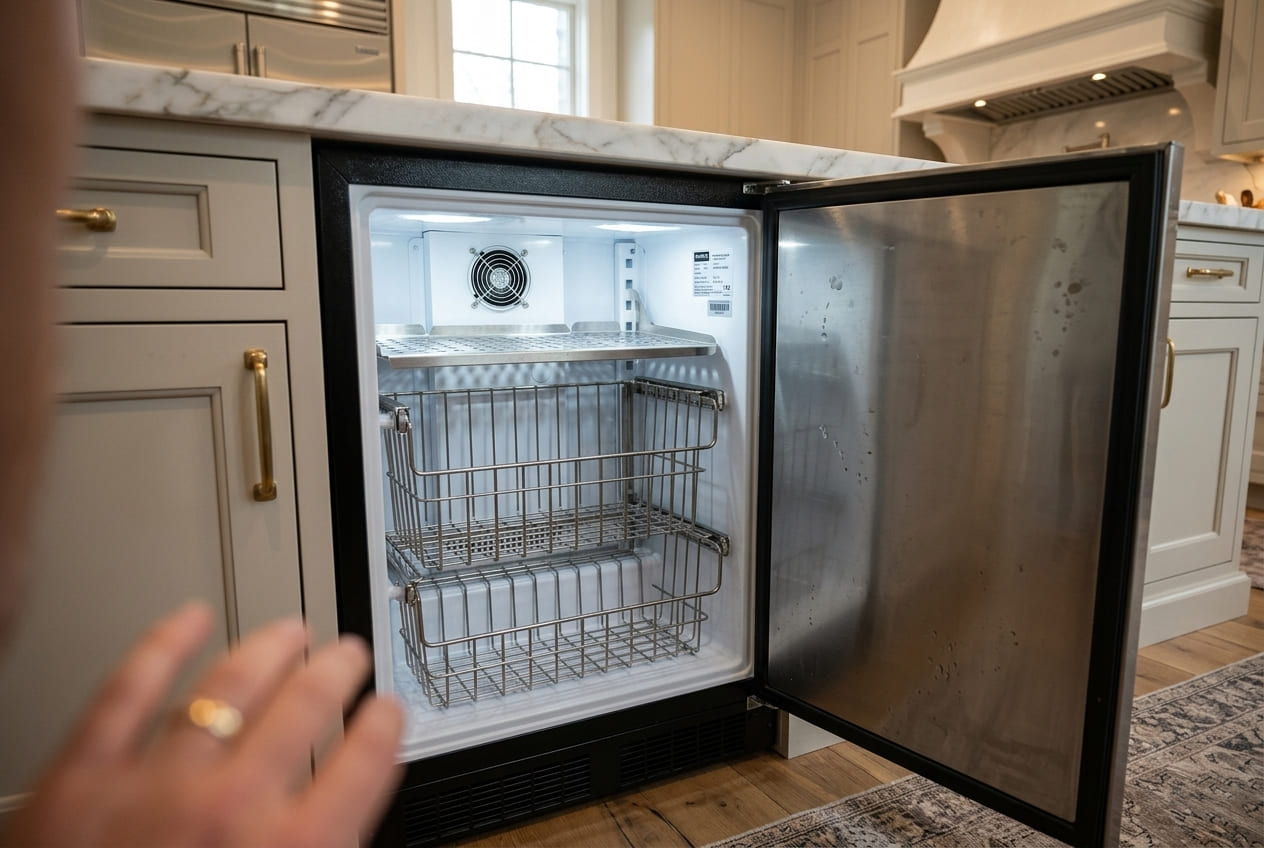
This is the section that matters most if your Marvel freezer making loud noise symptoms point to the rear-lower area of the unit and none of the fan checks explain it. The compressor is the heart of the refrigeration system, and what it sounds like tells you a great deal about what’s happening inside.
Start with the baseline: a healthy compressor produces a low, steady hum. It’s consistent in pitch and volume, and it runs in cycles — on for a period, off for a period. If you’ve owned the unit for a while, you know what its normal running sound is. What you’re listening for is deviation from that baseline.
Normal Compressor Hum vs. Abnormal Compressor Noise
A low, quiet hum that has been consistent since you’ve owned the unit is not a problem. A hum that has suddenly become noticeably louder — or that is accompanied by vibration you didn’t feel before — is a problem worth investigating.
Loud buzzing from the compressor area has several potential causes, ranging from minor to serious:
- Start relay failure — the start relay is a small component that sits on the side of the compressor and provides the initial electrical jolt needed to start the motor. When it’s failing, it can produce a buzzing sound as it struggles to deliver the correct starting current. It can also cause the compressor to attempt a start, click loudly, and then go quiet — the pattern described under “clicking” in the sound table above.
- Low refrigerant charge — when the refrigerant level is below spec, the compressor runs harder and longer for less cooling result. The increased workload can produce a louder-than-normal running sound, and cycle times extend noticeably.
- Compressor overload — if the condenser coils are heavily soiled and the condenser fan isn’t adequately cooling the refrigerant, the compressor operates at elevated temperature and load. The buzzing is the compressor working against thermal stress.
A rapid click-then-silence pattern, repeating every few minutes, is the classic start relay failure signature. The compressor attempts to start, the relay fails to hold, the compressor drops out. This pattern can repeat dozens of times per hour. While the relay itself is a less expensive component, each failed start attempt cycles the compressor through stress it isn’t designed to handle repeatedly. Prompt attention is warranted.
Hard Knocking or Grinding From the Compressor: Stop Operating the Unit
Grinding or hard knocking from the compressor area is a different category entirely. This is not a relay issue or a dirty-coils issue — it indicates the compressor’s internal mechanical components are failing. The pistons, bearings, or valve assemblies inside the sealed compressor body are not functioning correctly.
If you hear grinding or hard knocking from the compressor, stop operating the unit. Continuing to run a compressor producing these sounds accelerates internal damage and dramatically increases the likelihood that what could be a managed repair becomes a full compressor replacement. The difference in cost between those two outcomes is significant.
Call a technician and describe the sound specifically. A grinding knock is not the same as buzzing, and the diagnostic approach — and repair path — is different.
The Start Relay: The One DIY-Accessible Compressor Component
The start relay is a plug-in component that can be removed from the side of the compressor without accessing the sealed refrigerant system. On some Marvel undercounter models, it’s accessible after pulling the unit from the wall and removing the rear access panel. Replacing it requires matching the correct replacement relay for the specific model.
If you’re comfortable with appliance repair, relay replacement is something a confident DIYer can attempt. That said: if replacing the relay doesn’t resolve the noise or the start-failure pattern, stop there and call a technician. Continuing to experiment with a struggling compressor without professional diagnosis risks converting a start relay problem into a compressor replacement. The relay is the one entry point — anything beyond it requires professional tools and EPA-certified refrigerant handling.
Refrigerant diagnosis, recharge, or sealed system repair requires an EPA-certified technician. This is not a DIY category under any circumstances.
Defrost Timer and Drain Pan Rattles
Ticking, Dripping, and Rattling: The Sounds That Are Often Nothing — and Sometimes Everything
Two noise sources in this section are frequently misidentified as something more serious than they are. Understanding what they sound like — and what they mean — can save you an unnecessary service call. Or it can help you recognize when they’re masking something that does need attention.
The Defrost Timer
On older Marvel models with a mechanical defrost timer, a soft ticking or clicking during the defrost cycle is completely normal. The timer advances mechanically to initiate and terminate each defrost cycle. Hearing it occasionally, particularly in a quiet kitchen, is not a fault.
The defrost timer becomes a concern when the ticking is accompanied by evidence that the defrost cycle isn’t completing correctly — specifically, frost accumulating on the evaporator to the point where it reaches the fan blades (that’s the scraping in Section 3), or the unit running warmer than its set temperature because the evaporator is increasingly frost-blocked. A defrost timer that advances but doesn’t switch the heater on, or one that stays in the defrost mode too long, needs professional diagnosis.
The Drain Pan
The drain pan is a shallow tray at the base of the unit that catches defrost water. It has no moving parts of its own — but because it sits directly above (or adjacent to) the compressor, compressor vibration can transfer into the pan. If the pan has shifted forward, isn’t fully seated in its mounting position, or has accumulated debris that rattles at compressor frequency, the result is a bottom-located rattle that sounds more serious than it is.
The check is simple: access the drain pan (typically by removing the front kick plate or grille), confirm it is properly seated and pushed fully into position, and check for any debris inside it. Re-seating a shifted pan usually resolves the rattle immediately.
If the rattle continues after re-seating the pan — or if the drain pan is fully secured and the bottom rattle persists — the compressor itself may be the source, causing sympathetic vibration in surrounding sheet metal or the pan mount. In that case, the noise is a compressor issue in disguise.
Is the Noise Getting Worse? A Diagnostic Timeline
When to Act: How to Tell If Your Marvel Noise Is Escalating
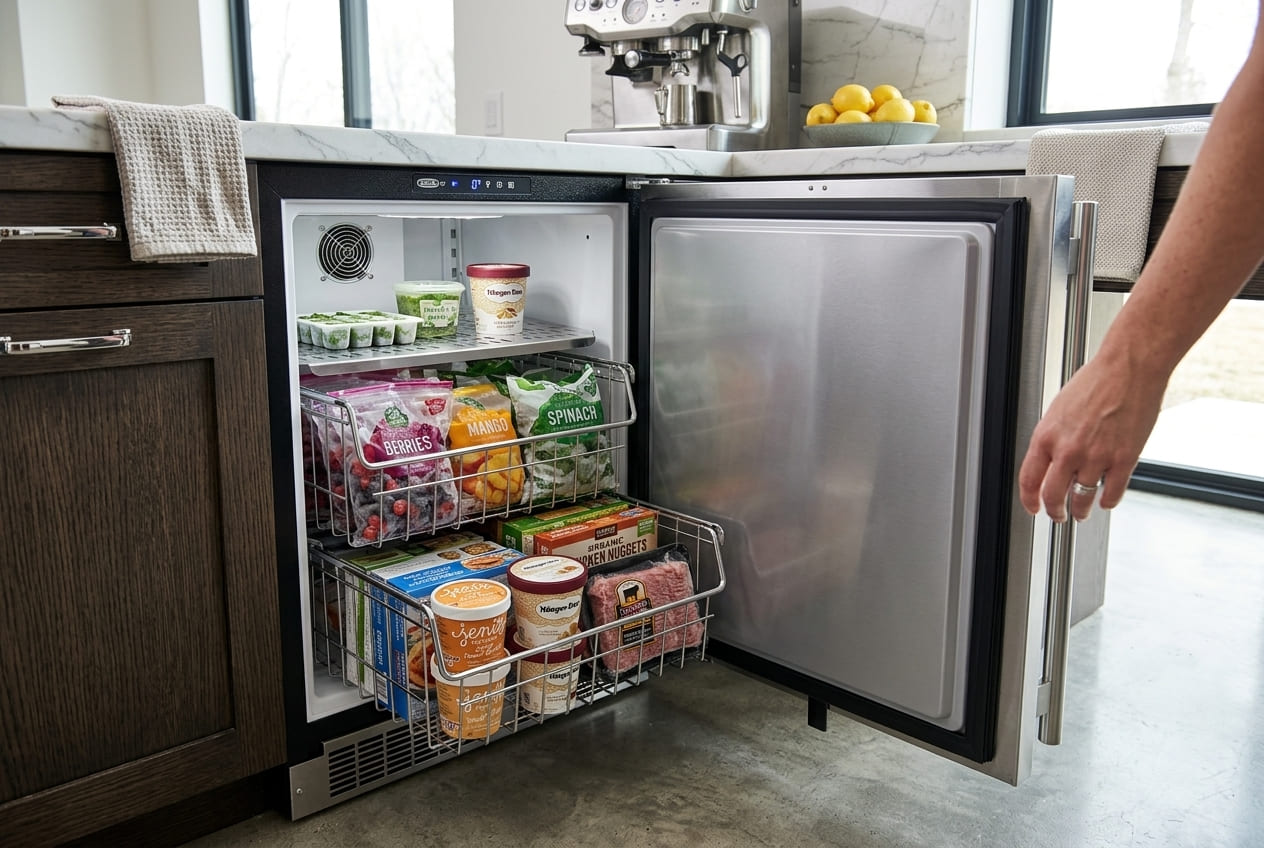
Not all noise requires the same response. A noise that has been present at the same level since you first noticed it is a different situation from one that is getting louder, changing in character, or now appearing alongside a temperature problem. The distinction is the difference between a minor maintenance item and a developing mechanical failure.
Use these three categories to assess your situation:
Category A — Constant, unchanged noise, present for weeks or months without worsening:
Low urgency. This category includes drain pan rattles that have been present since installation, normal compressor hum that’s simply louder than expected, and the defrost timer ticking that some owners only notice in a quiet room. These deserve investigation to confirm the source, but they don’t require emergency action. Schedule a technician check at your convenience.
Category B — Noise only during specific cycles (startup, door opening or closing, end of a cycle) and consistent in character:
Moderate urgency. This category includes start relay clicking (attempts to start that fail and retry), scraping that only occurs with the door closed (evaporator fan/ice), and vibration during startup that settles once the compressor reaches running speed. These indicate a component that is working imperfectly but hasn’t failed completely. Address within days, not weeks — these noises tend to escalate rather than resolve on their own.
Category C — Noise that is getting louder, more frequent, or is now accompanied by a temperature problem (Hi alarm, contents not staying frozen):
High urgency. Act now. A sound that is worsening is a component that is worsening. A noise combined with a temperature problem means the component driving the noise is also affecting the refrigeration system’s ability to maintain temperature. If the Hi alarm is showing alongside an unusual compressor or fan sound, these two symptoms are almost certainly connected — see our Marvel freezer temperature guide for the diagnostic that pairs with this article.
The practical rule: noise plus temperature problem equals urgent. Don’t wait to see if it resolves on its own.
DIY Noise Fixes vs. Professional Repairs
What a Homeowner Can Safely Address — and What Requires a Technician
The table below summarizes owner actions versus professional repairs for each noise source. The column headings say what they mean — use this as a quick-reference guide before deciding whether to call.
Noise / Source | Owner Action | Requires Professional? |
Drain pan rattle | Re-seat pan, clear debris inside pan | No — if re-seating resolves it |
Condenser fan buzzing from debris buildup | Pull unit from wall, clean condenser fan blades and coil area, check rear clearance | Generally no — if accessible without disassembly |
Start relay clicking (compressor not starting) | Replace relay on accessible models — experienced DIYers only. If it doesn’t resolve, stop and call. | Yes, if relay replacement doesn’t help |
Evaporator fan scraping from ice buildup | Manual defrost (unplug 24–48 hrs) for temporary relief; monitor next few cycles | Yes, if scraping returns after defrost — defrost system fault |
Evaporator or condenser fan motor bearing (squealing/grinding) | None — do not attempt disassembly | Yes — motor replacement requires panel access and correct parts |
Compressor grinding or hard knocking | Stop operating the unit immediately. Do not run further. | Yes — emergency. Call now. |
Soft defrost timer ticking (consistent, unchanged) | No action needed — normal on mechanical timer models | Only if accompanied by frost accumulation or temperature problems |
The practical summary: drain pan re-seating and condenser fan cleaning are legitimate owner tasks. Start relay replacement is within reach for confident DIYers on accessible models — with the clear caveat that it’s a one-attempt fix, not a diagnostic process. Everything else — fan motor replacement, compressor diagnosis, refrigerant work — is professional territory.
Conclusion
The central principle of this guide is worth restating simply: the sound type tells you the component. A Marvel freezer making loud noise isn’t just being noisy — it’s communicating a specific failure mode through the character of the sound it’s making.
Consult the noise table in this article when you first notice a problem. Scraping that stops at door opening is almost always the evaporator fan — ice buildup or bearing failure. Rear buzzing that responds to condenser cleaning is a maintenance item. A rapid click-then-silence pattern pointing to the compressor is a start relay issue that needs prompt attention. And a hard grinding knock from the compressor area is a situation where the unit should stop running immediately.
The three-category urgency framework described above gives you the decision tool: unchanged sounds are low urgency; sounds occurring in specific cycles are moderate urgency; sounds that are worsening or that are paired with a Hi alarm or temperature problem are high urgency. Noise left unaddressed consistently escalates — fan bearing wear that starts as a quiet squeal turns into motor failure; compressor knocking that goes ignored turns into compressor seizure. Early action is almost always less expensive than late action.
For Atlanta homeowners with a Marvel freezer that needs hands-on noise diagnosis, Appliance Repair Master is your local specialist — same-day appointments available across the metro area and throughout Georgia.
Related guides
FAQ
1. My Marvel freezer makes a scraping sound that stops when I open the door — what is it?
A scraping noise that stops when the door opens is almost always the evaporator fan — because Marvel units turn the fan off when the door is opened. The scraping indicates that ice has built up on or around the fan blades, causing them to strike ice as they spin. A manual defrost — unplugging the unit for 24–48 hours with the door open — may resolve it temporarily. If the ice returns within a few weeks, the defrost system has a fault and needs professional inspection. Don’t keep repeating manual defrosts as a long-term solution; the underlying defrost cycle issue won’t fix itself.
2. There is a clicking sound from the back of my Marvel unit every few minutes — is this serious?
A periodic click from the back, especially one that repeats every few minutes without the unit actually running properly between clicks, points to the compressor’s start relay failing. The relay is giving the compressor the jolt to start, the compressor attempts to fire up, and then drops out when the relay can’t sustain the signal. This pattern — attempt, click, silence, attempt again — can repeat rapidly. While the relay is a less expensive component, every failed start cycle stresses the compressor. This warrants prompt professional diagnosis, or a DIY relay swap if you’re comfortable with that repair — but only as a first step, not a diagnostic endpoint.
3. My Marvel freezer has started making a rattling noise that seems to come from the bottom of the unit — what should I check?
A bottom rattle is most often the drain pan — a shallow tray that catches defrost water. Over time it can slide forward, become unseated, or accumulate debris that vibrates at compressor speed. The check is simple: remove the front kick plate or grille and confirm the drain pan is fully pushed into its seated position. If the rattle stops after re-seating, you’re done. If the rattle continues with the pan properly secured, the compressor itself may be causing sympathetic vibration in surrounding sheet metal — which is a different problem and warrants a technician’s assessment.
4. My Marvel freezer has started making a loud buzzing noise and the temperature is also reading high — are these connected?
Yes, and this combination is significant. Loud buzzing paired with a Hi temperature alarm usually means the compressor or condenser fan is struggling, and the refrigeration system’s cooling capacity is reduced as a result. The most common explanation is a heavily soiled condenser — dirty coils force both the compressor and the fan to work harder, which produces more noise and less cooling simultaneously. Check whether the CL code is showing or has been dismissed in the past. Condenser cleaning may resolve both symptoms. If it doesn’t, the compressor itself may be struggling under load — have it inspected. Do not continue operating a unit that is simultaneously buzzing loudly and showing temperature alarms.
5. Is it normal for a Marvel undercounter freezer to make some noise, or should it be completely silent?
Marvel undercounters are not silent. Normal operational sounds include a low, steady compressor hum, the soft whir of the evaporator fan while the door is closed, and occasional soft clicks as the defrost timer advances. These sounds are consistent and don’t change over time. The test is change: has a sound appeared that wasn’t there before? Has an existing sound gotten louder or shifted in character? If yes, that’s the signal to investigate. A Marvel that has been quiet for years and has suddenly developed a new sound is telling you something specific. That new sound — whatever it is — corresponds to one of the five sources in this guide.