
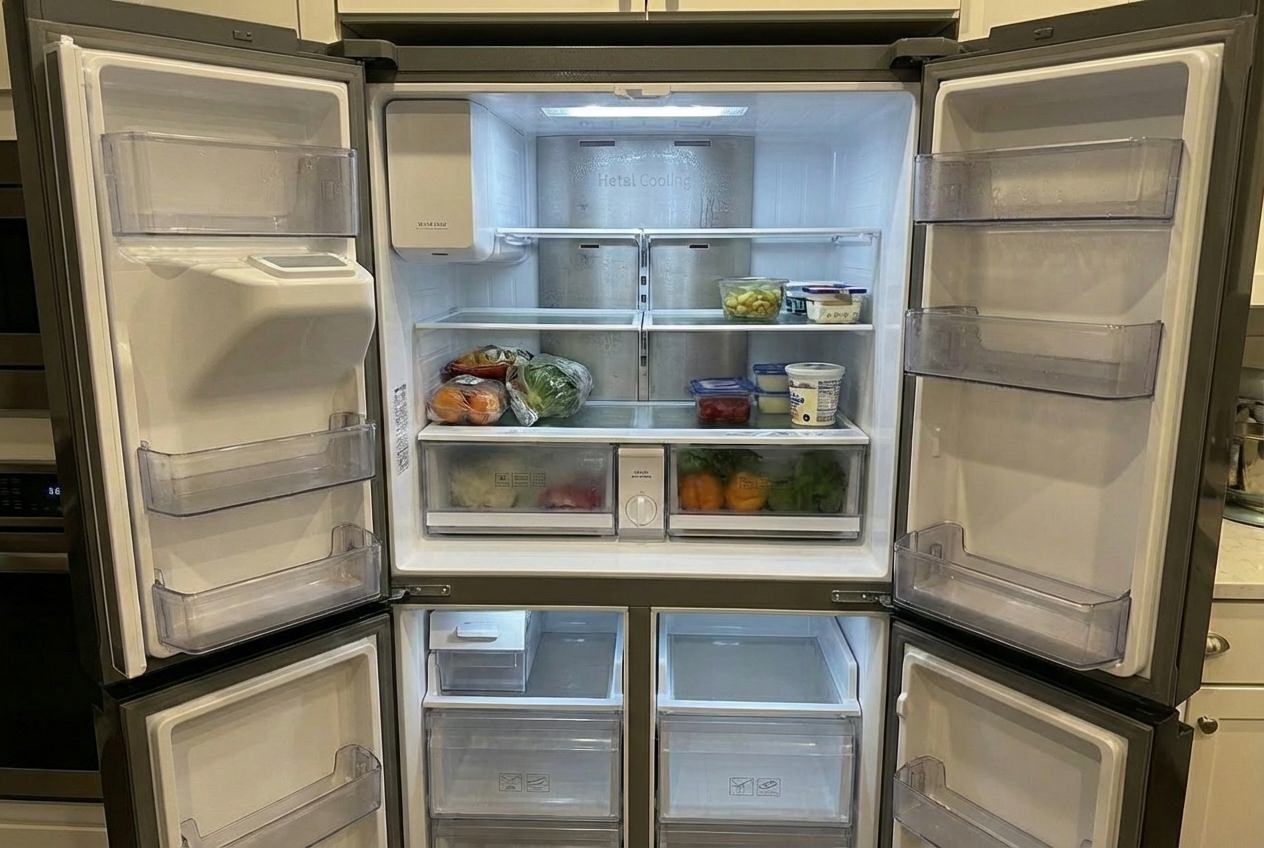
Samsung RF23 Series owners tend to run into the same set of headaches: weak water flow, small or clumped ice, a refrigerator compartment that runs warmer than the setting suggests, frost where it should not be, and sensor behavior that makes the display harder to trust. On this platform, those problems often connect. Ice maker water filter clog can hurt both the dispenser and ice production. A defrost function failure can choke airflow and leave the fresh-food side warm. A temperature sensor calibration complaint often starts when the panel still looks fine but the fo is spoiling.
Same symptom turns up on other brands too – start with the Bosch 800 Series problems troubleshooting guide.
That is the frame for this article. It treats the RF23 by symptom cluster, not by random parts. If you are dealing with fridge too warm RF23R6201SR, trying to make sense of the water inlet valve 20 psi question, or looking at a more serious stop-use complaint such as flaking coating contamination, this is where to start. You will get the checks that are safe to make at home, the signs that point to real Samsung RF23 Series trouble, and the point where samsung rf23 series repair is the smarter move.
Water and Ice usually belong to the same problem
If the dispenser slows down and the ice gets smaller, cloudier, dirtier, or starts clumping, stay on the water side first. Samsung manufacturers say that low water pressure or a faulty filter can reduce ice production. Samsung dispenser guidance says a clogged water filter can reduce water pressure and slow dispensing.
That is why ice maker water filter clog sits high on the RF23 list.
What to check first
- make sure the filter is the correct Samsung type and fully seated
- replace an overdue filter
- flush the line after replacement
- compare dispenser flow before and after
- ask whether the problem started right after a filter swap
What you see | Most likely direction | First move |
Slow water and weak ice together | Filter or supply restriction | Replace or check the filter and flush the line |
Small or cloudy ice | Low pressure or restricted water path | Check flow and supply pressure |
Ice clumps in the bucket | Weak fill, melt-refreeze, or airflow issue | Check water first, then frost or airflow |
Water taste changed too | Filter issue rises fast | Replace filter and flush |
Owners search water inlet valve 20 psi because they are trying to figure out whether the supply is good enough. Let’s set the practical target higher: the ice maker should have at least 30 psi to operate properly, and the dispenser should have around 30 psi to 125 psi. In plain terms, the line can still be too weak for stable RF23 ice performance even if some water is moving.
What not to do
- do not lower the freezer setting to solve weak water delivery
- do not assume the ice maker failed just because output dropped
- do not ignore the water side if the dispenser and ice both got worse together
A quick tip
If weak water and weak ice showed up together, the filter and pressure side deserve your first ten minutes.
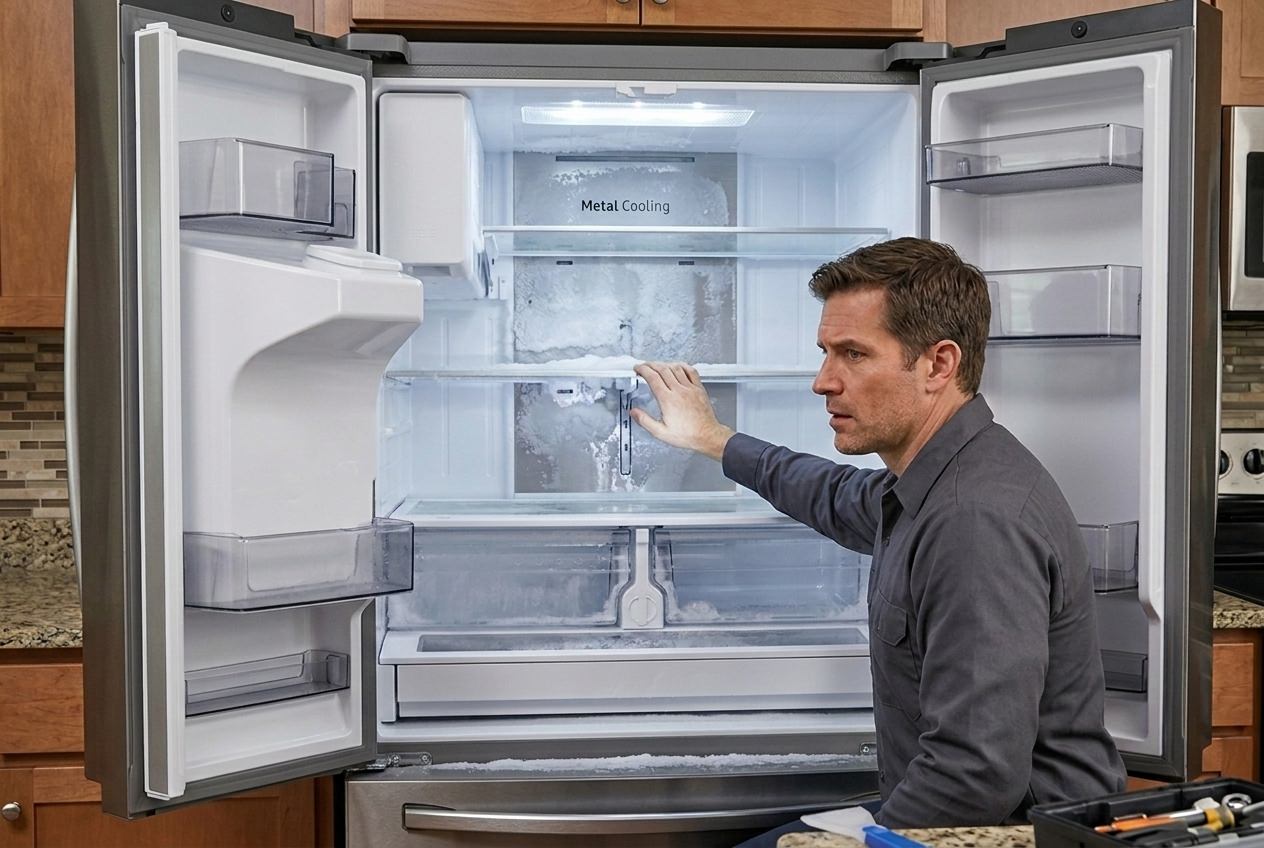
Fridge too warm RF23R6201SR usually points to airflow before it points to a dead system
This complaint shows up exactly the way owners search it: fridge too warm RF23R6201SR. The freezer may still seem acceptable as well as the panel may still look normal. But milk is spoiling and leftovers are no longer keeping their chill. Most cooling concerns can be resolved by checking settings, door seals, proper use, and vent clearance. We have to note that blocked vents can disrupt cooling, and doors that do not close properly will affect cooling and eventually create frost.
What to check first
- food blocking the rear vents
- frost on the back wall or near vents
- a drawer or door not closing fully
- a gasket that is dirty, twisted, or not sealing cleanly
- whether the freezer is still holding better than the fresh-food side
What you notice | What it usually points to | First check |
Fridge warm, freezer mostly okay | Airflow or fan-side issue | Vents, frost, closure |
Fridge warms after heavy door use | Seal or vent problem | Gasket, drawers, food position |
Back wall frosting | Defrost or airflow problem | Frost source and repeat pattern |
Temperatures drift but panel looks normal | Sensor or control-side issue | Real temperatures versus display |
That last pattern is where owners start using the phrase temperature sensor calibration. We don’t want to present it as DIY calibration routine as there are dozens of nuances toward error-code interpretation, blinking-display checks, and service if the refrigerator is reporting sensor or fan-side problems.
Defrost function failure is how a small frost problem turns into a bigger RF23 repair
A thaw can make an RF23 look fixed. That is why this issue wastes so much time. Moisture enters when doors are left open, warm items are placed inside, or compartments do not seal properly. Once that moisture freezes, frost can form in the refrigerator, freezer, or ice bucket. Frost on the back wall or near vents follows the same airflow-and-sealing logic, and its cooling page notes that vents covered in ice or frost need to be cleared because blocked vents disrupt normal cooling.
Signs the problem is moving past a one-time event
- frost comes back in the same area
- the fan gets noisy, then quiet, then noisy again
- a thaw helps for a few days and then the same complaint returns
- the fridge side warms before the freezer fully gives up
- ice quality gets worse at the same time airflow gets worse
We identify 22E and 22C as fridge fan errors and explain that fan errors often mean the electronics are not sensing proper fan rotation when the fan should be running.
What not to do
- do not keep repeating the same unplug-thaw cycle and call it repaired
- do not treat repeat frost as a temperature-setting issue
- do not ignore fan noise when frost is already visible
A quick tip
A thaw clears the symptom. It does not explain the symptom.
Temperature sensor calibration complaints start when the panel stops matching the food
Some RF23 calls are easy to see because of frost, weak water and bad ice production. Others show up as behavior. The panel looks normal but this gives the wrong impression. The refrigerator cools in swings instead of a steady pattern. That is when owners start describing the issue as temperature sensor calibration.
We don’t frame this as a homeowner calibration task. We consider this troubleshooting around actual cooling behavior, error displays, and service when the refrigerator keeps reporting sensor-side trouble. We also esteem refrigerator sensor and fan codes such as 5E for a fridge defrost sensor issue, 22E and 22C for fridge fan error, 39E and 39C for ice-maker function error, and 40E and 40C for ice-room fan error.
What to do before assuming the sensor is bad
- compare food temperature to the display reading
- check for frost or blocked vents first
- check door closure and gasket condition
- photograph any blinking or coded display
- stop resetting the refrigerator just to clear the panel
What not to do
- do not treat every temperature swing as a bad board
- do not chase the sensor first if frost and airflow issues are still unresolved
- do not reset before you record the symptom
A quick tip
If the panel and the food disagree, trust the food first and work backward from the actual compartment behavior.
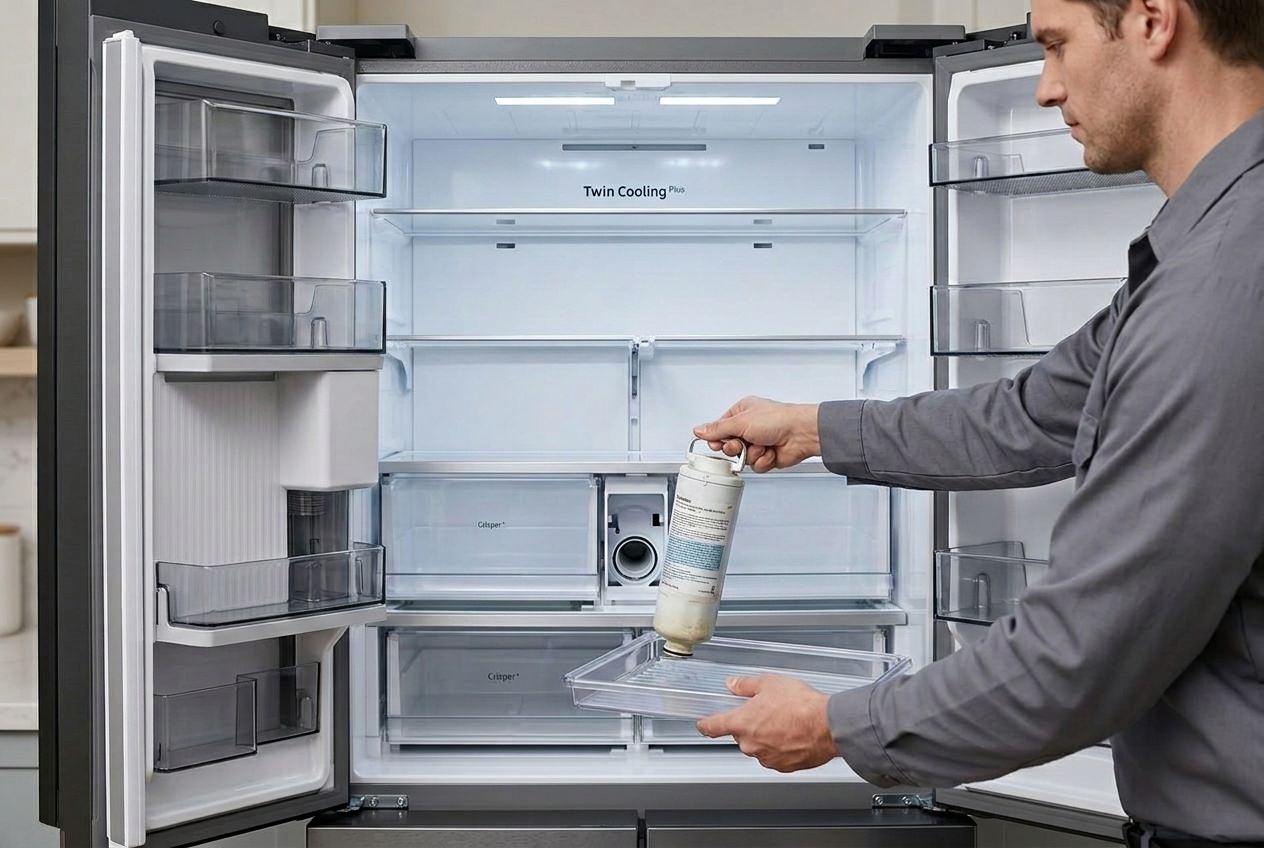
Flaking coating contamination is not a routine maintenance complaint
We are always detailed on filters, ice output, frost, error codes, and cooling behavior. When owners see flakes, film, or deteriorating surface material in an area that touches ice, water, or food, the safe move is not to keep testing the dispenser for a week. The safe move is to stop using the affected feature until the part is inspected.
Treat this as a stop-use condition if you see
- flakes in the ice path
- debris showing up in ice or water where it clearly does not belong
- visible surface breakdown in a food- or ice-contact area
- repeat contamination after cleaning the obvious loose material
A quick tip
This is not where clever DIY helps. Judgement is here to start its job.
What to check before you reset anything
Resets feel productive but it’s also a wrong impression. OF OF and O FF indicate Cooling Off mode and do not require a full reset. More importantly, error-code history and diagnostic information will be lost during a reset, and that this can make technician diagnosis harder. Resetting the ice maker is a last resort after other troubleshooting steps are tried first.
Use this checklist first
- check dispenser flow before blaming the ice maker
- confirm the filter is the correct Samsung type and properly seated
- flush the line after filter replacement
- look for frost around vents, the back wall, or the ice area
- make sure no food is blocking the vents
- check that doors and drawers are closing cleanly
- take a picture of any display code before resetting power
- notice whether the problem is arriving in pairs: warm fridge and bad ice, weak water and weak ice, frost and fan noise
What usually wastes time
- changing temperatures every few hours
- resetting before recording the symptom
- assuming the ice maker is the only problem when water is weak too
- thawing the unit over and over without asking why frost keeps returning
- treating a contamination-style complaint like ordinary maintenance
Home checks make sense for filters, vent clearance, door closure, obvious frost, and simple setup issues. Avoid them when the refrigerator is stacking symptoms, throwing repeat error codes, or showing contamination-style complaints. At Appliance Repair Master, that is where we step in. We keep pricing clear and stable, and we do not turn an RF23 visit into a fishing expedition.
Conclusion
RF23 problems get easier to sort once you stop treating each symptom as a separate event. Water and ice usually belong together. A warm fresh-food section with a mostly normal freezer usually points to airflow before it points to total system failure. Frost that returns after a thaw is not a settings issue. A panel that looks calm while food temperatures drift deserves a closer look, not another reset.
That is the value of this guide. We aimed to give you a cleaner way to decide what belongs in DIY and what belongs in professional Samsung RF23 Series repair. When the symptom cluster is already clear, the repair path gets shorter and cheaper.
If the fix above does not hold, appliance repair across Metro Atlanta can take it from here.
Related guides
FAQ
1. What are the most common Samsung RF23 Series problems?
The recurring ones are weak water flow, weak or clumped ice, fresh-food temperature drift, frost-related airflow trouble, and sensor or fan-side error conditions. Everything keeps circling around the same areas: water, filter, ice maker, cooling, frost, doors, and service when the basics do not solve it.
2. Why is my fridge too warm RF23R6201SR if the freezer still seems fine?
That usually points toward airflow, frost, sealing, or fan-side trouble before it points to a full sealed-system failure. On RF23 models, the fresh-food side often loses proper airflow before the freezer side fully gives up.
3. Can an ice maker water filter clog really cause bigger RF23 problems?
Yes. Low pressure and dirty or faulty filters can reduce ice output and cause small, cloudy, dirty, or clumped ice, while dispenser performance can also drop at the same time.
4. What does water inlet valve 20 psi mean on an RF23?
It is a phrase owners use when they are trying to figure out whether the water side has enough pressure to work properly. The ice maker should have at least 30 psi, so a line can still be too weak for reliable RF23 performance even if water is moving.
5. Is defrost function failure a real RF23 issue?
Yes. When frost builds where air has to move, the RF23 can run warm on the fridge side, make poor ice, or develop fan-related symptoms.