
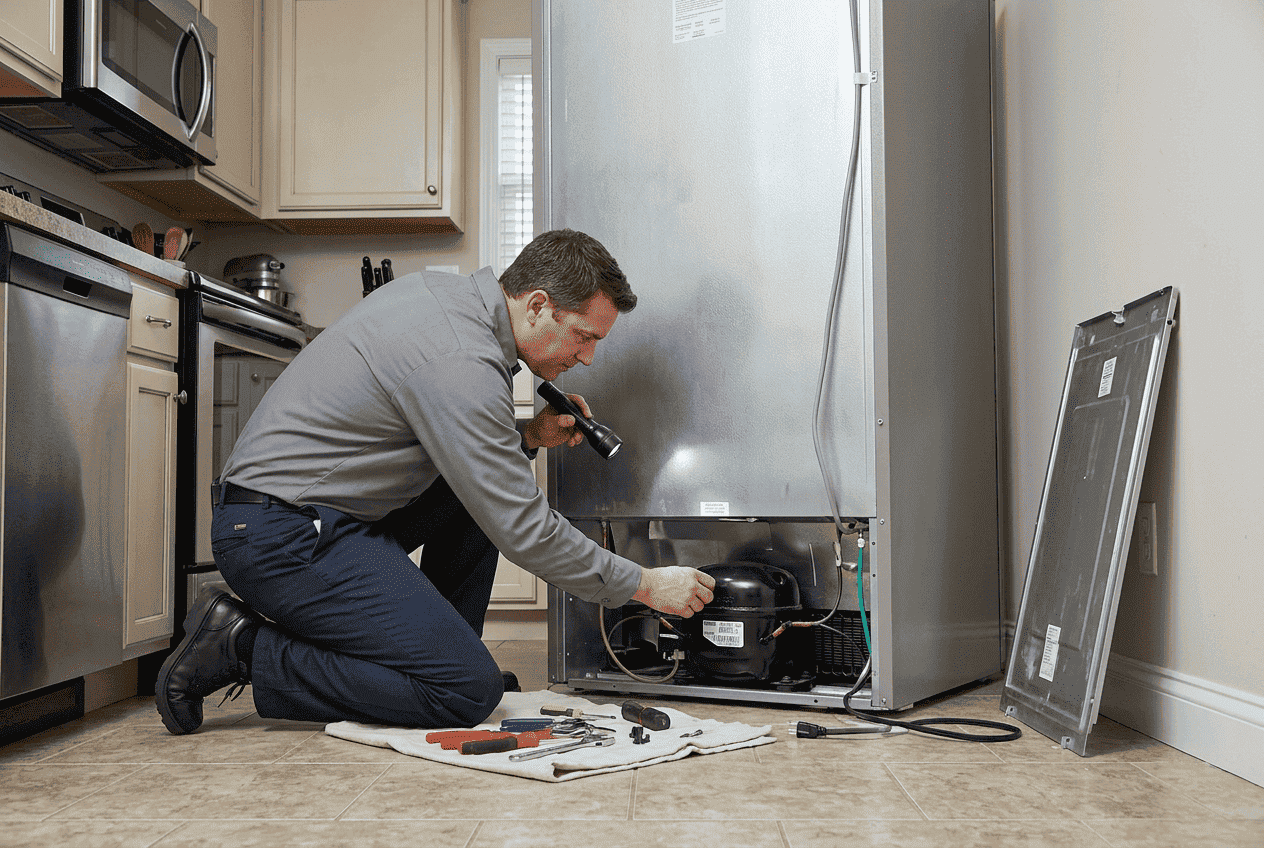
When a Frigidaire refrigerator starts making loud noise, something inside the machine has changed. Refrigerators are mechanical systems built around rotation, compression, and airflow. When those motions are smooth, the sound is low and steady. When they shift, the sound changes.
Same symptom turns up on other brands too – start with read our breakdown of LG making noise.
In our Atlanta service calls involving FGHS2631PF, FFHS2622MS, FRFS2823AS, FGHB2868TF, and models across the Gallery series and Professional series, noise complaints are common. Most of the time, the unit is still cooling. The problem is sound. That is important, because sound often appears before temperature performance declines.
If your refrigerator is making loud noise, the cause usually falls into one of five categories:
- evaporator fan motor noise
- ice buildup on fan blades
- ice maker buzzing
- condenser fan grinding
- compressor noise
Understanding which one is responsible determines whether the issue is minor, moderate, or potentially serious.
Our article explains how each sound develops, how to isolate it properly, what risk level it carries, and how it relates to compressor humming and sealed system health.
How a Refrigerator Produces Sound
Every refrigerator produces operational sound. That is normal. The difference between normal sound and developing failure is consistency.
A healthy refrigerator produces:
- Steady compressor humming
- Soft airflow from internal fans
- Brief ice production sounds
- Light clicking during relay engagement
When the unit is making loud noise, the sound is no longer consistent. It becomes sharper, more mechanical, or more noticeable under load.
The components capable of producing that change are limited:
- Evaporator fan
- Condenser fan
- Compressor
- Ice maker module
Each one produces a distinct acoustic pattern.
Isolate the Location Before Anything Else
The fastest way to narrow the cause is to determine where the sound originates.
Sound from inside the freezer compartment
Most often evaporator fan motor noise or ice buildup on fan blades.
Sound from beneath the refrigerator
Likely condenser fan grinding or compressor humming.
Sound during ice production only
Ice maker buzzing.
Deep vibration felt through the floor
Usually compressor noise.
Location eliminates unnecessary part replacement.

The Evaporator Fan: Circulation and Pitch Change
The evaporator fan circulates air across the evaporator coil and pushes cold air through both compartments. It runs frequently during cooling cycles.
When healthy, it produces a soft airflow tone.
Evaporator fan motor noise develops when internal bearings begin to wear. The shaft may wobble slightly. The pitch changes.
Common sound characteristics:
- High-pitched whirring
- Gradual increase in volume
- Slight chirping during startup
- Sound stops when freezer door opens
In FGHS2631PF and FFHS2622MS units, evaporator fan motor noise often appears gradually. Homeowners describe it as “getting louder over time.”
If ignored, reduced fan efficiency can later create airflow imbalance.

Ice Buildup on Fan Blades: Repetitive Impact Sound
Ice buildup on fan blades produces a distinct rhythmic tapping.
Each blade rotation strikes frost. The interval between sounds matches blade speed. It is mechanical contact, not motor strain.
Causes typically include:
- Minor air infiltration
- Humidity entering through gasket gaps
- Defrost timing imbalance
In FRFS2823AS and FGHB2868TF models, frost accumulation near the fan housing can escalate quickly when airflow slows.
Clearing ice resolves the sound temporarily. If moisture imbalance remains, it returns.
For the wider picture on this brand, see the Frigidaire leaking water troubleshooting guide.
This is one of the most frequently misdiagnosed noise complaints.

Ice Maker Buzzing: Electrical Cycle Resistance
Ice maker buzzing is different from fan noise. It has a sharper electrical tone.
A short buzz during water fill is normal.
Prolonged or repeated ice maker buzzing may indicate:
- Fill valve energized without water flow
- Internal gear resistance
- Motor strain within the module
In Gallery series and Professional series models, heavy ice production increases mechanical load, making minor irregularities more audible.
Persistent ice maker buzzing does not usually threaten the sealed system, but it should not be ignored.
Condenser Fan Grinding: Heat Removal Failure
The condenser fan sits near the compressor and removes heat from the sealed system.
When condenser fan grinding occurs, airflow across condenser coils is restricted.
Sound characteristics:
- Metallic scraping
- Rough vibration
- Rattling from beneath the unit
In FFHS2622MS models, accumulated dust under the cabinet often contributes to this problem.
Reduced airflow increases compressor operating temperature. Elevated heat accelerates internal wear.
This is where a small fan issue can contribute to a larger compressor problem if ignored.
Compressor Humming vs Compressor Noise
Compressor humming is normal. It should be steady and low.
Compressor noise is not.
When compressor humming becomes louder, irregular, or includes knocking, the mechanical tolerances inside the compressor may be changing.
Signs of developing compressor noise:
- Harder startup clicks
- Repeated relay engagement
- Deep vibration
- Knocking under load
Unlike fan noise, compressor noise does not stop when doors open.
Professional series units often have more powerful compressors, so humming may be stronger, but it should remain consistent.
Irregular compressor noise combined with longer cooling cycles increases concern.
The Sealed System: Why Noise Matters
The sealed system includes:
- Compressor
- Evaporator coil
- Condenser coil
- Refrigerant tubing
The compressor compresses refrigerant and circulates it. If internal components wear, compression becomes uneven.
Uneven compression changes sound patterns.
Early sealed system stress may present as:
- Slightly louder compressor humming
- Increased vibration
- Extended run cycles
Advanced stress produces:
- Knocking
- Metallic tapping
- Inconsistent pressure cycling
Noise combined with temperature fluctuation signals risk.
Progressive Noise Development Timeline
Noise often evolves through stages:
Stage 1
Subtle pitch change. Cooling unaffected.
Stage 2
Noticeable volume increase. Slight vibration.
Stage 3
Mechanical irregularity. Longer cycles.
Stage 4
Cooling instability. Hard starts.
Fan issues rarely escalate this way. Compressor issues do.
Troubleshooting Decision Guide
Does the sound stop when the freezer door opens?
Yes → evaporator fan or ice buildup on fan blades
No → continue
Is the sound clearly from beneath the unit?
Yes → condenser fan grinding or compressor humming
No → continue
Does it occur only during ice production?
Yes → ice maker buzzing
No → continue
Is it deep and vibrational?
Yes → compressor noise
Risk-Level Assessment
Component | Immediate Risk | Long-Term Risk | Repair Complexity |
Evaporator fan | Low | Moderate | Moderate |
Ice buildup on fan blades | Moderate | Moderate | Moderate |
Ice maker assembly | Low | Low | Moderate |
Condenser fan | Moderate | High | Moderate |
Compressor | High | Very High | Major |
Sealed system | Very High | Failure risk | Major |
Noise and Cooling Correlation
Noise Present | Cooling Stable | Cooling Declining |
Evaporator fan motor noise | Yes | Rare |
Condenser fan grinding | Yes | Possible |
Compressor humming | Yes | Monitor |
Compressor noise | Sometimes | Often |
Cooling changes alongside compressor noise require urgent evaluation.
Structural Amplification and Cabinet Resonance
Hard floors amplify vibration. Improper leveling transfers vibration through framing.
Check:
- Leveling feet
- Rear access panel
- Drain pan stability
- Compressor mounts
Sometimes correcting alignment significantly reduces perceived loudness.
When Immediate Service Is Recommended
Schedule service if:
- Compressor noise increases weekly
- Knocking accompanies startup
- Cooling performance changes
- Vibration becomes structural
- Unit struggles to engage
Sound escalation is mechanical warning.
The Final Thoughts
When a Frigidaire refrigerator is making loud noise, the sound is mechanical feedback.
Evaporator fan motor noise, ice buildup on fan blades, ice maker buzzing, condenser fan grinding, compressor humming, and deeper compressor noise each indicate different system behavior.
Fan issues are typically manageable. Compressor noise and sealed system stress carry higher long-term risk.
Identifying the source early protects the appliance and prevents avoidable major repair.
Sound always changes for a reason.
Related guides
FAQ
1. Why is my Frigidaire making loud noise suddenly?
Most sudden noise involves evaporator fan motor noise, ice buildup on fan blades, or condenser fan grinding.
2. Is compressor humming normal?
Yes. Steady compressor humming is normal. Irregular compressor noise is not.
3. Can ice buildup on fan blades cause scraping?
Yes. Ice buildup on fan blades creates repetitive scraping sounds.
4. What causes ice maker buzzing?
Ice maker buzzing may result from fill valve resistance or internal motor strain.
5. Is condenser fan grinding serious?
Yes. It increases heat load on the compressor.
6. When should compressor noise be evaluated?
If compressor noise grows louder, becomes irregular, or coincides with cooling changes.