
If your Frigidaire freezer is not freezing properly, you’re probably trying to figure out whether this is a minor adjustment or something more serious. The unit is running, the lights are on and it even feels cold inside. But food isn’t staying fully frozen.
Same symptom turns up on other brands too – start with read our breakdown of GE refrigerator freezer compartment not freezing properly.
That gray area is what makes this problem frustrating.
In our service work across Atlanta, we see this issue in models like FGHS2631PF, FFHS2622MS, FRFS2823AS, FGHB2868TF, and throughout the Gallery series and Professional series. The cause isn’t always obvious from the outside. It can range from airflow restrictions and a door gasket leak to a defrost system malfunction, or in more serious cases, compressor failure or a developing sealed system issue.
In this article, we’ll walk through what typically causes a Frigidaire freezer to lose freezing strength, how to recognize early warning signs, and how we determine whether the issue is mechanical, airflow-related, or something deeper inside the refrigeration system. Our goal is simple: we aim to help you understand what’s happening before food loss turns into a larger repair. Read on to get things right.
What Freezing Requires
Freezing is not just about generating cold air. It is about maintaining consistent temperature under load.
Every time the door opens, warm air enters. Every time groceries are added, the internal temperature rises. The freezer must remove that heat efficiently and distribute cold air evenly.
For proper freezing, three systems must work together:
- The refrigeration circuit must generate sufficient cold.
- Air must circulate freely through the compartment.
- Frost must be cleared automatically to keep airflow open.
When a freezer is not freezing properly, one of these systems is weakening.
The pattern of symptoms tells us which one.

Early Signs Most People Overlook
Before a freezer completely fails to freeze, small inconsistencies appear.
You may notice:
- Ice cubes sticking together.
- Frost forming near the door opening.
- Food near the front softening first.
- The compressor running longer than usual.
These are not random. They are indicators of either airflow imbalance or moisture intrusion.
That is why we always begin with air movement.
How Airflow Problems Reduce Freezing Strength

Inside a Frigidaire freezer, cold air is created at the evaporator coil and pushed outward by a fan system. That airflow distributes temperature evenly.
If the evaporator fan not running, cold air remains trapped near the back of the compartment. The rear panel may feel extremely cold while items near the door soften. Freezing becomes uneven rather than completely absent.
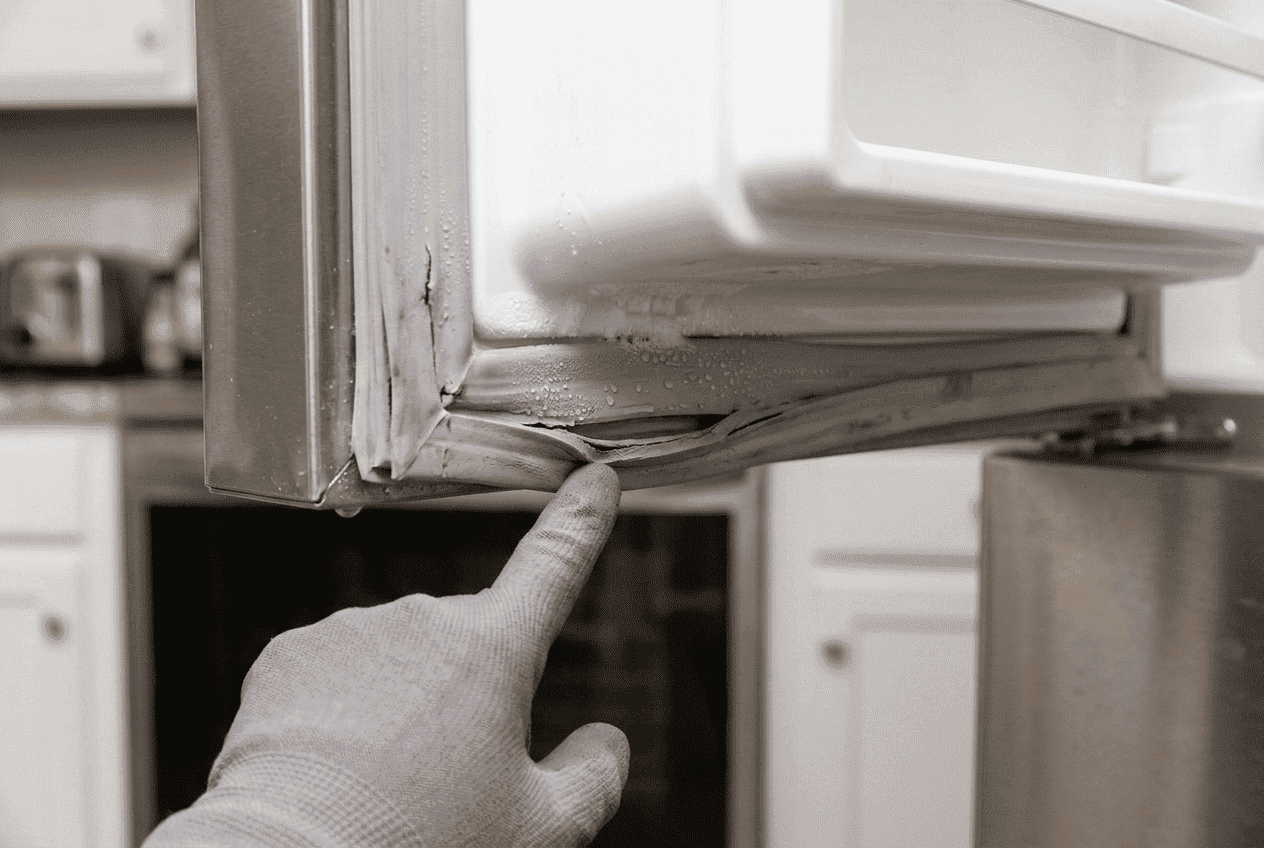
Airflow can also be affected by a door gasket leak. A freezer is designed as a closed environment. Even a small leak introduces warm air continuously. That warm air carries moisture. Moisture increases frost load. Frost restricts airflow. Over time, freezing performance declines.
The symptoms of airflow restriction often look like this:
Observation | Likely Direction |
Uneven freezing front to back | evaporator fan not running |
Frost near door edges | door gasket leak |
Longer cooling cycles | Air infiltration or circulation imbalance |
Airflow problems typically develop slowly. If freezing performance declined over weeks, airflow is a strong suspect.
For the wider picture on this brand, see more on Frigidaire leaking water.
When It’s Time to Sound the Alarm
A thin layer of frost on the evaporator coil is normal. Heavy frost buildup behind the interior panel is not.
Frigidaire freezers rely on timed defrost cycles to prevent excessive frost accumulation. When those cycles fail, frost begins to layer over the evaporator coil.
A defrost system malfunction interrupts this process. Instead of clearing frost during scheduled intervals, the system continues cooling while frost thickens.
Eventually, evaporator coil ice buildup restricts airflow so severely that freezing performance drops.
One of the most common causes is defrost heater failure. The heater is responsible for melting frost during defrost cycles. If it does not activate, frost accumulates unchecked.
The pattern homeowners describe is consistent:
- The freezer works better after being unplugged.
- Ice returns behind the back panel.
- Performance declines again within days.
Temporary improvement after manual thawing is a classic sign of defrost system malfunction.
Distinguishing Defrost Problems from Compressor Failure
This is where experience matters.
With a defrost system malfunction, freezing performance often improves temporarily after thawing. With compressor failure, it does not.
Compressor failure reduces the system’s ability to generate cold in the first place. Airflow may be fine. Frost may be minimal. But the evaporator coil does not reach proper temperature.
Common signs that suggest compressor failure or sealed system decline include:
- Freezer running continuously.
- No strong freeze anywhere in the compartment.
- Weak frost pattern on the evaporator instead of an even coating.
- Both the refrigerator and freezer are losing performance together.
Unlike airflow or defrost issues, sealed system problems do not fluctuate. They progress steadily.
Understanding the Sealed System
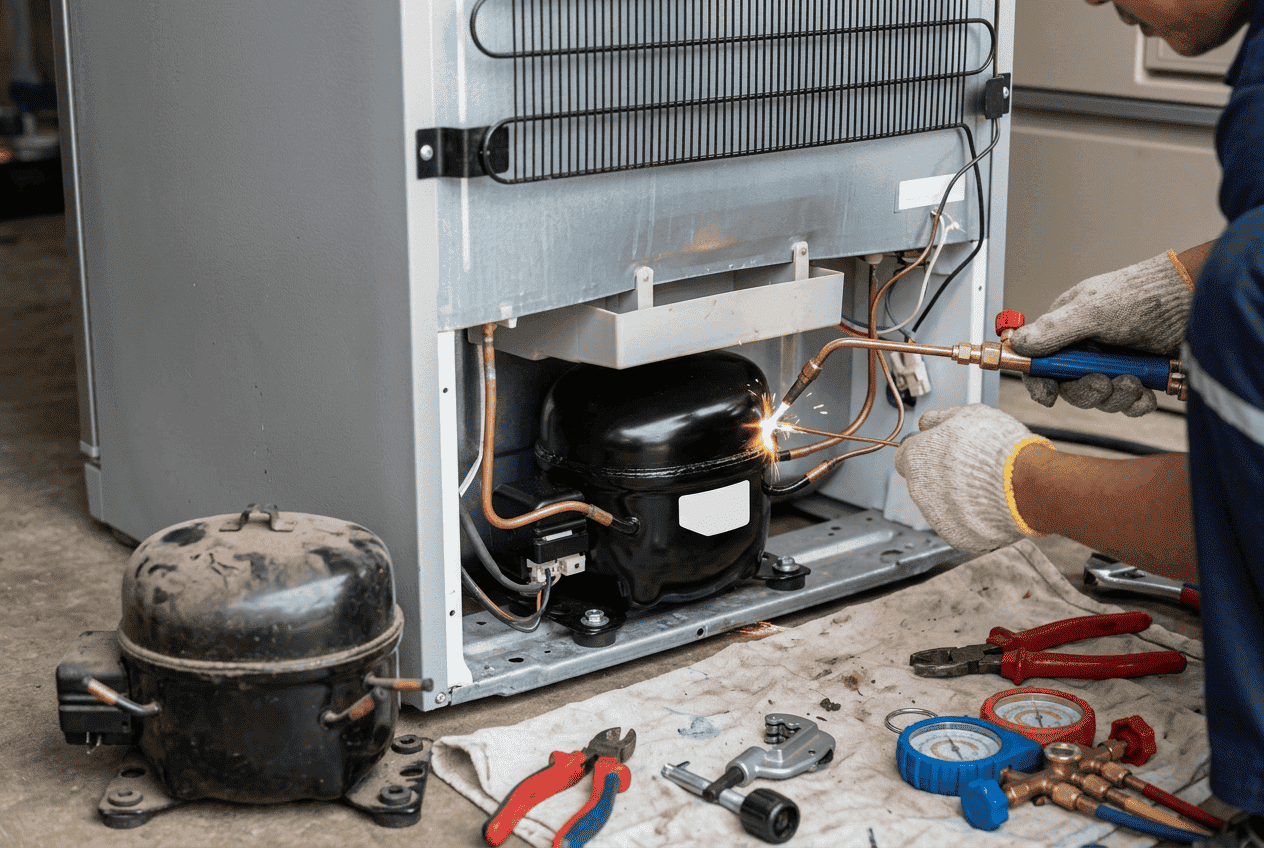
The sealed system includes the compressor, evaporator coil, condenser coil, and refrigerant lines. It is a closed loop responsible for heat transfer.
If a sealed system issue develops, refrigerant flow is disrupted or cooling efficiency drops. That decline affects overall freezing capacity.
Sealed system problems require pressure testing and proper equipment. They cannot be confirmed visually.
When airflow and defrost systems are functioning correctly, and freezing remains weak across the entire compartment, sealed system evaluation becomes necessary.
What We Do During a Full Diagnostic
A proper diagnostic is structured.
- First, we measure actual internal temperature rather than relying on the display.
- Next, we inspect for a door gasket leak and confirm whether the evaporator fan not running is restricting airflow.
- If frost is present, we remove interior panels and check for evaporator coil ice buildup. We test the defrost circuit to confirm or rule out defrost heater failure and broader defrost system malfunction.
- Only after airflow and defrost systems are cleared do we evaluate compressor performance and assess the sealed system.
- Each step eliminates possibilities logically. That process prevents unnecessary part replacement.
What Homeowners Can Check Safely in DIY mode
Before scheduling service, you can observe a few things:
- Inspect the door seal for visible gaps.
- Look for frost behind the rear interior panel.
- Listen for the evaporator fan when pressing the door switch.
- Notice whether freezing improves temporarily after thawing.
- Observe whether the unit runs almost nonstop.
If freezing improves after thawing, defrost system malfunction is likely. If it never improves, compressor failure or sealed system decline becomes more probable.
Model-Specific Observations
FGHS2631PF and FFHS2622MS models often show defrost-related airflow restriction as they age. FRFS2823AS and FGHB2868TF units sometimes develop early fan or control irregularities before deeper mechanical decline.
Gallery series and Professional series units feature more advanced controls. Proper testing avoids unnecessary board replacement when the root cause lies elsewhere.
Design differences matter. The same symptom does not always mean the same repair.
Why Waiting Makes It Worse
A freezer that is not freezing properly rarely stabilizes on its own.
Air leaks increase moisture. Moisture contributes to evaporator coil ice buildup. Defrost heater failure compounds frost load. Compressor strain increases as it runs longer cycles.
Here is how progression typically unfolds:
Stage | Behavior | Risk Level |
Early | Slight softening | Moderate |
Repeating | Daily inconsistency | Elevated |
Persistent | Constant partial freezing | High |
Advanced | Failure to maintain freeze | Severe |
Early correction limits system stress. Delayed action increases repair complexity.
Final Thoughts
When a Frigidaire freezer is not freezing properly, it is rarely random. It signals imbalance inside one of three systems: airflow, defrost, or refrigeration.
A door gasket leak or evaporator fan not running may be manageable. A defrost system malfunction or defrost heater failure requires correction before evaporator coil ice buildup spreads. Compressor failure or sealed system issues require careful evaluation.
Freezing should be steady. Once it becomes inconsistent, the system is asking for attention.
Related guides
FAQ
1. Why does my Frigidaire freezer feel cold but not freeze solid?
Cold air alone does not guarantee proper freezing. Airflow restriction or defrost system malfunction can prevent stable temperature distribution.
2. Can a door gasket leak cause serious freezing problems?
Yes. A door gasket leak allows warm air inside continuously, which reduces freezing strength and increases strain on the system.
3. What causes evaporator coil ice buildup?
Evaporator coil ice buildup is usually the result of defrost heater failure or a broader defrost system malfunction.
4. How do I know if it is a compressor failure?
Compressor failure typically presents as constant running with weak freezing and no temporary improvement after thawing.
5. What is a sealed system problem?
The sealed system includes the compressor and refrigerant loop. A sealed system issue reduces cooling capacity and requires specialized testing.
6. Should I keep using the freezer if it is not freezing properly?
Short-term use may be possible, but prolonged operation in a weakened state increases strain and may worsen the problem.