A Whirlpool freezer that cannot stay cold creates uncertainty fast. Food looks frozen one day, soft the next. Ice production slows. A temperature alarm may appear, disappear, then return. Most homeowners respond by adjusting settings, unplugging the unit, or waiting for the problem to resolve on its own.
It rarely does.
Whirlpool freezers warm up for specific reasons. Some are tied to how the refrigerator is installed or configured. Others point to airflow failures, defrost problems, or failing components that cannot be corrected through settings alone. The difficulty is that many of these issues produce similar symptoms, even though the underlying causes are very different.
This article is written to remove that confusion.
By the end, you will understand how Whirlpool freezers are supposed to regulate temperature, why they begin to lose cooling capacity, which warning signs matter, and when continued operation risks food loss or deeper mechanical damage. Just as importantly, you will be able to recognize when the problem is environmental or operational and when it is time for professional repair.
What Too Warm Condition Means Inside a Whirlpool Freezer
A Whirlpool freezer is engineered to maintain temperatures near zero degrees Fahrenheit. Short temperature swings occur during normal operation, especially after door openings or defrost cycles. What defines a problem is the freezer’s ability to recover.
When recovery slows or stops, the freezer enters a failure state.
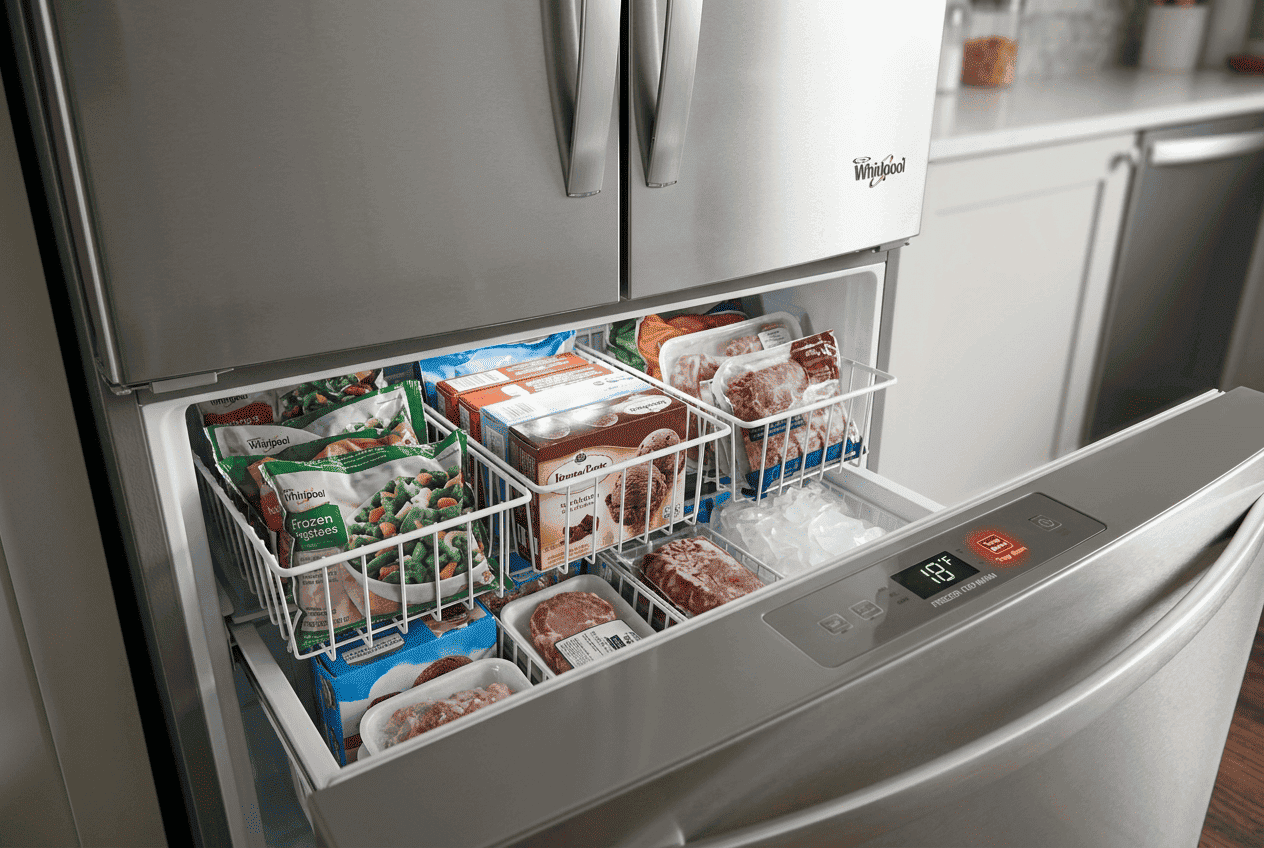
One of the clearest indicators is an over temperature alert 19F. At this point, frozen storage conditions are no longer being met. Food may still appear frozen, but texture degradation has already begun. Repeated thawing and refreezing damages food quality and increases internal strain on the cooling system.
What makes this situation deceptive is that the appliance often continues running. The compressor cycles. Fans may still be audible. From the outside, nothing seems urgent. Internally, temperature regulation has already been compromised.
How Whirlpool Freezers Control Temperature
Whirlpool freezers do not cool by flooding the compartment with cold air. Cooling is produced in a specific location and distributed from there. This design makes airflow and feedback just as important as cold production.
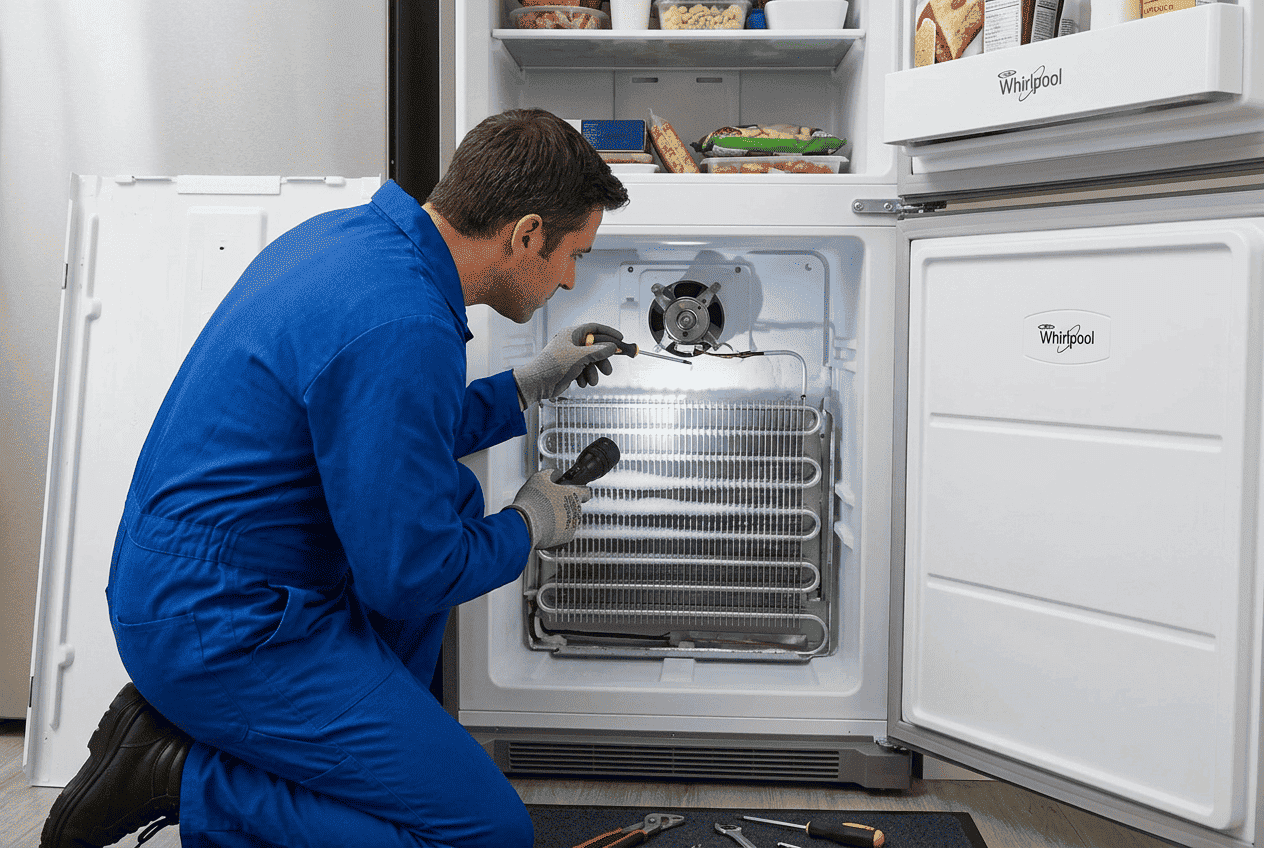
Cold air is generated at the evaporator coils behind the rear freezer panel. From that point, the system depends on:
- The evaporator fan, which moves cold air into the freezer compartment
- The temperature sensor, often a thermistor, which monitors internal conditions
- The control board, which decides how long the compressor and fans should operate
- The defrost system, which keeps the evaporator surface clear
When all of these elements work together, the freezer maintains a stable temperature with little variation. When one element falls out of balance, the freezer may continue running while gradually losing cooling capacity.
This is why many Whirlpool freezer failures feel slow and confusing rather than sudden.
Environmental Conditions That Push Freezer Performance Out of Range
Before any internal failure is considered, the environment must be evaluated.
Whirlpool refrigerators are designed to operate within a room temperature 55-110F range. Outside that range, cooling behavior changes. This is especially common in garages and unconditioned spaces.
In cooler environments, the refrigerator may not run long enough to support proper freezer cooling. Compressor cycles shorten, and freezer temperature drifts upward. Some Whirlpool models include a garage-ready setting, but this feature is limited. It does not override all environmental constraints and is not present on every model.
Heat causes problems as well. When ventilation around the refrigerator is restricted, heat builds up behind the cabinet. Efficiency drops, recovery slows, and the freezer is often the first compartment to show symptoms.
Environmental stress does not usually cause immediate failure. It reduces the system’s margin until another issue pushes it past the limit.
When Controls Work Against Cooling
Modern Whirlpool refrigerators rely on electronic controls. While precise, these systems allow cooling to be disabled in ways that are not always obvious.
On certain models, the cooling function off state can be activated while the refrigerator remains powered. Interior lights work. Displays respond. Cooling does not resume. This commonly occurs after power interruptions or accidental control input during cleaning.
Temperature selection also plays a role. A freezer set too high may never reach proper storage conditions. Because electronic controls respond gradually, homeowners may assume the freezer is malfunctioning when it is following its programmed instructions exactly.
Control-related issues are often overlooked because the appliance appears operational.
Airflow Inside the Freezer and Why It Matters
One of the most common mechanical causes of a warm Whirlpool freezer is restricted internal airflow.
Cold air must travel from the evaporator area to every part of the freezer. When that path is disrupted, temperatures become uneven. The most frequent cause is blocked air vents.
This often happens unintentionally. Large boxes, stacked bags, or oversized items press against vent openings near the rear wall. Cold air collects where it is produced and never reaches the front of the compartment.
The result is predictable. Food near the door softens first. Items near the back freeze harder. Temperature readings become misleading because sensors detect cold air in one location while the rest of the freezer warms.
Clearing space may help temporarily. If the problem returns, airflow is being restricted elsewhere or circulation has already degraded.

Defrost Failures and Ice Where It Should Not Be
When airflow is unobstructed but cooling still declines, the defrost system becomes the focus.
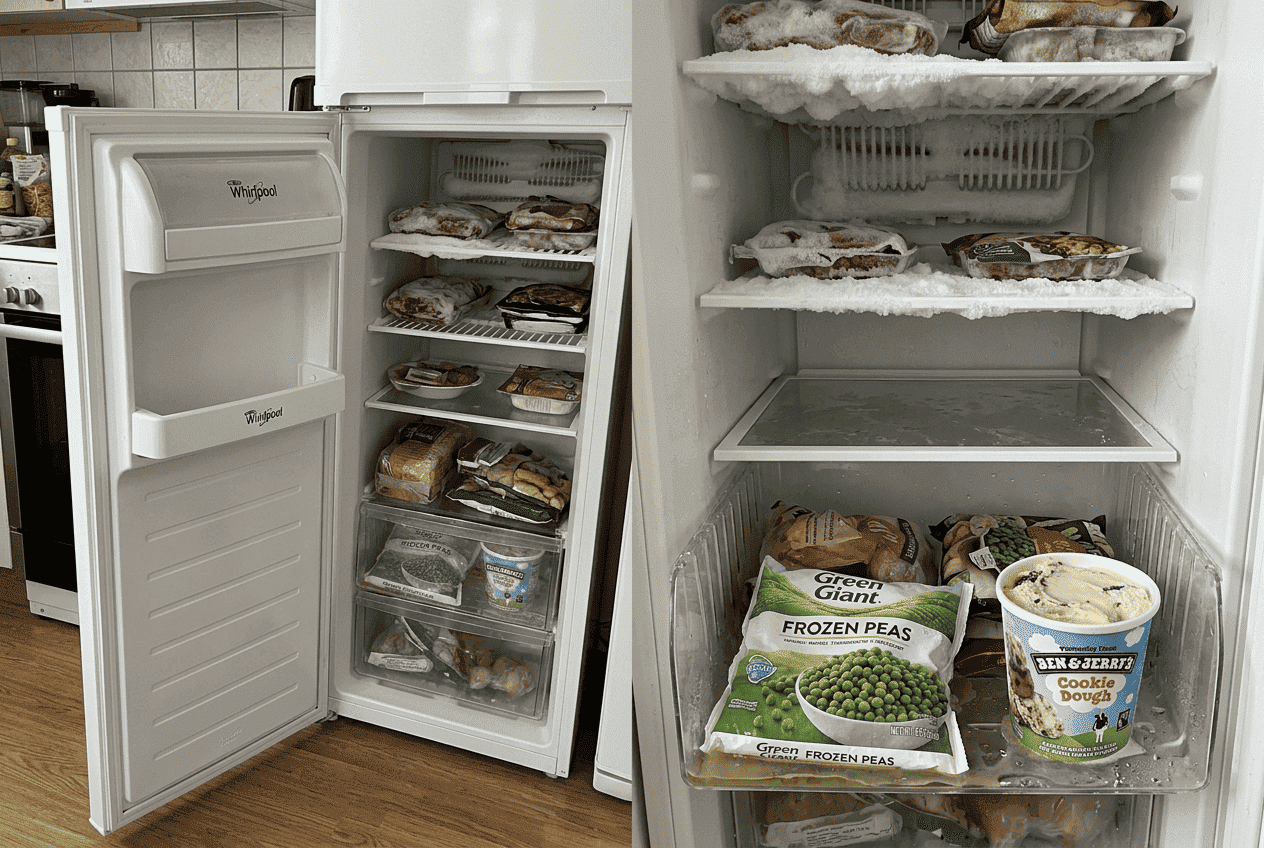
Whirlpool freezers rely on automatic defrost cycles to prevent ice from accumulating on the evaporator coils. When the system fails, frost builds gradually. Over time, the evaporator coils iced condition restricts airflow and reduces cooling output.
Homeowners often notice that unplugging the refrigerator restores cooling temporarily. Others attempt a defrost system manual reset. These actions melt ice but do not correct the failure that caused it.
Defrost system problems progress steadily. As ice thickens, airflow weakens further, and temperature rises accelerate. Left unaddressed, the freezer eventually loses the ability to maintain frozen conditions at all.
The Evaporator Fan and Circulation Loss
The evaporator fan is responsible for moving cold air throughout the freezer. Without it, cold remains trapped near the coils.
In Whirlpool freezers, fan failure is often partial. The fan may slow down, bind intermittently, or stop under certain conditions. This creates temperature changes that feel inconsistent and difficult to trace.
Because many Whirlpool designs rely on freezer airflow to cool the refrigerator section as well, evaporator fan problems often affect both compartments. A freezer temperature issue may be accompanied by fresh food warming at the same time.
Fan noise changes are often an early warning sign.
Sensor and Control Board Failures
Temperature regulation depends on accurate information. When the temperature sensor or thermistor sends incorrect readings, the freezer cannot respond correctly.
A faulty sensor may report that conditions are colder than they really are. The control board responds by shortening cooling cycles. The freezer warms without triggering immediate alarms.
Control board failures are less predictable. They may cause missed defrost cycles, improper fan timing, or unexpected cooling shutdowns. These issues cannot be corrected through resets or adjustments.
At this stage, diagnosis is required. Replacing parts without confirmation often leads to repeat failures.
How the Problem Appears by Refrigerator Type
Whirlpool freezer behavior varies by design.
Model Type | Typical Behavior |
French door | Freezer and refrigerator warm together due to shared airflow |
Side-by-side | Temperature changes appear quickly and unevenly |
Bottom-freezer | Early problems develop quietly and are noticed late |
Understanding the design helps determine urgency and inspection focus.
What Happens If the Issue Is Ignored
A Whirlpool freezer running too warm does not stabilize on its own.
As temperatures rise:
- Food quality deteriorates
- Freezer burn increases
- Ice production slows
- Internal components operate under prolonged strain
What begins as an airflow or sensor issue can escalate into more costly failures if ignored.
When Professional Repair Is the Right Call
Professional service is recommended when:
- Temperature alerts continue to return
- The freezer cannot hold safe temperatures
- Frost buildup reappears quickly
- Cooling improves briefly, then fails again
At this point, the issue is mechanical or electronic, not operational.
Whirlpool Freezer Repair in Atlanta and Georgia
Whirlpool freezer temperature problems require accurate diagnosis. Guesswork leads to repeat failures and higher costs.
Our Appliance Repair Master team services Whirlpool French door, side-by-side, and bottom-freezer models across Atlanta and Georgia. With more than 15 years of experience, we restore airflow, correct control issues, and return freezers to stable performance.
The Final Thoughts
Freezers rarely announce problems. They drift out of balance, one small change at a time, until the results become hard to ignore. That is why temperature issues tend to linger longer than they should.
When a Whirlpool freezer no longer holds cold the way it once did, attention matters more than adjustment. Small problems are easier to correct when they are addressed early, before food loss or added strain turns them into something larger.
Noticing the change and responding thoughtfully is often all it takes to keep a manageable issue from becoming an expensive one.
FAQ
1. Why is my Whirlpool freezer running but still too warm?
When a Whirlpool freezer runs but stays warm, the issue is usually not the compressor itself. In most cases, the problem is related to airflow, temperature feedback, or defrost operation. Cold air may be produced but not distributed correctly, or the control board may be responding to inaccurate sensor readings. This is why the freezer can sound normal while failing to hold temperature.
2. Can blocked air vents really cause freezer temperature problems?
Yes. Blocked air vents are one of the most common causes of uneven or rising freezer temperatures. When vents are obstructed by food packages or bulky items, cold air becomes trapped near the back of the freezer. The result is uneven freezing and gradual warming, especially near the door and upper shelves.
3. What does an over temperature alert 19F mean on a Whirlpool freezer?
An over temperature alert 19F indicates that the freezer has exceeded safe frozen storage limits. Even if food still looks frozen, quality and safety may already be compromised. This alert should not be ignored, as it often points to airflow issues, defrost failures, or control-related problems that require attention.
4. Does the garage-ready setting prevent freezer temperature issues?
The garage-ready setting can help some Whirlpool models operate more reliably in cooler environments, but it does not eliminate all risks. Whirlpool refrigerators are still designed to work within a room temperature 55–110F range. Outside that range, freezer performance can suffer even if the setting is enabled.
5. When should I stop adjusting settings and call for repair?
If you’ve confirmed that the cooling function off setting is not enabled, air vents are clear, and the freezer still cannot hold temperature, continued adjustments are unlikely to help. Repeated warming, returning alerts, frost buildup, or short-lived improvements after resets usually indicate a mechanical issue involving the evaporator fan, thermistor, or control board. At that point, professional diagnosis is the safest next step.