
Samsung refrigerator temperature issues typically begin as a control or sensing problem before they present as a clear cooling failure. The unit may still power on, the user interface may still display a normal setpoint, and some cooling may still be present, but internal temperature management becomes unstable.
Same symptom turns up on other brands too – start with our Bosch temperature problems guide.
Common symptoms include:
- incorrect temperature readings,
- temperature fluctuations,
- uneven cooling between zones,
- localized freezing in the fresh-food compartment,
- slow temperature recovery after door openings,
- or a mismatch between displayed settings and actual food-storage conditions.
Our guide is written around Samsung Common Problems in the category that causes the most confusion and the most avoidable food loss: Temperature Issues. It explains how Samsung temperature problems are commonly linked to airflow restrictions, thermistor drift, defrost-related faults, sealing loss, and control board issues, and why each fault produces a different temperature pattern inside the cabinet. Readers will find structured checklists of the most likely causes, the symptom logic behind each one, and the practical checks that help distinguish a maintenance issue from a component failure. For homeowners in Atlanta and across Georgia, the purpose of this guide is straightforward: to make Samsung refrigerator temperature behavior easier to interpret, easier to troubleshoot, and easier to resolve through accurate repair.
Quick read before you move the dial
- Samsung commonly recommends 38°F for the refrigerator and -2°F for the freezer; the display shows an average compartment condition, not the exact temperature of one shelf.
- If food feels wrong but the panel looks normal, start with a thermometer test instead of repeated setting changes.
- Incorrect temperature readings, a faulty thermistor, blocked vents, door seal problems, and defrost sensor failure can all look like the same complaint at first: uneven cold.
- If the refrigerator is warm and showing OF OF, O FF, or 0 / FF on some RF models, Cooling Off mode has to be ruled out before major parts are blamed.
- If both sections are warming or food is no longer holding safely, stop observing and start diagnosing.
Start with the checking temperature
Samsung’s manufacturers explain an important detail many homeowners miss: the display is showing an average compartment condition, not the exact temperature of one bottle, one shelf, or one drawer. That means a refrigerator can look set correctly and still cool unevenly in real use.
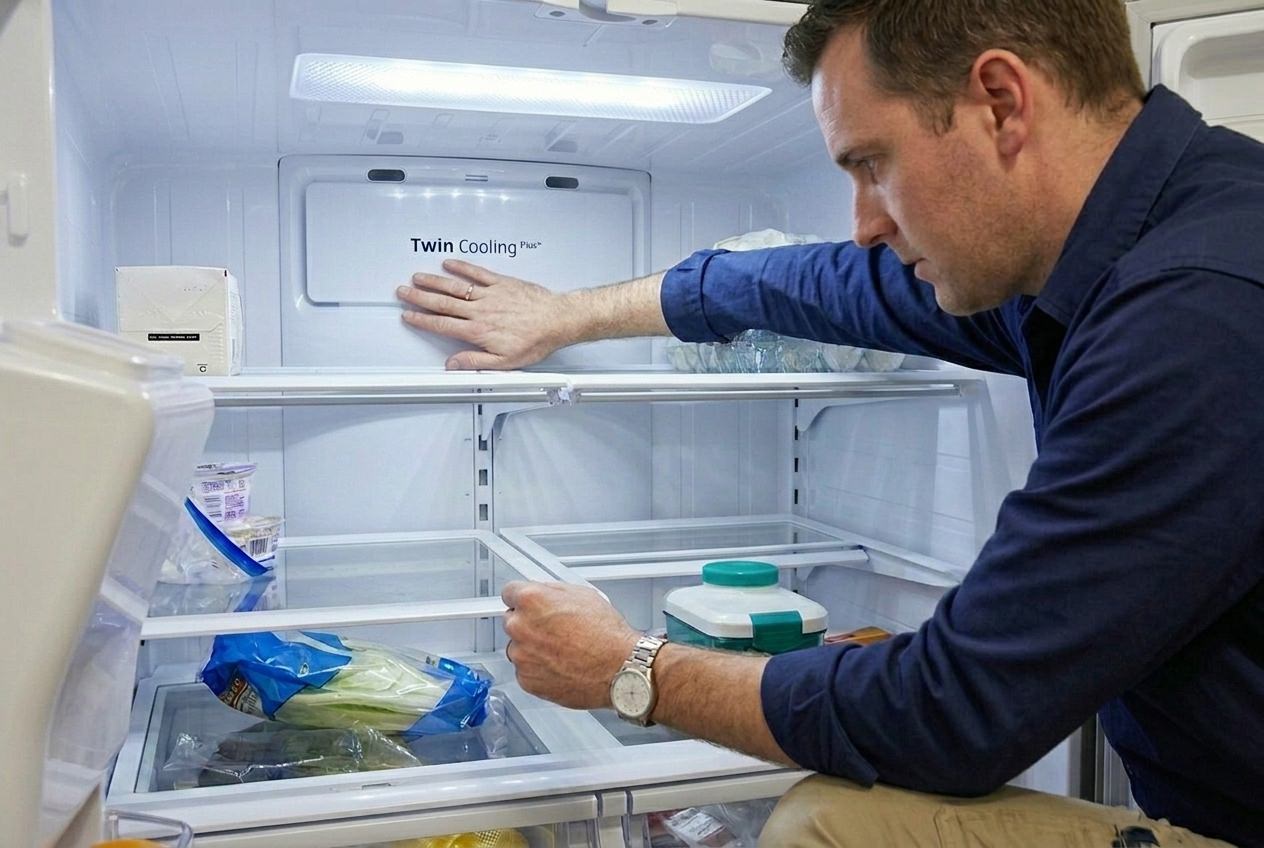
The cleanest first check is placing a thermometer in a glass of water near the center of the fresh-food compartment and giving the cabinet time to settle with the doors closed. That process is slower than most people expect, but it would be clearer than touching the air after opening the door. In other words, good Samsung diagnosis starts with the relevant cabinet temperature, not the impression left by the panel.
Samsung baseline | Recommended fresh-food setting: 38°F. Recommended freezer setting: -2°F. Food safety still depends on refrigeration below 40°F and frozen food at or below 0°F. |

Temperature symptom decoder
Below it’s a practical symptom map, it will help you before service begins.
What you notice | What it usually points toward | What to do next |
Fresh-food side warms first | Airflow imbalance, blocked vents, faulty thermistor feedback, or early defrost restriction | Check actual cabinet temperature and keep the rear air path clear |
Display looks normal but food feels off | Incorrect temperature readings, sensor drift, uneven cooling, or slow control response | Use a thermometer test before changing settings repeatedly |
Moisture or condensation at the door edge | Door seal problems, alignment issues, or warm humid air entering the cabinet | Clean the gasket and note whether one area releases easily |
A shelf freezes food while another runs warm | Uneven airflow, damper behavior, sensor mismatch, or frost restricting circulation | Look for blocked vents and document where the problem is strongest |
Back wall frost or a fan noise appears with warming | Defrost sensor failure or evaporator-area ice buildup interfering with airflow | Schedule service before the restriction grows |
Both compartments run warm together | A deeper control or cooling event, or Cooling Off mode on some models | Book service promptly and protect food first |
Where Samsung temperature issues usually begin
1) When the refrigerator is reading the cabinet wrong
If the control system believes the compartment is colder or warmer than it really is, the refrigerator starts chasing the wrong target. Homeowners experience that as temperature fluctuations, slow recovery, overcooling in one zone, or a cabinet that feels different from morning to night without any obvious reason.
A faulty thermistor is one of the classic reasons this happens. The thermistor helps the refrigerator interpret compartment conditions. When its feedback drifts, cooling commands drift with it. The result is not always a dramatic failure; often it is a cabinet that feels inconsistent while the display remains convincing.
This is also where incorrect temperature readings belong. Sometimes the panel is honestly showing an average while the cabinet is cooling unevenly. Sometimes the sensing circuit is off. Good repair work separates those scenarios instead of treating them as one symptom with one answer.
For the wider picture on this brand, see the Samsung RF23 Series problems troubleshooting guide.
2) When cold air cannot move the way Samsung designed it to
A refrigerator can have cooling ability and still fail to deliver stable cold where it matters. Samsung French-door platforms depend on clear internal airflow. If containers press into the rear channels, if packages crowd the vent path, or if frost begins restricting circulation, the cabinet may cool unevenly even while the sealed system is still doing real work.
The blocked vents deserve more respect than they usually get. They sound like a housekeeping note, but they often explain why one shelf runs colder, another warms, and the whole refrigerator starts feeling inconsistent instead of obviously broken.
Airflow complaints also overlap with defrost issues. If the evaporator area begins building ice because of defrost sensor failure or related defrost-management trouble, air movement becomes restricted and the symptom spreads. That is why a frost problem can wear the costume of a pure temperature complaint for longer than it should.
3) When the cabinet is letting the kitchen back in
Door seal problems are one of the most underestimated reasons for Samsung cooling drift, especially in Atlanta homes where heat and humidity expose weakness faster. A gasket does not need a dramatic tear to affect performance. It only needs to lose clean, even contact in one area.
Once warm room air begins entering the cabinet repeatedly, the refrigerator is forced to recover again and again, moisture increases, and the line between still working and still protecting food starts to separate. The symptom may show up as condensation, a damp edge, longer run times, or fresh-food inconsistency that seems worse later in the day.
4) When the machine starts producing wrong timing codes
Modern Samsung refrigerators are coordinated systems. Sensors, fans, dampers, defrost timing, compressor behavior, and user settings all move through electronic logic. When control board issues begin, the symptoms often look scattered rather than dramatic: the freezer looks acceptable, the fresh-food side wanders, and the display still responds even though the cabinet no longer feels governed with confidence.
That is exactly why board diagnosis should be earned and not guessed. The smarter path is to check the real temperatures, note the order in which the symptom developed, rule out vent obstruction and door sealing, and then test whether the logic is responding properly to the inputs it is receiving.
5) Cooling Off mode
Some Samsung RF-series models can create one of the most misleading temperature complaints in the category: the refrigerator looks awake, the fan and lights may still operate, but the cabinet does not cool because Cooling Off mode is active. On different Samsung panels, owners may see OF OF, O FF, or a 0 / FF style display.
It matters because it changes the entire repair conversation. Before anyone starts assuming compressor, board, or sealed-system failure, demo mode has to be ruled out on applicable models.
Homeowner checklist before service
Check this first | Why it matters |
| This separates a display concern from a real storage concern. |
| Even premium refrigerators lose performance when airflow is blocked. |
| Uneven seal contact is useful evidence, not just a yes-or-no test. |
| Shelf-to-shelf differences help separate airflow from whole-cabinet loss. |
| A rub, tick, or scrape alongside warming can point toward ice or fan-path restriction. |
| Demo mode can imitate a major cooling failure. |
| They can erase symptom history and make clean diagnosis harder. |
What can wait, and what should not
Not every inconsistency is an emergency. Some are watch closely and document situations. Others are stop monitoring and book service situations.
Usually reasonable to watch briefly | Time to call sooner rather than later |
The display was adjusted recently and the cabinet is still within the normal stabilization window. | Food is no longer holding safely or both compartments are warming. |
The complaint is mild, isolated, and not affecting food safety yet. | The display looks normal but the thermometer confirms a real storage problem. |
You found obvious vent crowding and are correcting it now. | The door edge is wet, the cabinet is sweating, or the seal is inconsistent. |
The refrigerator is recovering normally once the doors stay closed. | A fan rub, scrape, or frost pattern appears with declining cooling. |
Why Atlanta kitchens expose these problems sooner
Atlanta is not a neutral test environment for refrigeration. Long warm seasons, high humidity, busy family kitchens, and frequent door traffic all reduce the margin for a refrigerator that is already beginning to drift.
That does not mean every symptom is severe. Small symptoms become visible earlier. The sooner the pattern is recognized, the more likely the repair stays in the contained category instead of turning into food loss and a rushed replacement decision.
Why people search Samsung RF Series (lawsuit)
Some homeowners arrive at this topic after searching Samsung RF Series (lawsuit) because they are trying to answer a fair question: is this a one-off issue, or am I seeing a symptom other owners have discussed publicly as well?
The important distinction is that a lawsuit search term is not a diagnosis. A unit with blocked vents, door seal problems, or a faulty thermistor can produce real food-protection issues without sharing the same repair path as a refrigerator with a deeper cooling or control event.
Before you call: details that make the visit faster
Consider this a short note sheet. When the technician already knows where the pattern starts, whether it is temperature fluctuating in one zone or spreading through the whole cabinet, diagnosis usually gets more precise faster.
What to note | Why it helps |
Model family or series | RF / French-door / side-by-side / unknown is enough to start |
Which section changes first | Fresh-food side, freezer, deli drawer, or both together |
Best thermometer reading you captured | Fresh-food temp in water, freezer temp, and roughly when you measured it |
What travels with the warming | Moisture at the seal, fan rubbing, frost on the back wall, or a blinking panel |
Whether the problem is constant or cyclical | All day, mostly afternoons, only after heavy door use, or after a reset/power event |

Conclusion
Samsung refrigerators are supposed to make temperature control feel invisible. When that changes, the first evidence is often small: a warmer shelf, a slower recovery, unexpected frost, an edge of condensation, or a compartment that looks correct on the display but feels wrong in use.
If your Samsung refrigerator is no longer holding temperature, do not let the conversation stop at the panel setting. Look at the real cabinet temperature. Note whether the issue is isolated or spreading. Pay attention to airflow, sealing, and signs of sensing or defrost drift. Appliance Repair Master provides Samsung refrigerator repair throughout Atlanta Georgia, with diagnosis built around how the symptom behaves in the home.
Related guides
FAQ
1. What temperature should a Samsung refrigerator hold?
For everyday food storage, the refrigerator should stay below 40°F, and Samsung commonly recommends a 38°F setting for the fresh-food compartment. The freezer should hold at or below 0°F, with many Samsung models using a -2°F setting as the recommended target.
2. Why does my Samsung display look normal when the food feels warm?
Because the display represents an average compartment condition, not the exact temperature of one shelf or one item. If cooling is uneven, one zone can drift before the panel tells the whole story.
3. Can a faulty thermistor really cause temperature fluctuations?
Yes, faulty thermistor can feed the control system inaccurate information, which means the refrigerator may cool too long, not long enough, or unevenly from zone to zone.
4. Do blocked vents really matter that much?
They do. When cold air cannot move cleanly through the cabinet, temperatures stop feeling consistent. Items near the path may overcool while other areas start running warm.
5. When should I worry about defrost sensor failure?
Worry less about the part name and more about the pattern: frost where it should not be, airflow changes, fan rubbing, and a fresh-food side that gets weaker over time are all reasons to have the refrigerator checked.