
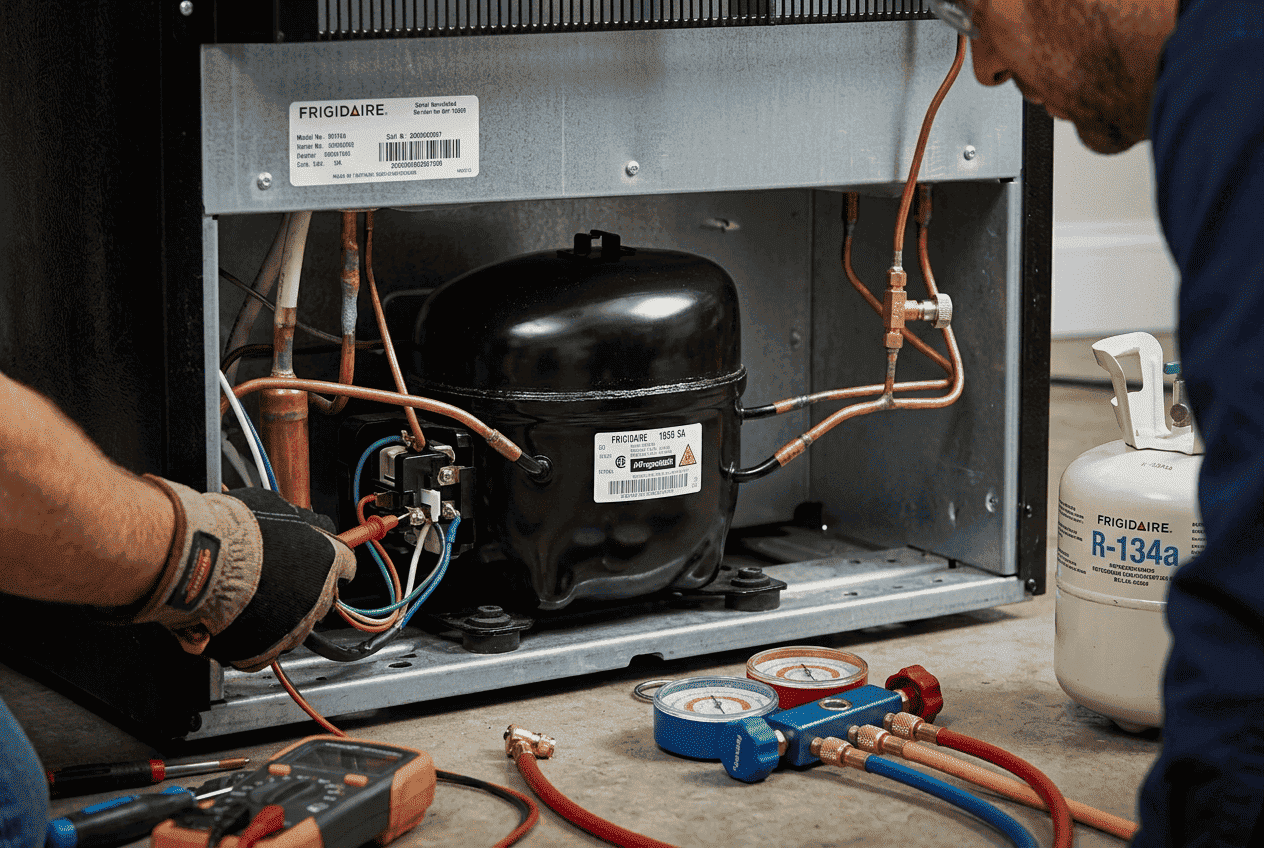
Your refrigerator should work quietly in the background, keeping food safe without ever demanding attention. But when your Frigidaire fridge suddenly stops cooling, keeps running without chilling, or makes odd clicking or humming sounds from the back, everything in the kitchen changes fast.
Same symptom turns up on other brands too – start with more on Bosch compressor failure.
Many homeowners jump to one conclusion: it’s compressor failure. That phrase carries a reputation of expensive and serious issues, possibly meaning the death of a fridge you count on every day.
Here’s the reality: sometimes it really is compressor failure.
But often what looks like compressor trouble, whether the compressor is not running, is overheating, or seems dead, is actually caused by related issues such as relay malfunction, a failed start capacitor, refrigerant pressure imbalance, or sealed system problems.
Our article provides a detailed, system-level examination of:
- The operational role of the compressor in Frigidaire refrigeration architecture
- Electrical and mechanical causes of compressor failure
- How relay malfunction and start capacitor degradation mimic internal compressor faults
- The impact of refrigerant pressure deviations within the sealed system
- Failure progression patterns observed in Frigidaire FGHB/FGSS Series units
- Diagnostic methodology used in professional appliance repair
- Repair feasibility versus replacement strategy in the Atlanta market
By the end, you’ll understand why your refrigerator isn’t cooling, what steps lead to a smart decision (not a guess), and how professional repair can save you time and money.
Let’s start by answering the most misunderstood question in refrigerator repair:
Why does your fridge act like the compressor has failed — even when it hasn’t?
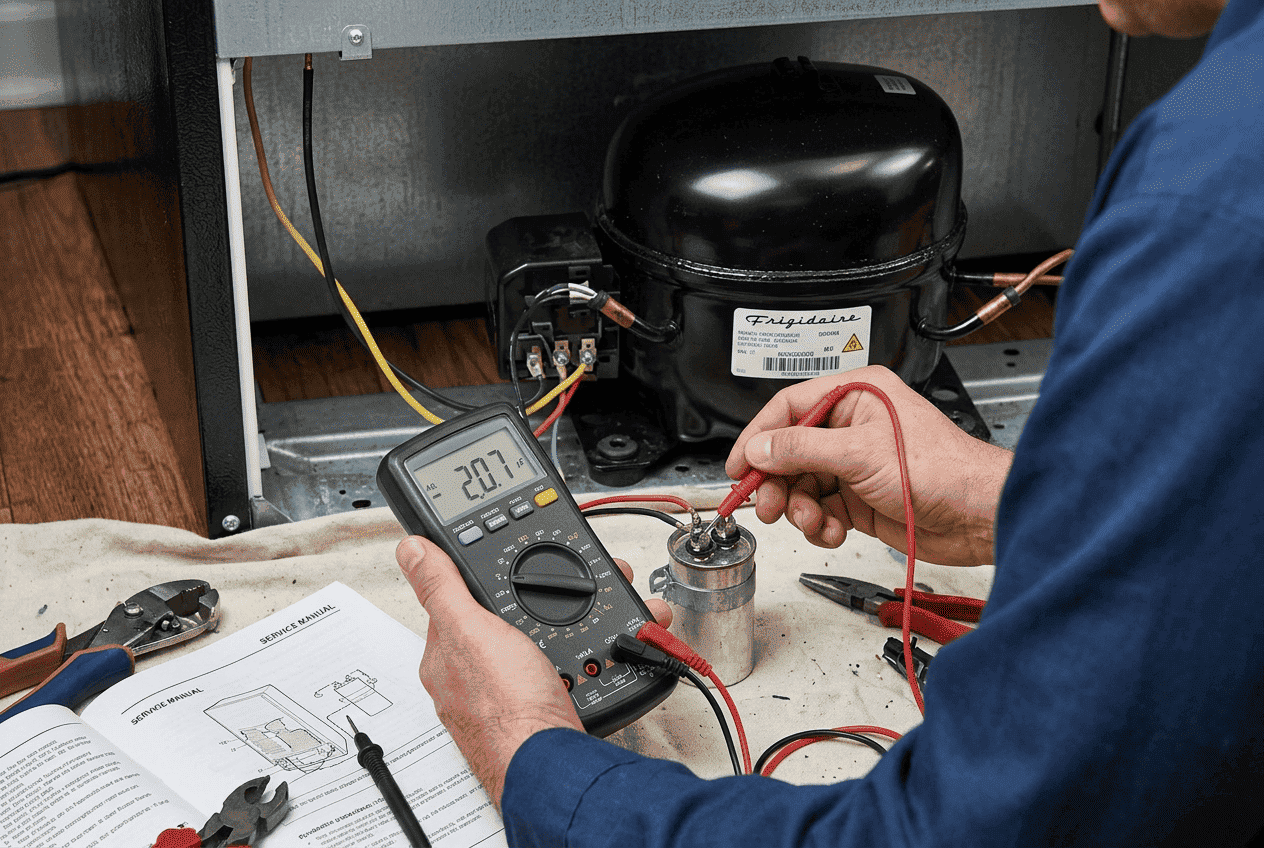
Fast symptom triage for Frigidaire FGHB/FGSS Series
Before you assume true frigidaire compressor failure, map what you’re seeing to the most common technical causes. This is the same first-pass triage our Atlanta technicians use to decide whether the issue is likely in the start circuit, airflow/heat rejection, or the sealed system.
What you notice | Most common causes | What a tech confirms |
compressor not running (silent) | No start signal, relay malfunction, failed start capacitor, control issue | Voltage at compressor terminals; relay/capacitor test; winding resistance |
Clicking every few minutes | Relay malfunction or overload cycling; compressor overheating | Start device condition; amp draw; compressor temperature; condenser airflow |
Runs constantly, still warm | sealed system issue; refrigerant pressure imbalance; restriction/leak | Refrigerant pressure readings; coil temperature profile; leak/restriction checks |
Very hot rear base | Condenser airflow restriction; compressor overheating; high head pressure | Condenser coil cleanliness; fan operation; discharge temperature/pressure |
If you’re in Atlanta and trying to protect groceries, the fastest path is a targeted diagnosis. A start-device test plus basic system checks can confirm whether you’re dealing with a relay malfunction/start capacitor issue or a sealed system problem before any major decisions.
Why It’s The Compressor That is Always Got Blamed
When a refrigerator stops cooling, the compressor takes the blame almost immediately. It’s the most expensive component. It is situated at the back and makes noise. When something sounds wrong, people feel like it’s the obvious suspect.
But in day-to-day appliance service across Atlanta, true internal compressor failure is not the most common cause of cooling complaints.
What homeowners describe as:
- The compressor isn’t coming on.
- It clicks but doesn’t start.
- It runs but nothing gets cold.
- The back of the fridge is extremely hot.
…often turns out to be a startup or system condition problem, not a destroyed compressor.
Understanding the difference can save you from replacing a refrigerator prematurely.
At this point, most people want a straight answer: is it a bad compressor, or something around it? The only way to answer that reliably is to understand how the compressor interacts with the rest of the refrigeration circuit in these models.
Compressor Architecture in Frigidaire FGHB/FGSS Series
The FGHB/FGSS Series utilizes a hermetically sealed reciprocating compressor integrated into a closed-loop refrigeration circuit. The compressor assembly contains:
- Motor windings (start and run circuits)
- Internal overload protection
- Mechanical piston or scroll compression mechanism
- Oil-lubricated internal components
The compressor’s function is to elevate low-pressure refrigerant vapor exiting the evaporator into a high-pressure, high-temperature state, enabling heat rejection at the condenser coil.
System performance depends on:
- Proper voltage supply
- Functional start relay and start capacitor
- Stable refrigerant charge
- Correct refrigerant pressure differential
- Unrestricted condenser airflow
Any disruption in these parameters can produce symptoms frequently misinterpreted as compressor failure.
Defining True Compressor Failure
True internal compressor failure falls into one of three primary categories:
1. Electrical Winding Failure
Motor windings may open due to thermal degradation or short to ground due to insulation breakdown. This results in a compressor not running despite correct voltage supply.
2. Mechanical Seizure (Locked Rotor)
Internal mechanical components can seize due to oil breakdown, contamination, or long-term overheating. In this case, startup current spikes but rotation does not occur.
3. Valve or Internal Compression Loss
The compressor motor may operate, but internal valve damage prevents adequate compression. In this scenario, the compressor runs but fails to generate sufficient refrigerant pressure differential to maintain cooling.
For the wider picture on this brand, see read our breakdown of Frigidaire leaking water.
These conditions require compressor replacement. They cannot be repaired externally.
Startup Circuit Failures Frequently Misdiagnosed as Compressor Failure
In field diagnostics across Atlanta service environments, startup circuit failures are more common than internal motor failure.
Relay Malfunction
The relay regulates current between start and run windings. A relay malfunction interrupts proper startup sequencing. The compressor may:
- Attempt to start
- Draw current
- Trigger the overload protector
- Reset and repeat
Audible clicking every few minutes is characteristic of this pattern.
What this means in practice: a relay malfunction can make a perfectly good compressor behave like a dead one. Confirming the relay and overload behavior first is how experienced techs avoid unnecessary sealed system work.
Start Capacitor Failure
The start capacitor provides phase shift and torque amplification during startup. Degradation leads to insufficient rotational force, particularly under load. Symptoms include:
- Brief humming
- Immediate shutdown
- Repeated overload cycling
In both cases, the compressor motor itself may remain fully functional.
Replacement of start components is materially different from compressor replacement in both complexity and cost.
A weak start capacitor is one of the most common reasons homeowners report compressor not running. The key is that the symptom is dramatic, but the fix is often contained to the start circuit once verified by testing.
Compressor Overheating: Thermal Stress and Progressive Damage
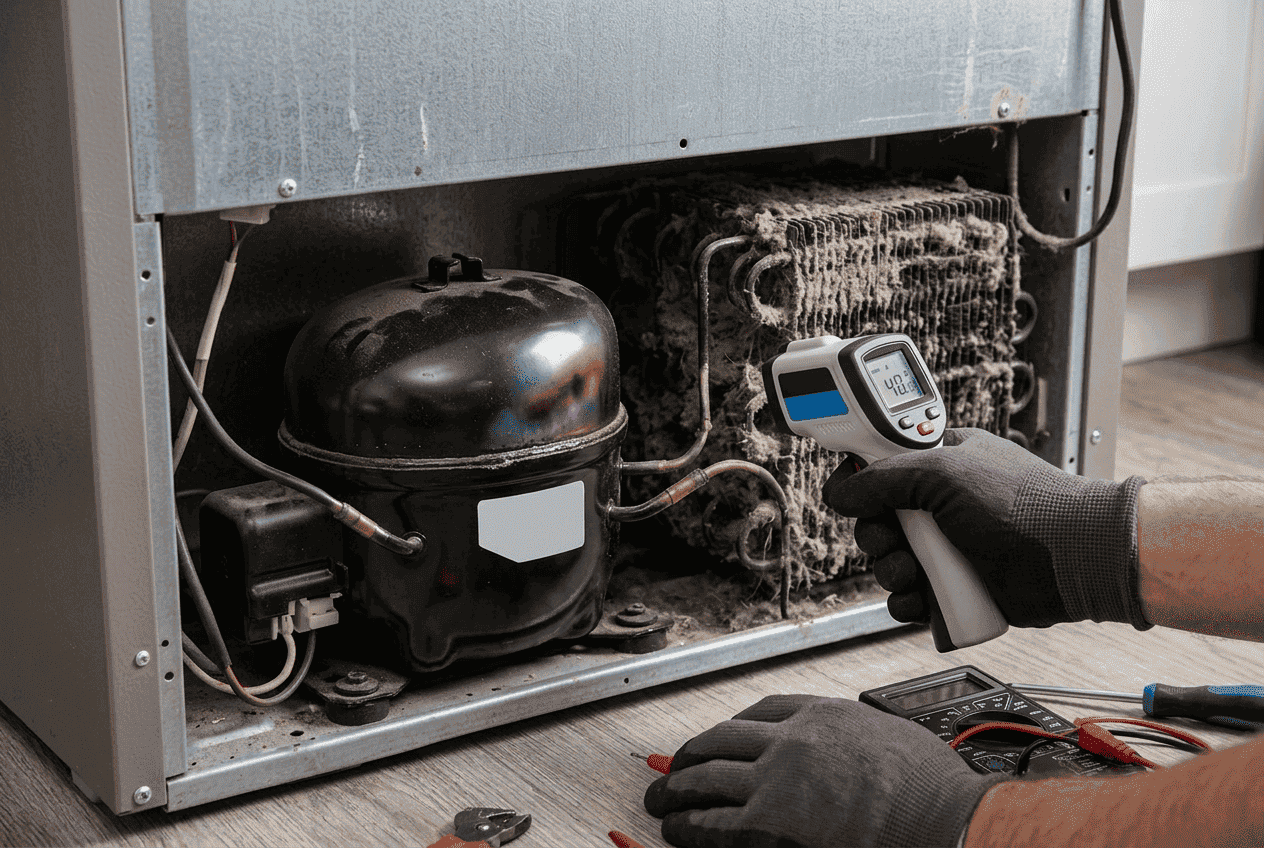
Compressor overheating is a significant contributing factor in failure progression, particularly in Georgia’s high ambient temperature conditions.
Overheating may be caused by:
- Condenser coil contamination
- Condenser fan motor failure
- Restricted airflow due to installation constraints
- Elevated ambient temperature
- Refrigerant overcharge or restriction
Thermal stress degrades winding insulation and accelerates oil breakdown. Repeated thermal cycling weakens internal motor integrity.
It is critical to distinguish between overheating as a symptom and overheating as a cause. For example:
- Low refrigerant pressure may extend runtime and elevate temperature.
- High discharge pressure may increase mechanical load.
Both increase compressor temperature but originate from different system imbalances.
Sealed System Integrity and Refrigerant Pressure Dynamics
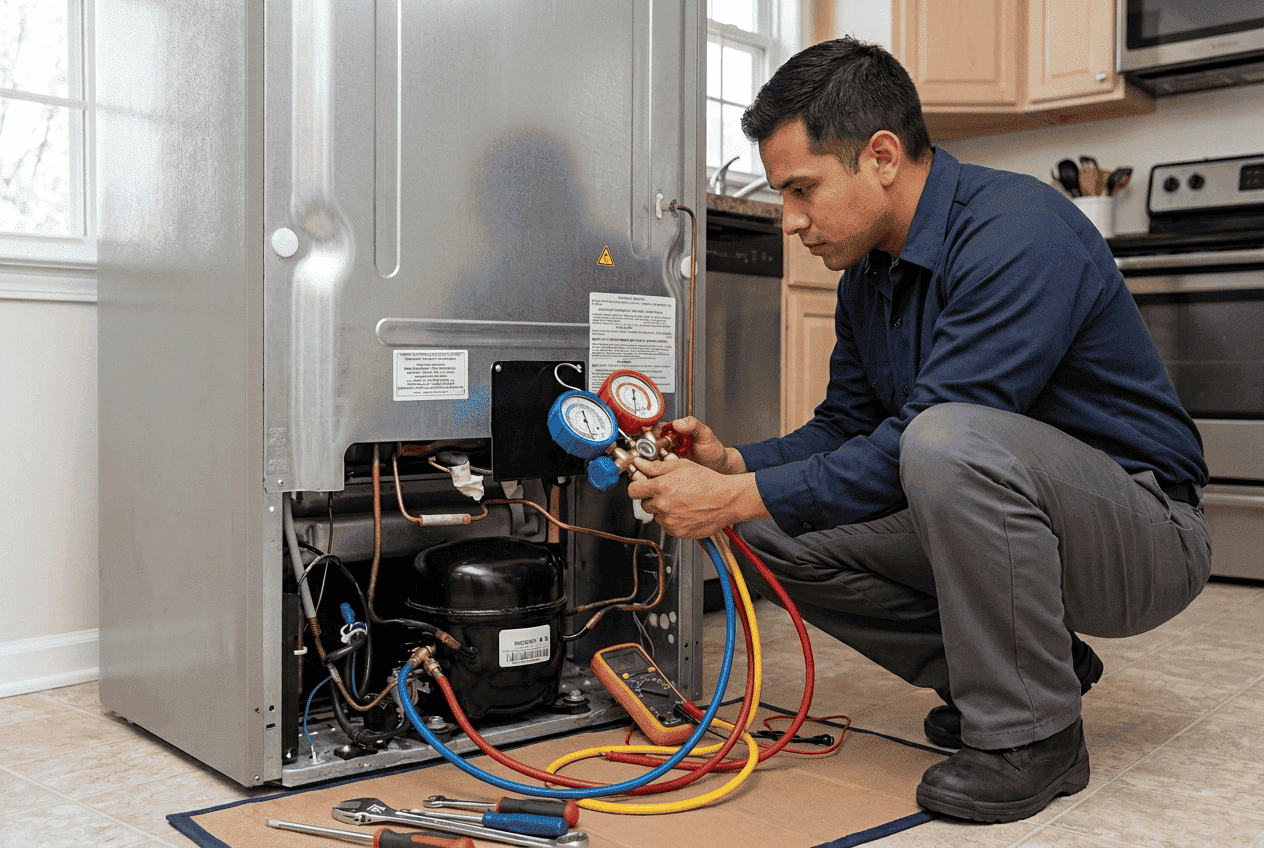
The sealed system in the Frigidaire FGHB/FGSS Series includes the compressor, condenser, evaporator, capillary or metering device, and interconnecting refrigerant lines.
System performance is highly sensitive to refrigerant pressure.
Low Refrigerant Pressure
Typically caused by leaks or gradual refrigerant loss. Effects include:
- Extended compressor runtime
- Reduced evaporator heat absorption
- Progressive compressor overheating
High Refrigerant Pressure
Often caused by restriction, contamination, or condenser inefficiency. Effects include:
- Elevated discharge temperature
- Increased amp draw
- Accelerated mechanical stress
In both cases, prolonged pressure imbalance can lead to eventual compressor failure.
Replacing a compressor without correcting refrigerant pressure imbalance results in recurrence.
Diagnostic Methodology Used in Professional Evaluation
Accurate evaluation of suspected frigidaire compressor failure includes:
- Voltage verification at compressor terminals
- Relay and start capacitor testing
- Resistance measurement between common, start, and run terminals
- Ground fault testing
- Amp draw analysis during startup
- Refrigerant pressure measurement (high and low side)
- Thermal analysis of compressor casing
Diagnosis should proceed in sequence, eliminating startup and airflow causes before condemning the compressor itself.
This systematic approach prevents unnecessary sealed system intervention.
If you’re comparing repair quotes, ask one specific question: what tests were performed to separate start-device failure from sealed system problems? A credible diagnosis should reference the start capacitor/relay checks and refrigerant pressure evaluation, not just a guess based on sound.
Failure Patterns Observed in Frigidaire FGHB/FGSS Series Units
In Atlanta service history, recurring patterns include:
- Aging start assemblies leading to compressor not running complaints
- Condenser airflow restrictions resulting in compressor overheating
- Gradual refrigerant pressure loss due to evaporator leaks
- Internal compressor failure following prolonged overheating
Understanding these patterns improves diagnostic accuracy and informs repair decisions.
Repair Or Replacement: Technical and Economic Evaluation
When true compressor failure is confirmed, decision-making must account for:
- Appliance age
- Overall sealed system condition
- Cabinet insulation integrity
- Energy efficiency
- Market replacement cost
Compressor replacement remains viable in mid-life units where structural integrity remains strong.
However, in aging units with multiple systemic failures, replacement may provide superior long-term value.
Professional assessment in the Atlanta market should balance technical feasibility with economic practicality.
Decision clarity: treat compressor replacement as a system decision, not a part decision. If the sealed system is stable and the cabinet is sound, repair can be rational. If pressure irregularities, contamination, or multiple aging components are present, replacement often becomes the more reliable long-term play.
Strategic Consideration for Atlanta Homeowners
Given Atlanta’s climate and installation environments, preventive maintenance is critical in reducing compressor stress.
Recommended measures include:
- Biannual condenser coil cleaning
- Ensuring adequate rear clearance
- Prompt replacement of failing start components
- Early evaluation of cooling irregularities
Timely intervention often prevents progression from startup malfunction to full compressor failure.
Pro Tip:
In tight cabinetry installs and high-heat seasons, we see compressor overheating driven by condenser airflow issues more often than people expect. That local pattern is exactly why diagnosis should include airflow and condenser-fan verification alongside electrical and refrigerant pressure testing.
Conclusion
Frigidaire compressor failure is a serious but frequently misunderstood condition.
True internal failure is distinct from startup component degradation, refrigerant pressure imbalance, and airflow-induced compressor overheating.
Accurate, system-level diagnosis determines whether the solution involves:
- Replacing a start capacitor
- Correcting a relay malfunction
- Addressing sealed system pressure irregularities
- Or replacing the compressor itself
In Atlanta and throughout Georgia, homeowners benefit from technical evaluation grounded in refrigeration principles rather than assumption.
A refrigerator is a sealed thermodynamic system. When it fails, the solution must address root cause — not surface symptoms.
Related guides
FAQ
1. What are the most common symptoms of frigidaire compressor failure?
The most common signs include the compressor not running, repeated clicking during startup, compressor overheating, or the refrigerator running continuously without reaching temperature. However, these symptoms can also be caused by relay malfunction, a failed start capacitor, or sealed system refrigerant pressure issues.
2. Why is my Frigidaire compressor not running but the refrigerator has power?
If lights and display functions work but the compressor is not running, the issue is often related to the startup circuit. A relay malfunction or weak start capacitor frequently prevents the compressor from engaging, even though power is present.
3. Can compressor overheating damage the refrigerator permanently?
Yes. Persistent compressor overheating accelerates internal motor wear and insulation breakdown. Overheating is often caused by restricted airflow, dirty condenser coils, or abnormal refrigerant pressure inside the sealed system. Addressing it early can prevent full compressor failure.
4. How does refrigerant pressure affect compressor failure?
Improper refrigerant pressure increases compressor workload. Low pressure from a leak causes extended run cycles. High pressure from restriction increases mechanical strain. Both conditions contribute to premature compressor failure if not corrected.
5. Is sealed system repair always required when the compressor fails?
If true internal compressor failure is confirmed, sealed system repair is required because the compressor is part of that closed circuit. However, not every cooling issue involves the sealed system. Startup components and electrical faults are common alternatives.
6. Is compressor replacement worth it for Frigidaire FGHB/FGSS Series models?
It depends on the unit’s age and overall condition. For mid-life units in good structural condition, compressor replacement is often viable. For older units with multiple developing issues, replacement may be more practical.