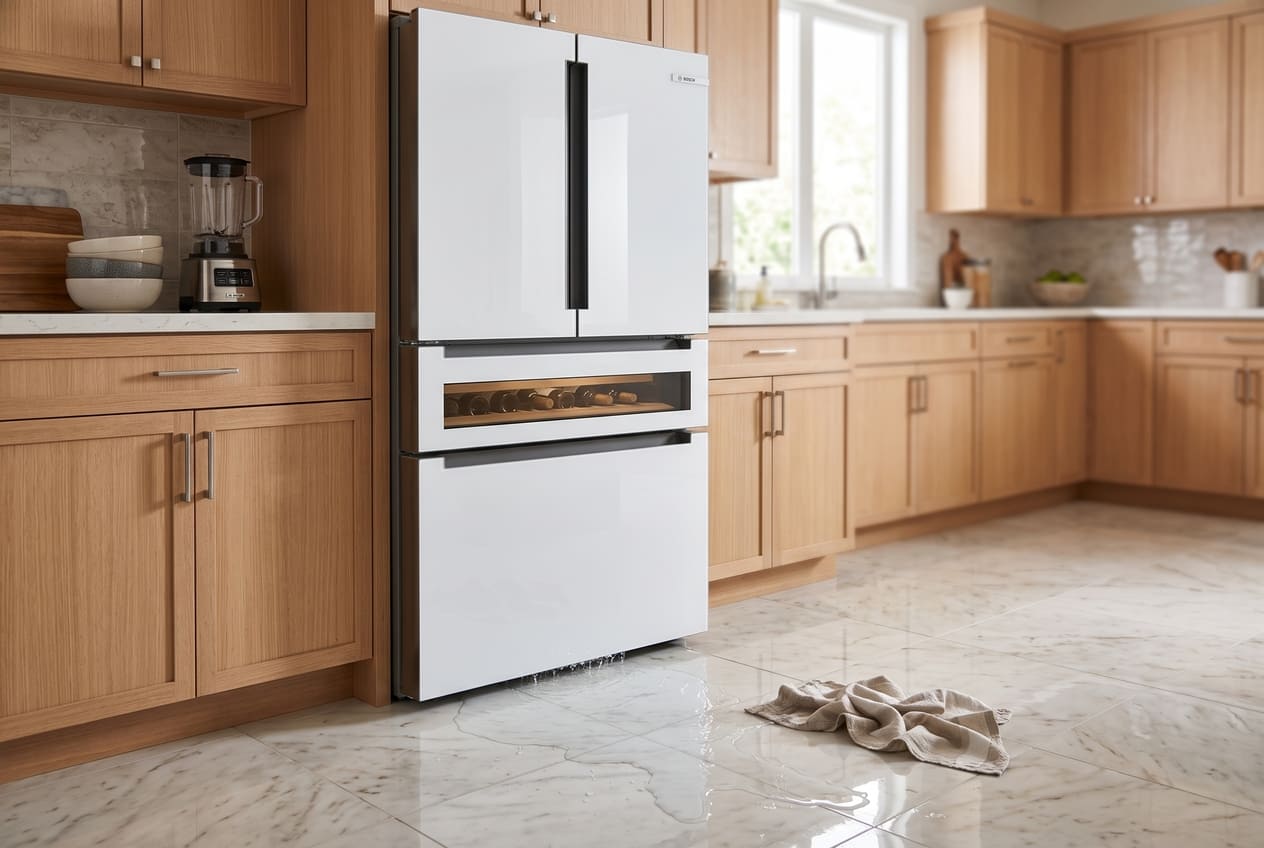
Water under Bosch refrigerator is frustrating because the appliance often looks perfectly normal while it is making a mess. Homeowners notice that the lights work, the cooling seems fine, the ice maker may still run. Then water shows up near the toe kick, below the dispenser, or by the freezer drawer, and a practical question appears in the homeowner’s head: can I safely fix this myself, or is the refrigerator already leaking somewhere hidden?
Same symptom turns up on other brands too – start with our guide to Frigidaire leaking water.
Our article gives customers a safe way to sort the leak, make a reasonable filter-related attempt when that makes sense, and recognize the moments when waiting becomes more expensive than booking service.
Start Here: Choose Your Leak Path
Leak Selector
Pick the box that matches what you see. The goal is to choose the safest next move.
□ Path A: It started after a filter change The dispenser sputters, drips, or water appears around the filter area shortly after replacement. Try the filter reset and flush first. | □ Path B: Water is around the dispenser Water appears behind trim, inside the door area, or around the internal dispenser cover. Stop testing. Check for service signs. | □ Path C: Water is under the refrigerator The floor gets wet near the toe kick, rear, front feet, or freezer side even when cooling seems normal. Shut off water if active and call. |
Homeowner Leak Worksheet
Use this quick worksheet before we go deeper to understand things better.
Mark what you see
If you mark only the filter-change items, try the safe reset. If you mark floor, rear, door-area, or ice-maker items, call for repair.
- Leak is from the dispenser nozzle.
- Leak is around dispenser trim or inside the door area.
- Leak is around the filter housing.
- Water is under the front of the refrigerator.
- Water is under the back or side of the refrigerator.
- Leak appeared after a filter change.
- Leak appeared after moving the refrigerator.
- Ice maker is slower than usual or leak appears after ice cycles.
The 90-Second Bosch Leak Triage
Before you touch the filter, pull the fridge, or order a part, run this quick triage. It will prevent the most common DIY mistake: adding more water to an active leak.
Quick homeowner checklist
If you check two or more red-flag items below, move from DIY to service.
- Dry the floor and the dispenser area so new water is easier to spot.
- Stop using the dispenser and ice maker if water is active or spreading.
- Turn off the water supply if you can do it safely.
- Take one photo of where the water appears before wiping everything clean.
- Note whether the leak started after a filter change, after moving the refrigerator, or after ice maker activity.
- Don’t pull the refrigerator hard if the water line may be tight behind it.
If you see this | Risk level | Recommended move |
|---|---|---|
A few dispenser drips right after filter replacement | Low | Reinstall filter, flush system, watch for new drips |
Dispenser drip plus water behind trim | Medium | Stop using dispenser and schedule inspection |
Water under refrigerator | High | Shut off water if safe and call service |
Weak water flow plus leaking | Meduim | Mention both symptoms when booking repair |
Water returns after the floor is dry | High | Call before flooring or cabinets absorb more water |
Bosch Leak Can Be Simple Or It Can Hide Behind a Clean Stainless Door
Bosch refrigerator can leak for a boring reason, which is why the problem gets expensive when people ignore it. A few drops near the dispenser may come from air trapped in the water system after a filter change. Water under the refrigerator, however, can point to something more mechanical: a loose supply connection, a kinked hose, water inlet valve cracks, dispenser tube leaks, or drain pan issues.
The refrigerator may still cool normally while all of this is happening. That is what makes Bosch leaks easy to underestimate. Nothing flashes or screams. The food stays cold. Meanwhile, water may be traveling through a route you cannot see.
After a new water filter is installed, air can remain in the water system and the dispenser should be flushed until the water contains no more air bubbles. We link appliance water leaks to water connections or hoses that are not leak-tight and warn you against damaged, kinked, crushed, modified, cut, reused, or pulled water hoses.
A filter-change drip may be safe to troubleshoot. Water under the appliance, water behind dispenser trim, or a leak that returns after cleanup deserves a technician.
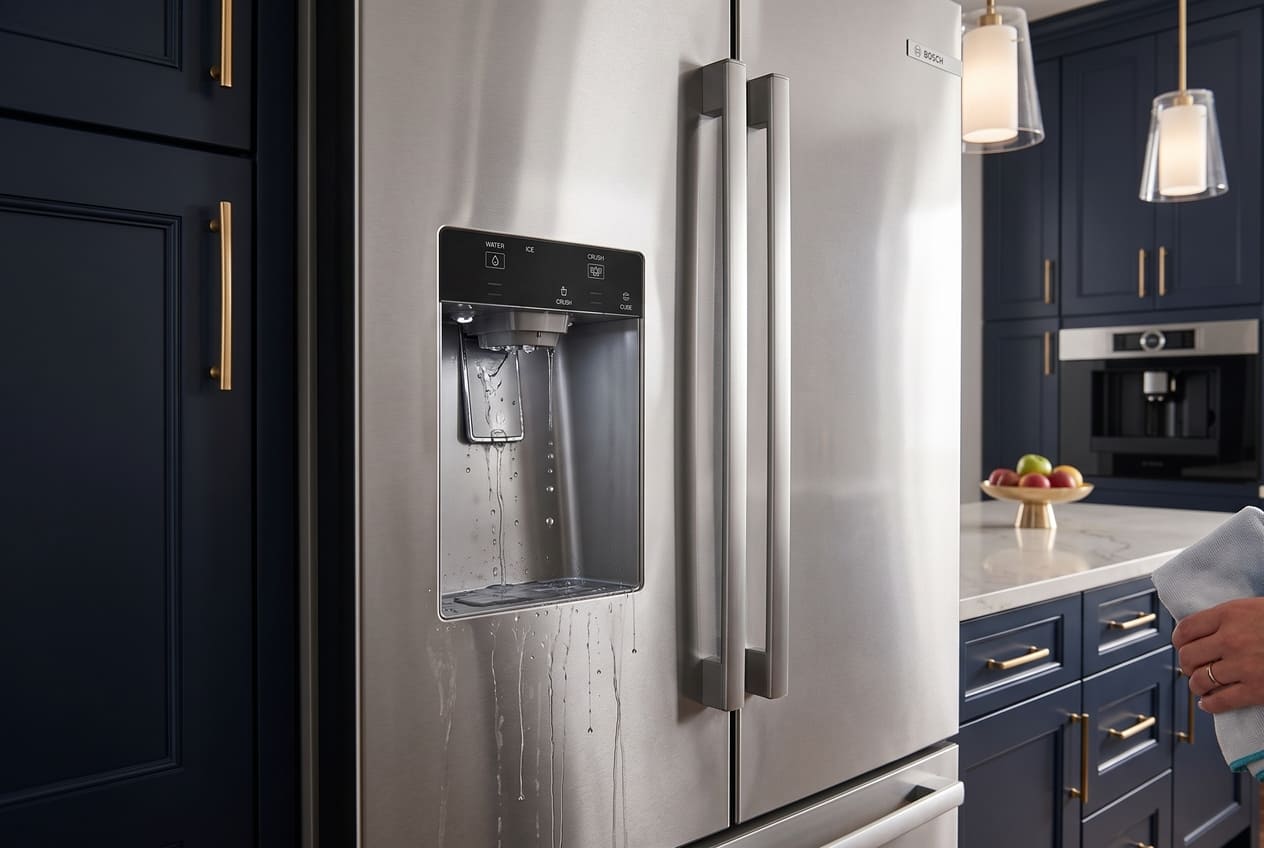
Path A: If the Leak Started After a Filter Change
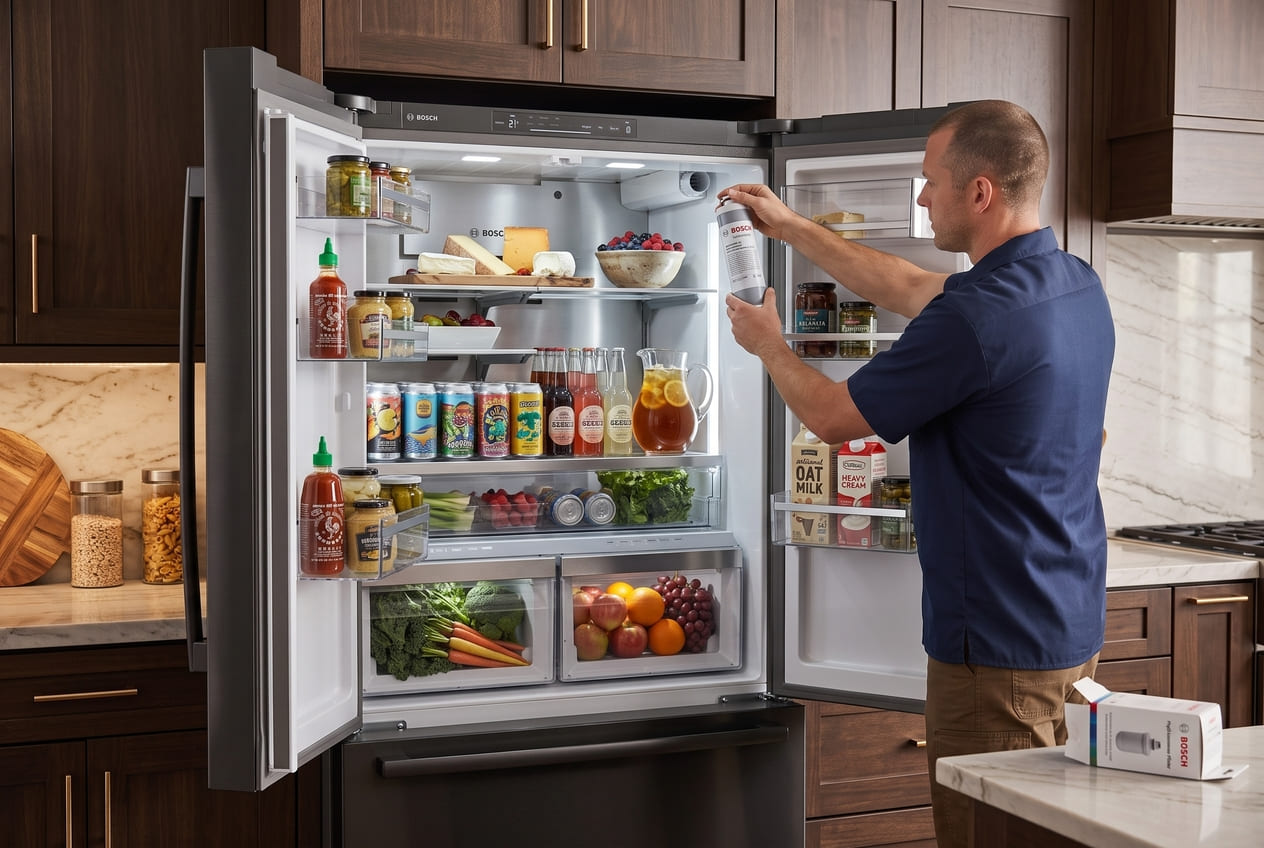
This is the one leak path where a careful homeowner can often make a safe first attempt. A filter change disturbs the part of the refrigerator that handles pressurized water. If the filter is not seated cleanly, an O-ring is out of place, or air is trapped in the line, the dispenser may sputter or drip.
We recommend replacing refrigerator water filters about every six months, installing the correct approved filter, flushing the system after replacement, and checking the housing and dispenser for drips.
DIY filter reset and flush
Use this checklist only if the leak clearly began after a filter change and water isn’t spreading under the refrigerator.
- Remove the filter according to the model instructions.
- Check for visible debris, moisture, or a damaged O-ring around the housing.
- Reinstall the filter until it locks firmly without forcing it.
- Flush 2-3 gallons through the dispenser, or follow the model-specific amount.
- Dry the filter housing and dispenser area.
- Watch for new moisture over the next few hours.
Result after reset | What it means | Next action |
|---|---|---|
Drip stops | Likely trapped air or seating issue | Monitor the area and replace filters on schedule |
Drip returns from nozzle only | Air may remain, or dispenser/valve seepage may be involved | Flush again briefly; if it continues, schedule repair |
Water appears around housing | Seal, housing, filter head, or fit issue may be present | Stop forcing the filter and call |
Water appears under the fridge | Likely not just a simple filter reset issue | Stop using water system and call |
For the wider picture on this brand, see more on Bosch 800 Series problems.
Path B: If the Bosch Dispenser Area Keeps Getting Wet
A dispenser drip after a filter change can be ordinary. Water behind the trim is a different story. If moisture appears around the internal dispenser cover, inside the door area, or away from the nozzle itself, the leak may involve the tube, fittings, housing, or internal water route.
Many homeowners get nervous about the door. That reaction makes sense. A modern refrigerator door may carry insulation, wiring, water routing, trim, and a finished stainless panel. The word door can make a repair quote jump fast.
But a dispenser-area leak doesn’t mean the whole door has failed. On Bosch 800 and 500 Series models, a tube can shift, a fitting can loosen, a filter seal can act up, or a line can continue to push air after replacement. Those are very different repairs from replacing a door assembly.
Door replacement sanity check
Before approving a Bosch door replacement cost around $700 or higher, the dispenser tube, fittings, cover area, filter housing, and water route should be checked.
Dispenser symptom | Likely direction | Homeowner move |
|---|---|---|
Drip only from nozzle after filter change | Air in the system or dispenser seepage | Flush and monitor |
Water behind trim or cover | Dispenser tube or fitting issue | Stop using dispenser and call |
Water inside door area | Door water route or tube leak | Book service before door damage grows |
Filter area wet plus dispenser drip | Filter seating, housing, or filter head issue | Do not force filter; call |
Path C: If Water Is Under the Refrigerator
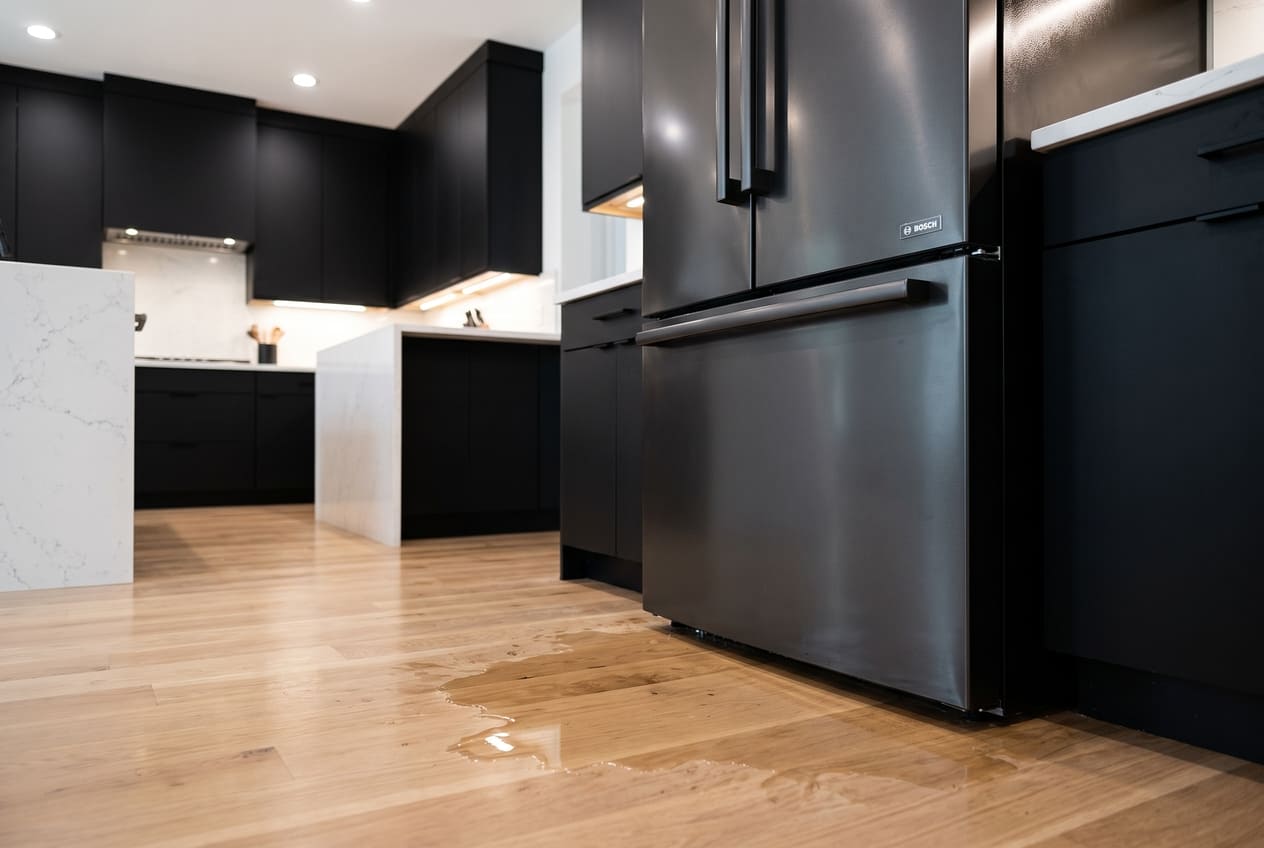
Water under a Bosch refrigerator changes the conversation. At that point, the dispenser may not be the source at all. The leak may be coming from a rear water hose, a loose connection, a cracked inlet valve, the ice maker fill system, a clogged defrost drain, or a drain pan problem.
This is why dragging the refrigerator out in a rush is a bad move. Bosch refrigerators are heavy, the rear water line can be stressed, and a kinked hose can create a new problem while you are hunting for the old one.
Red flags: call instead of guessing
If any of these are true, the safest move is a technician visit.
- Water is under the refrigerator, not only under the dispenser.
- The same spot gets wet again after drying.
- The leak appears after the ice maker cycles.
- The refrigerator was recently moved or pushed back.
- Water pressure changed, or the dispenser flow looks weak.
- Cabinet toe kick, flooring, or baseboard already feels damp.
For Atlanta homes, this matters. Many kitchens use hardwood, engineered flooring, laminate, tight cabinet openings, or counter-depth layouts. A slow leak under the refrigerator doesn’t need to flood the room to cause damage. It only needs time.
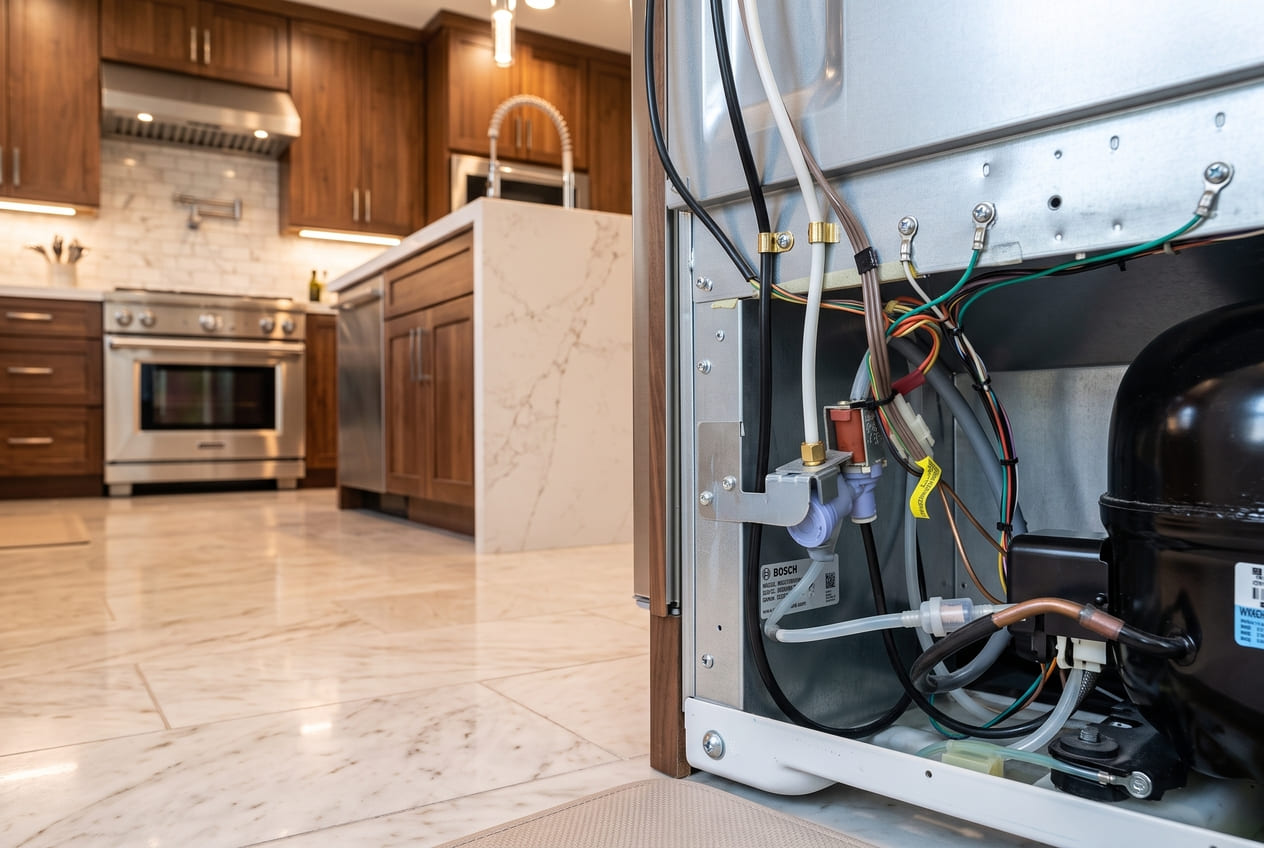
Water Inlet Valve Cracks: A Small Part That Can Make a Large Mess
The water inlet valve controls water entering the refrigerator for the dispenser and ice maker. When the valve works, nobody thinks about it. When the valve body cracks or a fitting loosens, water can collect behind the refrigerator or run underneath it before the source is obvious.
We consider cracked or loose Bosch refrigerator water inlet valves as one possible leak source. Our practice shows that
- damaged filter housings,
- damaged filter heads,
- water line problems,
- hose connector issues,
- water tank leaks,
- ice maker assembly problems,
- door gasket issues,
- and clogged or frozen defrost drains are also possible causes of Bosch refrigerator leaks.
Clue | Why it matters |
|---|---|
The dispenser pressure changed | The water system may be restricted, leaking, or affected by valve behavior |
Ice production slowed | The ice maker fill path and valve should be inspected |
Water returns after the floor is dry | The leak may be intermittent or cycle-based |
Leak appears after ice maker activity | Valve, fill tube, or ice maker fill route may be involved |
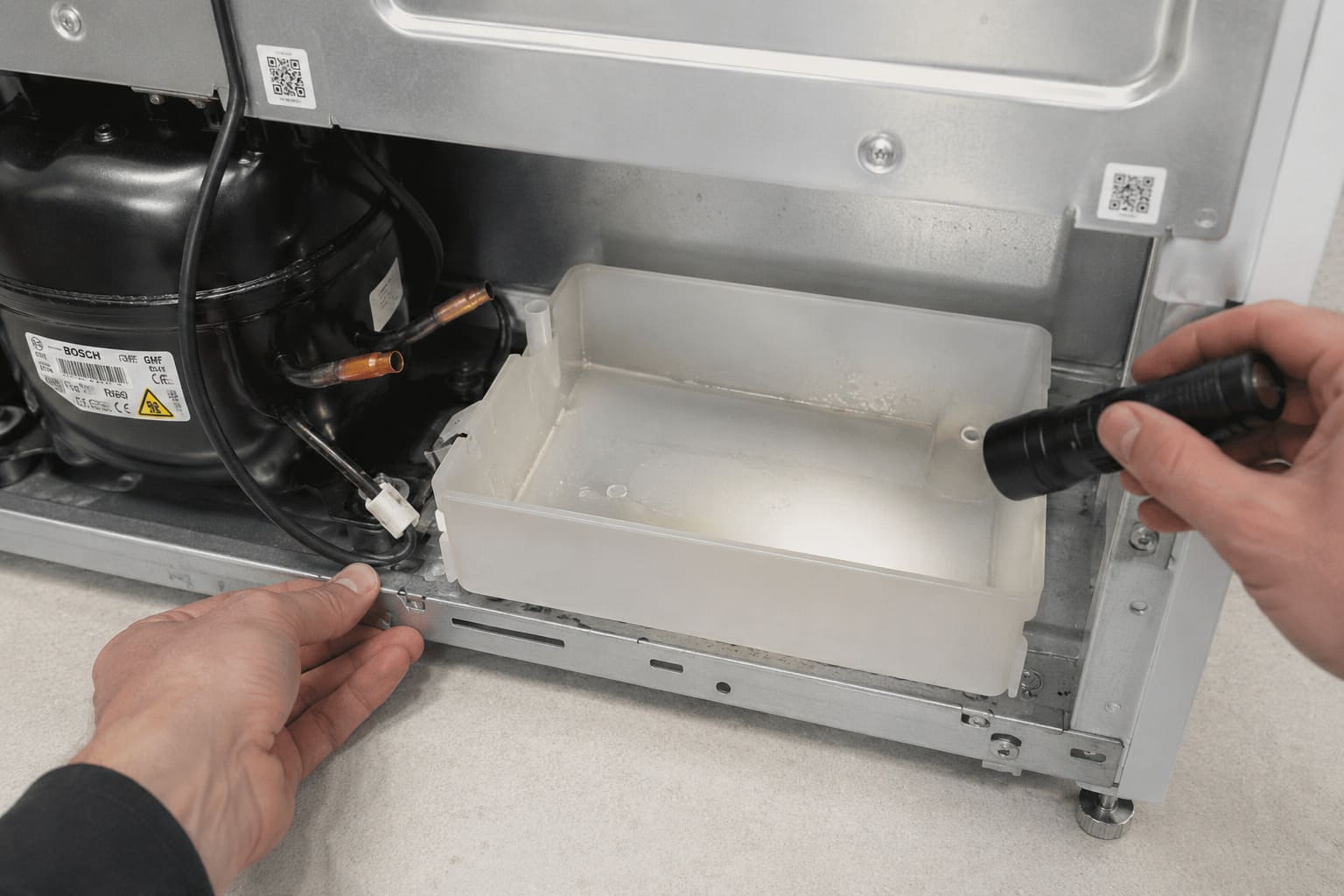
Drain Pan Issues and Defrost Drain Problems
Not every Bosch water leak comes from the drinking-water system. If water appears when nobody has used the dispenser, the defrost drain and drain pan should be part of the inspection.
A clogged or frozen defrost drain can send water into the wrong area. A drain pan that is cracked, shifted, or not handling condensate correctly can leave water under the appliance while the refrigerator still cools normally.
Do not chip ice with sharp tools
A knife or screwdriver may clear visible ice and damage the liner, tubing, or nearby components at the same time. If ice buildup is part of the leak pattern, the drain system should be cleared correctly.
Drain-related clue | What it suggests |
|---|---|
Water appears without dispenser use | The leak may not involve the filtered water dispenser |
Ice buildup near lower compartments | The defrost drain may be restricted or frozen |
Water returns after cleanup | The drain path or pan may still be compromised |
Cooling seems normal | Drain leaks can happen even when temperature looks fine |
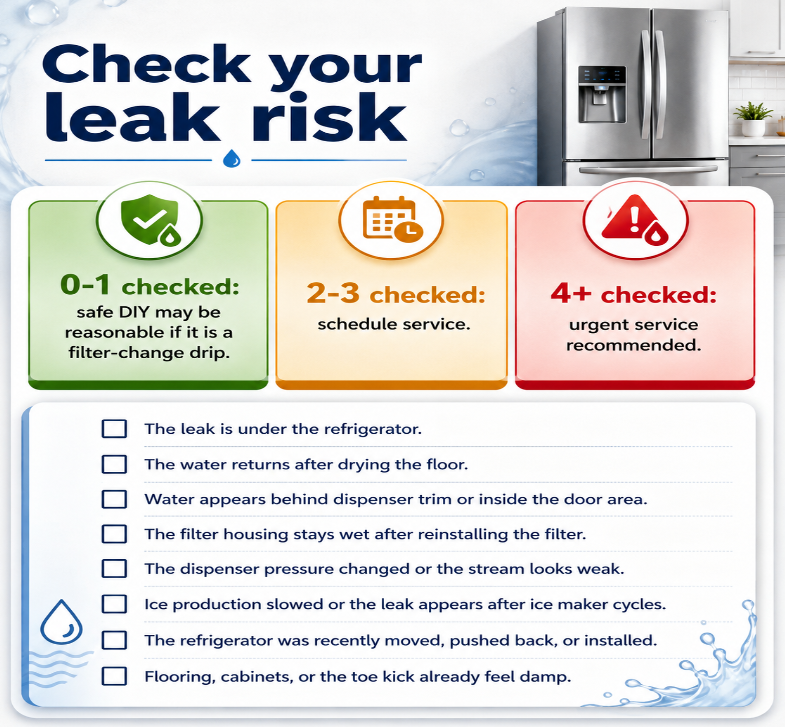
Homeowner Leak Scorecard
This scorecard turns a vague leak into a clear decision. Ask the reader to check each line that applies. The more boxes they mark, the more likely the article should move them toward service.
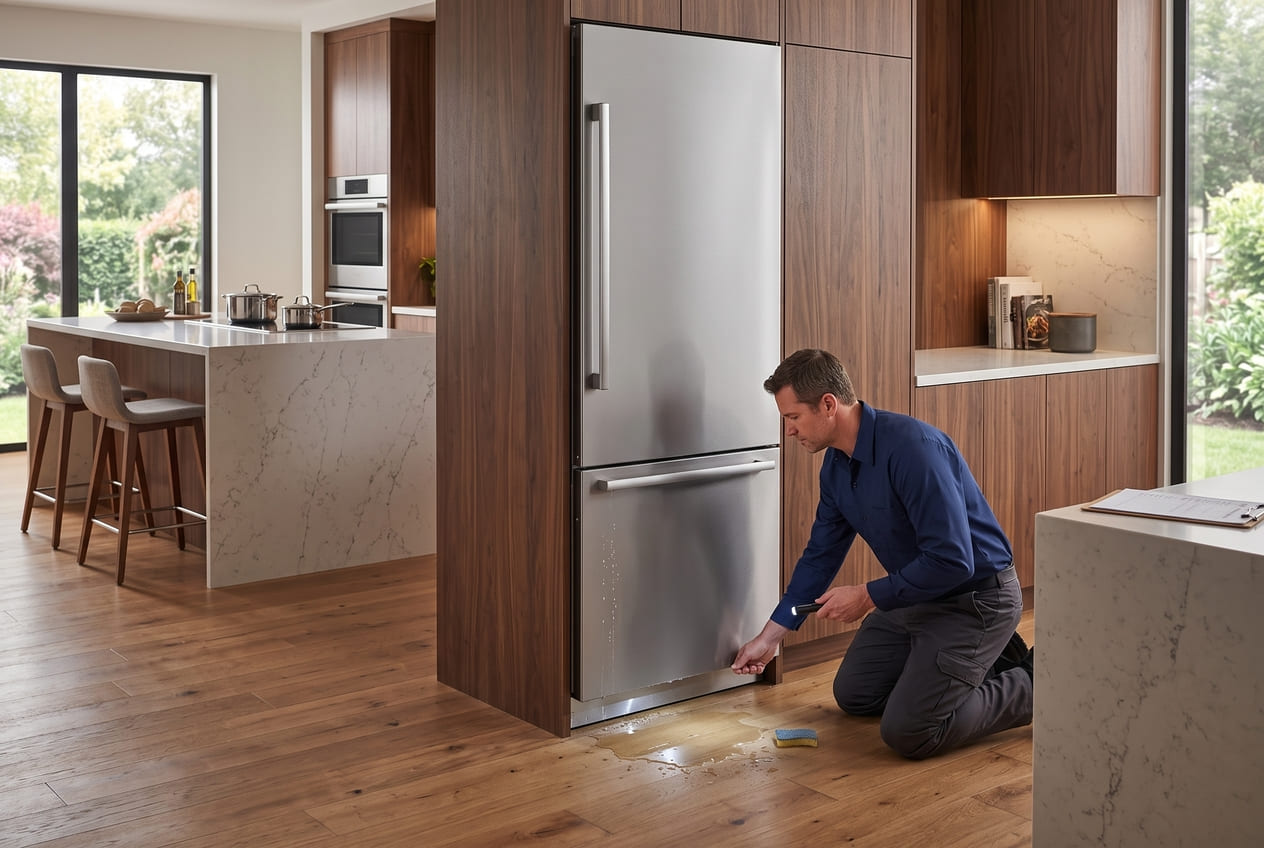
What Appliance Repair Master Checks During Bosch Leak Visit
A leak repair starts with the water path. Appliance Repair Master checks
- where water enters,
- where it is routed,
- where it is supposed to drain,
- and where it escapes.
System area | What we inspect | Why it matters |
|---|---|---|
Filter area | Filter seating, housing, O-rings, filter head, visible moisture | Many leaks begin after replacement or poor sealing |
Dispenser route | Nozzle, tube, fittings, cover area, door water path | Dispenser leaks can mimic expensive door problems |
Rear water path | Supply hose, connectors, inlet valve, kinked lines | Leaks may show at the front even when they start behind the unit |
Ice maker route | Fill valve timing, fill tube, ice maker assembly area | Cycle-based leaks often involve the ice system |
Drain system | Defrost drain, pan position, visible ice buildup | Not all leaks come from the dispenser side |
Surrounding kitchen | Floor, toe kick, cabinet base, moisture pattern | Early repair helps avoid water damage outside the appliance |
Before You Call: Make the Service Visit Faster
This checklist makes the call feel easier, which improves conversion.
Call prep checklist
A clear symptom pattern helps the technician bring the right diagnostic plan.
- Find the Bosch model number if it is easy to access.
- Take a photo of where water appears.
- Note whether the leak started after a filter change.
- Mention weak water flow, sputtering, or slow ice production.
- Tell us if the refrigerator was recently moved or installed.
- Tell us if flooring, cabinets, or the toe kick are already damp.
Why Atlanta Homeowners Call Appliance Repair Master
Bosch refrigerator leak is usually fixable, but it needs a careful diagnosis. A front puddle may start at the back. A dispenser leak may come from air, a tube, a fitting, or a filter seal. Water under the refrigerator may have nothing to do with the dispenser at all.
Appliance Repair Master helps homeowners avoid the expensive mistake: replacing the part nearest to the water instead of the part that failed. We inspect the leak path, explain what failed, and repair the problem before water has more time to reach floors, cabinets, or the door assembly.
Local Atlanta repair | Bosch leak diagnosis | Same-day availability | Clear repair options |
We service | Including |
|---|---|
Bosch 800/500 Series refrigerators | Water leaks from dispenser, filter area, drain system, ice maker, rear valve, and under-cabinet areas |
Atlanta and nearby communities | Buckhead, Midtown, Decatur, Sandy Springs, Brookhaven, Marietta, Roswell, Alpharetta, Smyrna, Dunwoody, and surrounding areas |
Homeowner leak emergencies | Water under refrigerator, recurring puddles, floor-risk leaks, and door-area dispenser leaks |
Conclusion
Bosch refrigerator water leak rewards early action. If the issue is only air in the system after a filter change, a careful reset and flush may be enough. If the water is coming from the dispenser tube, inlet valve, filter housing, rear hose, defrost drain, or drain pan, waiting usually gives the leak more time to reach the floor, cabinets, and hidden spaces around the appliance.
The important part is not to guess from the puddle alone. A leak near the front can start at the back. A dispenser drip can come from trapped air, a tube, a fitting, or a filter seal. Water under the refrigerator may have nothing to do with the dispenser. Bosch 800 and 500 Series refrigerators use tight internal water routing, so the right repair starts with tracing the water path, not replacing the most expensive part first.
For Atlanta homeowners, Appliance Repair Master brings the leak back into focus. We inspect the full Bosch water system, explain what failed, and help you avoid unnecessary parts, rushed door replacement decisions, and avoidable floor damage.
Related guides
FAQ
1. Why is my Bosch refrigerator leaking after I changed the water filter?
The filter may not be fully seated, or air may still be trapped in the water system. Bosch recommends flushing the system after filter replacement and checking the housing and dispenser for drips.
2. Why is my Bosch refrigerator water dispenser dripping?
A dispenser drip can happen after a filter change if air remains in the line. If water appears behind trim or inside the door area, the dispenser tube, fitting, filter housing, or internal route should be inspected.
3. Why is water leaking under my Bosch refrigerator?
Water under the refrigerator can come from a damaged supply hose, loose connection, cracked inlet valve, clogged defrost drain, drain pan issue, filter housing problem, or filter head failure.
4. Can Bosch water inlet valve cracks cause a leak?
Yes. If the valve body cracks or a fitting loosens, water can leak behind or beneath the refrigerator. The valve and rear connections should be inspected rather than patched.
5. Can a clogged defrost drain make a Bosch refrigerator leak water?
Yes. A clogged or frozen defrost drain can overflow and send water toward the bottom of the refrigerator or onto the floor.