
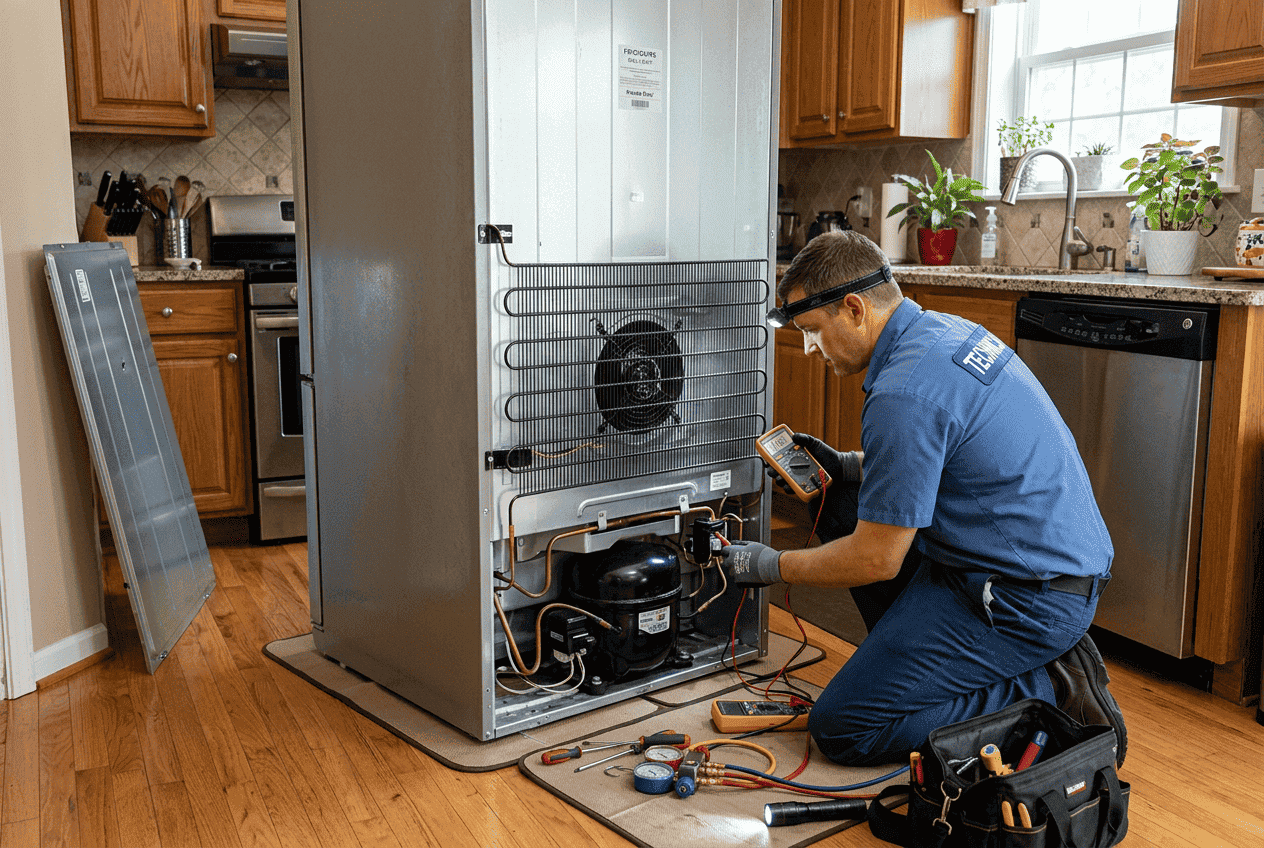
When a Frigidaire refrigerator is not cooling properly, the issue is already developing inside the system. A fridge warm condition rarely appears without warning. Airflow slows, heat stops releasing efficiently, or the sealed system loses pressure.
In the FGHB and FGSS Series, cooling depends on steady refrigerant circulation, proper air movement, and accurate temperature control. When one of those fails, temperature drops quickly.
In this guide, we explain how frigidaire cooling is crafted to function, what changes when performance declines, and how to recognize whether the problem involves airflow, control components, compressor failure, or a refrigerant leak. Understanding the pattern helps prevent misdiagnosis and unnecessary repairs.
How Airflow and Refrigerant Flow Affect Cooling
When a Frigidaire refrigerator is warm inside, the first systems we evaluate at Appliance Repair Master are airflow and refrigerant flow. A fridge that once maintained stable cold temperature does not suddenly fail without one of these fundamental processes being compromised.
In the FGHB and FGSS Series, cooling is not just about cold air — it’s about moving heat out of the cabinet efficiently. Everything else depends on that basic flow of air and refrigerant.
Here is what we see again and again in our Atlanta service calls.
Why Cold Air Distribution Matters More Than You Think
A refrigerator has two compartments: freezer and refrigerator. They use the same refrigeration cycle, but the refrigerator section depends heavily on proper airflow from the freezer.
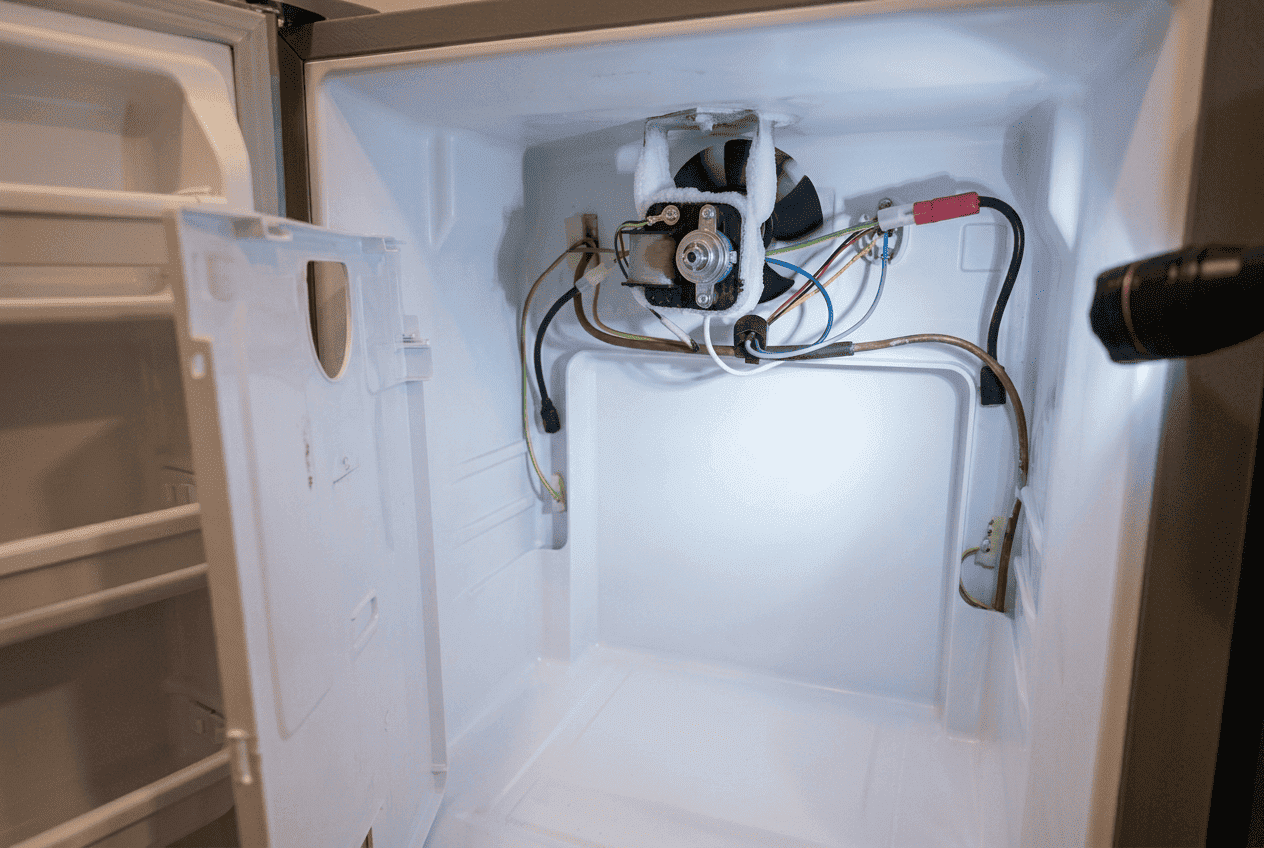
Inside the freezer compartment, cold air is produced at the evaporator coils. An evaporator fan keeps that cold air circulating. When the evaporator fan is working normally, cold air reaches every shelf in the freezer and also travels downward into the refrigerator section through vents.
If the evaporator fan fails, cold air stays trapped near the coils. The freezer may still feel cold, but the refrigerator warm condition becomes noticeable quickly. This is one reason why we hear complaints like:
“Freezer is fine, but the fridge is not cold.”
In our practice, this pattern is one of the most consistent early clues that airflow is the primary issue rather than the compressor or sealed system.
How the Evaporator Fan Fails in Real Use
The evaporator fan can fail in a few ways:
- Motor bearings wear out
- The fan blade becomes unbalanced
- Ice forms around the blade and blocks rotation
- Wiring to the fan becomes brittle and loses connection
From our experience, the most common scenario is ice buildup near the fan housing that eventually blocks blade rotation. This typically happens when defrost cycles are insufficient or when the door seal allows excess humidity inside.
When the fan hums but does not move air effectively, the fridge feels cool very close to the evaporator but warm on the shelves.
This is not a mystery. It is an airflow failure.
How Warm Air Entry Amplifies the Problem
Doors that do not seal properly introduce warm, humid air into the refrigerator. That moisture attaches to cold surfaces and freezes into frost. Over time, frost accumulates around the evaporator coils and fan housing. As frost builds, the system becomes less efficient.
Warm air intrusion does more than make the fridge warm. It increases frost load and worsens airflow restriction. At Appliance Repair Master, when we see repeating frost buildup in FGHB and FGSS Series units, the culprit is almost always a combination of door seal wear and fan airflow loss.
This combination elevates the amount of moisture inside the cabinet far beyond what the defrost system was designed to handle.
Dirty Condenser Coils Slow Heat Rejection
While the evaporator side moves cold air, the condenser side must remove heat. The condenser coils are usually located under or behind the refrigerator. Their job is to release heat absorbed inside the cabinet into the surrounding air.
When condenser coils are covered with dust, pet hair, or debris, they cannot do that job effectively. The compressor works harder. Internal pressure rises. Cooling capacity declines.
In many FGSS Series units we service in Atlanta, heavy dust build-up around the condenser area directly correlates with the fridge warm complaint.
The first step in those cases is always cleaning — not replacing parts.
This isn’t guesswork. It’s proven behavior from field diagnostics.
Pressure Patterns Inside a Refrigeration System
To maintain cold, pressure differentials must remain inside design specification. The compressor raises pressure on the condenser side. The evaporator remains at lower pressure.
If the condenser cannot reject heat efficiently — because coils are dirty — pressure rises on both sides. The refrigerant cannot absorb enough heat inside the evaporator. As a result, cooling performance drops.
This is why a fridge may feel warm even when the compressor is running normally.
In our experience, pressure imbalance due to restricted condenser airflow is one of the biggest contributors to a fridge warm condition that is misinterpreted as compressor failure.
When Multiple Subsystems Interfere
Sometimes airflow issues and condenser issues combine. Here’s a real pattern we see:
- The door seal begins to lose compression. Moisture enters.
- Evaporator coils start building frost.
- The evaporator fan slows due to frost resistance.
- Cold air circulation decreases.
- The refrigerator compartment warms.
- Condenser coils are dusty from normal use.
- Heat rejection slows further.
- Pressure rises. The compressor runs harder.
By the time the customer notices, multiple factors are contributing, not just one.
That’s why partial fixes don’t last. Clearing frost temporarily fixes the symptom, but until the moisture influx and coil cleanliness are addressed, the root remains.
How We at Appliance Repair Master Confirm Airflow Failures
When we first inspect a cooling complaint:
- We measure actual internal refrigerator temperature, not just rely on the digital display.
- We test evaporator fan operation under load.
- We inspect frost patterns on the evaporator coils.
- We check door seal integrity and hinge alignment.
- We access and inspect condenser coils for dust, debris, and airflow restriction.
Often multiple small issues produce a big symptom.
For example, a customer may report “fridge warm but freezer okay,” and we find:
- Moderate frost buildup on evaporator coils
- Evaporator fan motor drawing power but spinning slowly
- Dust-packed condenser coils restricting heat rejection
- Door seal gaps on one corner
That combination is a consistent pattern in FGHB/FGSS units that are not cooling properly.
Common Misconceptions We Observe
Temperature settings are already at the lowest level.
We often hear this. Settings rarely cause a fridge warm by themselves. Settings influence how cold the system tries to be, but if airflow and heat rejection are compromised, lower settings won’t fix the underlying inefficiency.
It was fine yesterday.
Cooling systems can decline over days or weeks. One day, air circulation was adequate. The next, frost buildup or a failing fan disrupts distribution. Once that balance breaks, it doesn’t self-correct.
The freezer is cold, so everything should be fine.
The freezer may still achieve low temperatures locally near the evaporator, but that doesn’t guarantee cold air is moving into the refrigerator section.
Airflow Failures in FGHB and FGSS Series
In our experience at Appliance Repair Master, airflow restriction is the most common reason a Frigidaire refrigerator is not cooling properly.
The freezer produces cold air. The refrigerator section depends on that air being distributed correctly. When circulation weakens, temperature becomes uneven.
Common Signs of Airflow Imbalance
- Freezer remains cold but fridge warm
- Upper shelves warmer than lower drawers
- Cold air felt near rear panel but not throughout compartment
- Evaporator fan humming but weak airflow
- Frost accumulation near vent openings
When we see this pattern in FGHB or FGSS Series units, we test evaporator fan performance under load and inspect for airflow obstruction.
Frost Restriction and Evaporator Overload
Airflow problems often connect to frost accumulation.
Every time the door opens, humid air enters. That moisture freezes onto the evaporator coils. The defrost cycle is designed to clear it. When that cycle becomes inefficient or airflow weakens, frost begins to accumulate faster than it is removed.
For the wider picture on this brand, see our full write-up on Frigidaire leaking water.
As frost thickens, air channels narrow. The evaporator fan pushes against resistance. Circulation drops further. The fridge warm condition becomes more noticeable.
We see this especially during humid Atlanta summers. A slightly weakened door seal allows more moisture inside. The evaporator coils ice buildup increases. Within weeks, airflow becomes restricted enough to affect refrigerator temperature.
In these situations, clearing visible frost is only part of the solution. The underlying airflow or sealing issue must be corrected or the frost returns.
Condenser Efficiency and Heat Rejection
Cooling inside the cabinet depends on heat leaving the system outside the cabinet.
Dirty condenser coils reduce that ability. When coils are packed with dust or pet hair, heat cannot dissipate effectively. The compressor runs longer. Pressure increases. Cooling performance declines gradually.
Unlike airflow problems, condenser restriction affects both compartments over time. The refrigerator may still cool, but it struggles during hot weather or when the door opens frequently.
In many FGSS Series units we service, we find heavy debris under the cabinet. Cleaning the condenser area often restores stable frigidaire cooling without replacing major parts.
Neglected maintenance increases compressor strain and raises the risk of compressor failure later.
When Controls Create Cooling Confusion
Sometimes the mechanical components function properly, but control feedback does not.
A temperature sensor that drifts out of range can misinform the control board. The refrigerator may shut off before reaching the proper temperature. The display may show normal settings while the fridge warm condition persists.
A thermostat malfunction in older configurations can produce similar results. The system cycles inconsistently, leading to uneven cooling patterns throughout the day.
In these cases, airflow and coils appear normal. The issue lies in temperature regulation, not refrigerant movement.
Electrical diagnosis is required to confirm this type of failure.
Airflow or Sealed System: Knowing the Difference
This is where proper interpretation matters.
If the freezer remains cold but the refrigerator section is warm, airflow is the likely cause. The evaporator fan or frost restriction should be inspected first.
If both compartments are warm and the compressor runs continuously without achieving temperature, sealed system performance must be evaluated. That includes compressor failure or a refrigerant leak.
If both compartments are warm and the compressor runs continuously without achieving temperature, sealed system performance must be evaluated. That includes compressor failure or a refrigerant leak.
The pattern of temperature loss narrows the cause.
Below is a simple comparison that reflects what we see in our field practice:
Condition Observed | Most Likely Direction |
Freezer cold, fridge warm | Airflow restriction or evaporator fan issue |
Both sections warm | Compressor failure or refrigerant leak |
Display normal, temperature unstable | Temperature sensor or thermostat malfunction |
Long run cycles, cabinet hot underneath | Dirty condenser coils |
We use this mapping daily in Atlanta service calls. It prevents guesswork and avoids unnecessary component replacement.
When the Problem Is Inside the Sealed System
Not every cooling complaint is airflow related. When both compartments are warm and the unit struggles to recover temperature, we shift attention to the sealed system.
In the Frigidaire FGHB and FGSS Series, sealed-system failures show a different pattern than airflow problems.
If the evaporator fan is moving air and condenser coils are clean, yet the refrigerator is still not cooling properly, pressure inside the refrigeration circuit must be evaluated.
Two primary concerns arise:
- Compressor failure
- Refrigerant leak
Compressor Failure Patterns
The compressor is the engine of the cooling system. It compresses refrigerant and maintains pressure difference between the condenser and evaporator.
When compressor failure begins, we usually see one or more of the following:
- Compressor runs continuously but cabinet stays warm
- Repeated clicking from start relay
- Compressor casing excessively hot
- Weak or incomplete frost pattern on evaporator coils
A healthy system creates a consistent frost pattern across the evaporator surface. When compression weakens, frost forms only partially or not at all.
In our Atlanta service work, true compressor failure in FGHB and FGSS models is less common than airflow issues, but when it occurs, it affects both compartments at once.
If the freezer and refrigerator are equally warm, the sealed system must be tested.
Refrigerant Leak Behavior
A refrigerant leak does not usually cause sudden total failure. It produces gradual decline.
Customers often report that the refrigerator was slightly warm for weeks before becoming clearly not cold. That slow change is characteristic of pressure loss inside the system.
Typical refrigerant leak indicators include:
- Long run cycles
- Reduced cooling in both compartments
- Partial frost pattern on one corner of evaporator coils
- Compressor running but temperature not reaching target
Refrigerant does not get used up. If it is low, it escapes.
Leak detection and sealed-system repair require specialized equipment. This is not a surface-level repair.
Field Case Example From Our Practice
Recently, we serviced an FGSS Series unit that was not cooling properly. The freezer temperature hovered just below freezing, but the refrigerator was clearly warm.
Initial inspection showed:
- Evaporator fan operating normally
- Condenser coils clean
- No visible frost restriction
When we accessed the evaporator, frost covered only one small section. That pattern confirmed a refrigerant leak.
Without measuring pressure and inspecting the sealed system, this unit could have been misdiagnosed as airflow or control failure.
Correct diagnosis prevented unnecessary part replacement.
Escalation Timeline: From Minor to Major
Cooling failures often begin small.
An evaporator fan weakens. Airflow drops slightly. Frost increases. The compressor runs longer to compensate. Dirty condenser coils add additional strain.
Over time, extended run cycles increase heat load on the compressor. Internal wear accelerates. What began as a circulation issue can contribute to premature compressor failure.
We see this progression in units that operated for months with restricted airflow.
Addressing early symptoms protects the sealed system.

Diagnostic Logic We Use at Appliance Repair Master
When a customer reports that their Frigidaire is not cooling properly, we follow a structured approach:
- Verify actual internal temperature with calibrated tools.
- Confirm evaporator fan airflow.
- Inspect frost pattern on evaporator coils.
- Evaluate condenser coil condition.
- Test compressor operation and temperature.
- Assess temperature sensor feedback accuracy.
This sequence allows us to isolate airflow, control, or sealed-system causes without replacing unnecessary components.
Proper order matters.
Before You Call: What You Can Safely Check
Before scheduling service for a Frigidaire that is not cooling properly, there are a few basic observations that help narrow the issue.
Check the following:
- Is the freezer cold while the refrigerator is warm?
- Do you hear the evaporator fan running inside the freezer?
- Are condenser coils visibly covered in dust underneath the unit?
- Is the compressor running constantly without reaching temperature?
- Is there heavy frost on the rear freezer panel?
These checks do not replace diagnosis, but they provide direction.
If the freezer works but the fridge warm condition persists, airflow is the likely cause.
If both compartments are warm and the compressor runs continuously, the sealed system may be involved.
If heavy frost appears on the back freezer panel, evaporator coils ice buildup may be blocking airflow.
Clear symptoms prevent guesswork.
Common Misdiagnosis Patterns
Over the years, we have seen the same misunderstandings repeat.
Many homeowners respond to a fridge warm condition by lowering the temperature setting. That does not correct a failing evaporator fan. If airflow is restricted, colder settings only force longer run cycles.
Another common reaction is replacing the thermostat. A thermostat malfunction is possible, but it will not fix dirty condenser coils. If heat cannot leave the system, temperature will remain unstable.
We also see people thaw visible frost and assume the problem is solved. Thawing removes the symptom, not the cause. If airflow restriction or moisture intrusion remains, frost will return.
The most costly mistake is assuming compressor failure without checking airflow first. In the FGHB and FGSS Series, a refrigerator that is warm while the freezer still works is far more likely to have an airflow problem than a sealed-system issue.
The phrase not cooling properly describes what you observe. It does not identify which component has failed.
Our role at Appliance Repair Master is to determine the exact mechanical or electrical cause before any part is replaced.
Preventing Cooling Decline in FGHB and FGSS Models
Preventive maintenance reduces the risk of sudden fridge warm complaints.
We recommend:
- Cleaning condenser coils at least once per year
- Inspecting door seal integrity regularly
- Avoiding overpacking shelves that block internal vents
- Addressing unusual fan noise immediately
- Scheduling professional inspection if temperature fluctuates
Small adjustments extend the life of the compressor and reduce the chance of refrigerant leak development due to prolonged strain.
Frigidaire cooling systems are durable when maintained properly. Neglect accelerates wear.
Why Professional Diagnosis Matters
Modern refrigerators are not single-component machines. Airflow, controls, and pressure interact constantly.
Replacing the wrong part does not fix the system. It adds cost and delays proper repair.
When we service a Frigidaire FGHB or FGSS Series unit in Atlanta, we evaluate the entire cooling system before recommending replacement.
We confirm airflow, sensor accuracy, condenser efficiency, and compressor behavior in sequence.
This prevents unnecessary sealed-system work when the issue is minor. It also prevents delay when the issue is major.
Precision protects both your appliance and your budget.
Conclusion
A Frigidaire that is not cooling properly is sending a clear signal. The cause may be airflow restriction, thermostat malfunction, temperature sensor error, dirty condenser coils, compressor failure, or a refrigerant leak.
The pattern of temperature loss indicates the root reasons.
If the freezer remains cold and the refrigerator is warm, airflow imbalance is likely. If both compartments are warm, the sealed system requires inspection. If temperature fluctuates without visible frost or airflow problems, control components may be involved.
Understanding these distinctions prevents misdiagnosis and unnecessary repair.
At Appliance Repair Master, we approach each cooling complaint with structured evaluation based on years of experience. Identifying the exact failure restores frigidaire cooling performance efficiently and safely.
Browse the rest of our troubleshooting guides for more step-by-step fixes.
Related guides
FAQ
1. Why is my Frigidaire freezer cold but the fridge warm?
This usually indicates restricted airflow. A failing evaporator fan or frost blockage prevents cold air from reaching the refrigerator section.
2. Can dirty condenser coils cause a refrigerator to stop cooling?
Yes. Dirty condenser coils reduce heat rejection and force the compressor to work harder, lowering overall cooling efficiency.
3. How do I know if it is a compressor failure?
If both compartments are warm and the compressor runs continuously without reaching temperature, sealed-system evaluation is necessary.
4. What does a refrigerant leak look like?
Cooling declines gradually. The compressor runs longer. The frost pattern on evaporator coils appears incomplete.
5. Can a temperature sensor cause not cooling properly?
Yes. A faulty temperature sensor can misinform the control board, causing incorrect cycling and uneven cooling.
6. Should I unplug the refrigerator if it is warm?
If the compressor is running excessively or overheating, unplugging temporarily may prevent damage. However, professional diagnosis should follow.